Free Car Advice: What It Includes and Where Extra Costs Can Appear
Free Car Advice: What It Includes and Where Extra Costs Can Appear
Free car advice can be extremely helpful when you are buying, selling, maintaining, or troubleshooting a vehicle. It promises quick answers without upfront payment, which makes it appealing when you want direction but do not yet want to commit to a paid service. The challenge is that free car advice is often limited in scope, and the line between truly free guidance and paid add-ons is not always obvious.
That is why it pays to look past the headline offer. Some providers genuinely give useful no-cost guidance, while others use a free entry point to lead you toward premium reports, diagnostics, appointments, or related products. In this article, we will break down what free car advice usually includes, where extra costs can appear, and how to decide whether a free option is enough for your situation.
What free car advice usually means
At its simplest, free car advice is an entry-level service that gives you basic guidance without charging you immediately. It may be offered by dealerships, independent garages, online platforms, insurance companies, car marketplaces, or automotive content sites. In many cases, the free offer is designed to build trust, answer common questions, or encourage you to take the next step with the same provider.
That does not automatically mean the service is low quality. It simply means the scope is usually limited. A free offer may help you understand your options, but it may not include a full inspection, a detailed written report, or individualized recommendations that require substantial time or expertise.
Common service models
There are several ways free car advice is commonly packaged:
- Free initial consultation: A short conversation where you can ask basic questions and receive a general opinion.
- Limited online guidance: A website or chatbot that answers common car-related questions, often in a broad and standardized way.
- Advice supported by advertising or sales incentives: The service may be free because it earns revenue elsewhere, such as through ads, referrals, or product sales.
- Free service with optional paid upgrades: You may start with a no-cost check, then be offered a more detailed inspection, report, or support package for a fee.
In other words, “free” often means the first layer of help costs nothing. Everything beyond that layer may be chargeable depending on what you need and how much detail you want.
What is usually included for free
Most free car advice is designed to solve simple problems quickly. It is often best for first impressions, basic decisions, and early-stage research. If your question is straightforward, the free version may be entirely sufficient.
Quick guidance and first opinions
The most common free inclusion is a quick answer or general recommendation. For example, a mechanic might explain what a warning light could indicate, a car-buying site might give broad guidance on market prices, or a seller may be told how to prepare a vehicle for listing.
This kind of advice can help you decide your next step without paying for a full evaluation. It often includes:
- Initial questions about the car’s make, model, age, or symptoms
- General suggestions about possible causes or likely outcomes
- Basic next-step advice, such as checking fluids, reviewing documents, or comparing prices
- Simple checks that do not require time-consuming diagnostics
Common examples of included value
Free car advice may cover a surprising amount of ground, especially if your needs are simple. Here are a few common examples:
- Short assessment of a car problem: A technician may give a rough idea of whether a noise sounds urgent or minor.
- General buying or selling advice: You may be told what to look for in a used car or how to price your vehicle competitively.
- Basic answers about paperwork: A provider might explain the typical documents needed for a sale, transfer, or registration update.
- Timing guidance: You may get advice on whether to act now or wait, such as during seasonal price changes or before a major repair.
These examples show the value of free car advice: it can reduce uncertainty quickly. For many everyday decisions, that is enough to move forward with confidence.
Where extra costs can appear
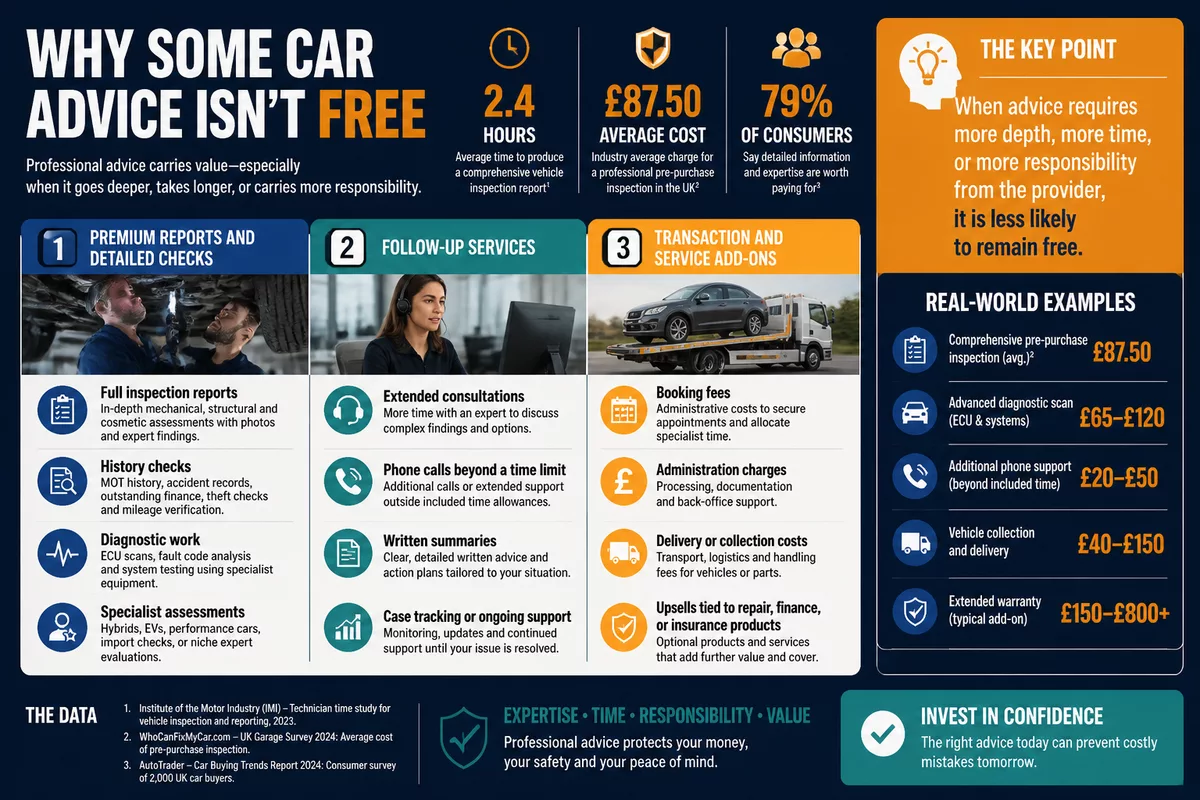
This is the area where many people get caught off guard. A free first step can become a paid service once the issue requires more depth, more time, or more responsibility from the provider. Extra costs do not always mean the offer is misleading; sometimes the additional work is genuinely outside the free scope. Still, you should know where the charges are likely to appear.
Premium reports and detailed checks
One of the most common cost triggers is a request for more detailed information. A quick opinion is often free, but a formal report is usually not. This can include:
- Full inspection reports: A deeper review of the car’s condition, often with documented findings and recommendations
- History checks: Reports covering accident records, mileage issues, outstanding finance, or prior ownership details
- Diagnostic work: Time-consuming testing to identify the cause of a warning light, fault code, or performance issue
- Specialist assessments: Evaluations for engines, transmissions, electronics, EV batteries, or performance modifications
The pattern is simple: when the advice requires research, equipment, or liability, the offer is less likely to remain free. A provider may be happy to tell you what might be wrong, but not to spend an hour proving it without charging.
Follow-up services
Another common source of extra charges is follow-up support. The initial guidance may be free, but ongoing help can move into paid territory. Typical examples include:
- Extended consultations: Additional time beyond an introductory call or message exchange
- Phone calls beyond a time limit: Many free offers cap the conversation length and charge once the limit is exceeded
- Written summaries: A personalized report, checklist, or action plan may come with a fee
- Case tracking or ongoing support: If someone continues monitoring your issue, the service may no longer be considered free
This is especially important for buyers and owners who want reassurance over several days or weeks. A single quick answer may be free, but continuous support is often priced separately.
Transaction and service add-ons
Extra costs can also appear around the advice itself rather than inside the advice. For example, a free consultation may lead to chargeable services such as:
- Booking fees: A charge to reserve an inspection, test drive, or mechanic appointment
- Administration charges: Fees for paperwork handling, processing, or coordination
- Delivery or collection costs: Transport charges if the car or the customer needs to be moved
- Upsells tied to repair, finance, or insurance products: You may be offered related services that are not included in the free advice
These add-ons can be legitimate, but they should be clear. If the free offer leads naturally to paid services, the key question is whether you understood that from the beginning.
How to tell whether a free offer is really free
One of the easiest ways to avoid surprise charges is to check the terms before you begin. Many providers are transparent, but the details can be buried in small print, a booking page, or a short disclaimer. A few minutes of checking can save you from paying for something you expected to receive at no cost.
Read the terms before you start
Look for practical limits that define the free offer. The most important things to check are:
- Time limits: Is the advice free only for a short call or a set number of minutes?
- Scope limits: Does the free offer cover only general questions, not detailed diagnostics or written reporting?
- Eligibility rules: Is the free service limited to certain customers, vehicle types, or first-time users?
- Payment method requirements: Is a card required upfront, even if you are not supposed to be charged?
- Optional add-ons: Are upgrades clearly optional, or are they pre-selected by default?
If the provider asks for payment details in advance, do not assume it means you will be charged. It may be used for booking protection or future billing, but you should still confirm exactly when payment would occur.
Questions to ask before accepting the offer
When in doubt, ask direct questions. A clear provider should have no problem answering them. Helpful questions include:
- What exactly is included at no cost?
- What triggers a charge?
- Is the advice independent, or is it connected to a sales process?
- Are follow-up messages, reports, or callbacks free?
- Can I decline upgrades without affecting the free advice?
If the answers are vague, that is a signal to proceed carefully. Transparent providers make it easy to understand where the free service ends and the paid service begins.
Free advice versus paid advice
Neither option is automatically better. The right choice depends on how complex your question is and how much confidence you need before acting. Free advice is ideal when the issue is simple, but paid advice can be worthwhile when the stakes are high.

When free advice is enough
Free car advice usually works well in situations like these:
- You need a quick answer to a simple question
- You are just beginning your research
- You want to compare a few broad options before going deeper
- You are trying to understand whether a problem seems urgent or minor
For example, if you are choosing between two similar vehicles or asking what a dashboard warning might mean, a free first opinion may be perfectly adequate.
When paid advice may be better
There are times when a paid service is the smarter choice from the start. Consider paying when:
- The car is expensive or the decision carries high financial risk
- The mechanical issue is complex or difficult to diagnose
- You need a detailed inspection, report, or repair recommendation
- You want someone to take responsibility for the accuracy or completeness of the work
In these situations, paying for expertise may save money in the long run by preventing bad purchases, missed faults, or unnecessary repairs.
Practical tips to avoid surprise costs
The best way to get value from free car advice is to use it strategically. Free guidance can save time and money, but only if you understand its boundaries and stay alert to optional extras.
- Compare several providers: Different companies may offer different free scopes, so do not assume the first one is the best.
- Save screenshots or written terms: Keep evidence of what was promised in case the pricing changes later.
- Confirm any upgrade price before agreeing: If a provider suggests a paid add-on, ask for the exact cost first.
- Avoid rushing into bookings: A free answer should not pressure you into immediate paid action.
- Choose providers that explain scope clearly: The best offers state upfront what is and is not included.
If you are comparing services, look for wording that is precise rather than promotional. Clear definitions usually indicate a lower risk of hidden charges.
Frequently asked questions
Is free car advice really free
Often yes, but usually only within a limited scope. In many cases, free car advice means you can ask basic questions and get general guidance without paying. However, more detailed work, such as diagnostics, written reports, or follow-up support, may cost extra.
What is usually included in a free consultation
A free consultation often includes a short conversation, a first opinion, simple next-step guidance, and answers to general questions. It may also cover basic concerns about buying, selling, paperwork, or whether a problem seems urgent.
When can extra costs appear
Extra costs usually appear when the request becomes more detailed or time-intensive. Common triggers include premium reports, vehicle history checks, diagnostics, extended calls, admin fees, or optional upgrades linked to repairs, finance, or insurance.
How can I avoid hidden fees
Read the terms carefully, ask what is included at no cost, and confirm whether any add-on is optional before you accept it. Also look out for time limits, payment card requirements, and services that start free but become paid after the first stage.
Conclusion: choosing the right kind of car advice
Free car advice can be a smart starting point when you want quick, practical guidance without upfront spending. It is especially useful for simple questions, early research, and rough direction. At the same time, it is important to remember that “free” often means limited rather than unlimited.
The main rule is straightforward: check what is included before you commit. If you understand the boundaries, you can use free car advice to your advantage and avoid unexpected fees. When the issue is complex, high-value, or safety-related, paid advice may be the better investment. The best choice is the one that matches both your question and your level of risk.