How Car Warranty Coverage Works: What It Covers, What It Doesn’t, and How to Claim
How Car Warranty Coverage Works: What It Covers, What It Doesn’t, and How to Claim
A car warranty is a promise to repair or replace certain defects or failures within a fixed time and mileage limit. Car warranty coverage usually applies when a part fails because of a manufacturing problem, not because of normal wear, neglect, misuse, or accident damage.
The safest way to read car warranty coverage is to start with the VIN-specific booklet, then match the symptom, the component, and the claim rules before paying out of pocket. That approach helps you separate a covered repair from a repair you are likely to own yourself, which is where many surprise bills start.
Quick summary
🛡️ Car warranty coverage pays for defects and premature failures, but only inside the stated time and mileage limits.
🔧 Powertrain coverage usually protects major engine and transmission parts, while bumper-to-bumper coverage is broader but still excludes wear items.
📄 The warranty booklet and your service records matter more than assumptions, because coverage is vehicle-specific.
📞 Before you approve a repair, check the failed part, confirm maintenance, and ask the dealer or manufacturer for a claim decision in writing.
What is car warranty coverage?
Car warranty coverage is the part of the vehicle promise that pays for certain repairs when a covered component fails under normal use. The exact rules are set by the manufacturer or contract provider, so the booklet, the VIN, the mileage, and the in-service date control the answer, not a generic rule of thumb.
In practice, that means a dead alternator may be covered if it failed because of a defect, while worn brake pads usually are not. The difference is simple: a warranty handles unexpected failure, while the owner normally handles wear, maintenance, and damage from outside the vehicle.
| Warranty type | What it usually covers | What it usually leaves out | Best fit |
|---|---|---|---|
| Factory warranty | Defects in materials or workmanship during the original coverage period | Wear items, accident damage, neglect, modifications | New cars and recent used cars still inside the original terms |
| Bumper-to-bumper warranty | Many vehicle systems, often including electronics, comfort features, and interior controls | Maintenance, cosmetic damage, normal wear, some trim items | Owners who want broader repair protection |
| Powertrain warranty | Engine, transmission, drive shafts, and related major mechanical parts | Most electrical parts, body hardware, fluids, wear items | Drivers focused on high-cost mechanical failures |
| Extended car warranty | Coverage after the factory term ends, if the contract says so | Anything excluded in the service contract, plus deductibles and conditions | Owners comparing post-factory repair risk and contract cost |
According to the FTC, many third-party products sold as extended car warranties are actually vehicle service contracts. That detail matters because the promise, the exclusions, and the claim process are often different from a factory warranty.
Common new-car coverage is often described as 3 years or 36,000 miles in consumer guides such as Kelley Blue Book, but your own booklet always comes first. A 2026 model from one brand may have very different terms from another brand with the same sticker price.
What do car warranties usually cover?
Car warranties usually cover defects in materials, factory assembly problems, and certain component failures that happen before the part should reasonably wear out. The most useful test is not whether the part is expensive. It is whether the failure looks like a defect, a premature breakdown, or a normal wear issue.
Coverage often includes major mechanical and electrical systems, as long as the booklet names them or does not exclude them.
- Engine internals such as pistons, gaskets, timing components, and related seals when the failure is linked to a covered defect.
- Transmission parts, driveline pieces, and certain transfer case or axle components in powertrain coverage.
- Electrical modules, sensors, infotainment units, and control units when the term is included in bumper-to-bumper coverage.
- Factory corrosion or emissions items when the warranty booklet lists them as special coverage.
- Labor and diagnostics if the warranty explicitly says those charges are included.
A warranty pays for a covered failure, not for the age of the car by itself.
Three real-world examples help separate coverage from assumptions. A leaking seal on a low-mileage powertrain component may be covered if the leak is tied to a defect. A dead infotainment screen may be covered if the screen or module fails early. A worn brake pad set usually is not covered because it is designed to wear down.
What do car warranties usually not cover?
Car warranty exclusions are just as important as covered parts. A warranty usually does not pay for normal wear and tear, accident damage, misuse, poor maintenance, or repairs triggered by outside factors. If the booklet excludes the item, the dealer has a strong reason to deny the claim.
- Normal wear items such as brake pads, rotors, clutches, wiper blades, bulbs, belts, filters, and tires unless the contract says otherwise.
- Damage from crashes, flooding, road debris, salt, vandalism, or other external events.
- Problems caused by missed oil changes, overheating, low fluids, or ignored warning lights.
- Unauthorized modifications, racing use, off-road abuse, or improper repairs.
- Cosmetic issues, trim wear, rattles that are not tied to a defect, and maintenance services.
If the issue comes from neglect, abuse, or an ordinary replacement cycle, the warranty usually stops there.
A worn brake pad and a failed brake caliper are not the same claim. The pad is a wear item, but the caliper may be covered if it seized because of a manufacturing defect. That is why the failed part and the cause of failure matter more than the symptom alone.
What fine print changes car warranty coverage?
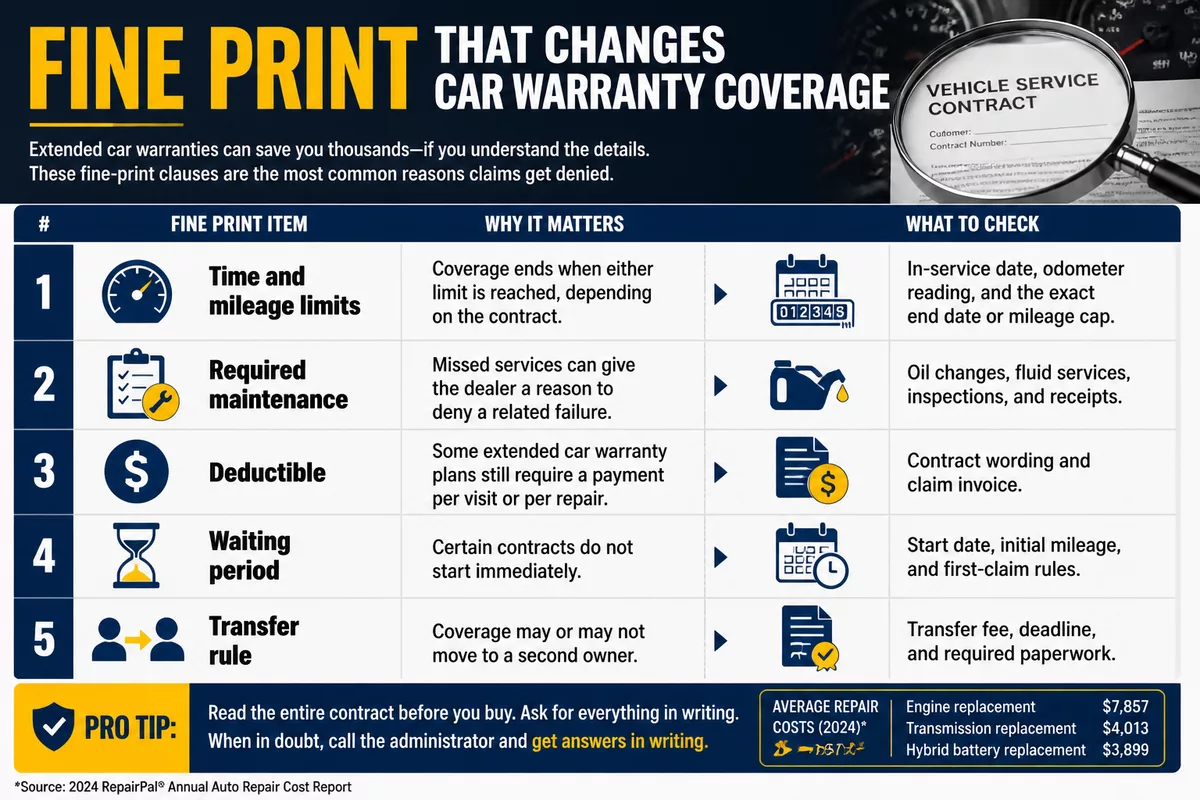
The fine print changes car warranty coverage more than most owners expect. Time limits, mileage limits, maintenance rules, deductibles, and transfer rules can all decide whether the answer is yes or no. A claim that looks obvious on paper can still fail if the vehicle is outside the term or the service history is missing.
| Fine-print item | Why it matters | What to check |
|---|---|---|
| Time and mileage limits | Coverage ends when either limit is reached, depending on the contract | In-service date, odometer reading, and the exact end date or mileage cap |
| Required maintenance | Missed services can give the dealer a reason to deny a related failure | Oil changes, fluid services, inspections, and receipts |
| Deductible | Some extended car warranty plans still require a payment per visit or per repair | Contract wording and claim invoice |
| Waiting period | Certain contracts do not start immediately | Start date, initial mileage, and first-claim rules |
| Transfer rule | Coverage may or may not move to a second owner | Transfer fee, deadline, and required paperwork |
Warranty transfer is especially important on used cars. A used-vehicle buyer should verify whether the remaining factory warranty still applies, whether a third-party contract is transferable, and whether the seller kept the maintenance records that support the claim.
How do you check whether a repair is covered?
The fastest way to check car warranty coverage is to match the symptom to the named component and then compare that component with the warranty booklet. If the booklet names the part, the term is still active, and the maintenance history is clean, the repair is worth challenging before you pay.
- Find the VIN-specific warranty booklet or digital terms for your exact model year.
- Write down the failed part, the symptom, the mileage, and the date the problem started.
- Check whether the item is listed under covered parts, exclusions, or wear items.
- Gather service records, oil change receipts, and previous repair invoices.
- Ask the dealer to diagnose the fault and state in writing whether the repair is covered.
- If the answer is unclear, contact the manufacturer or contract administrator before authorizing the work.
The key document is the written warranty, not the service adviser’s memory. A polite, documented question gets a better answer than a quick hallway conversation, especially when the repair estimate is large.
How do you file a warranty claim?
A warranty claim is usually filed by the dealer or repair shop after diagnosis, but the owner still needs to supply the facts. Bring the vehicle identification number, service records, a clear description of the failure, and any prior warning messages or photos that show the issue. File before paying if the repair is still undetermined.
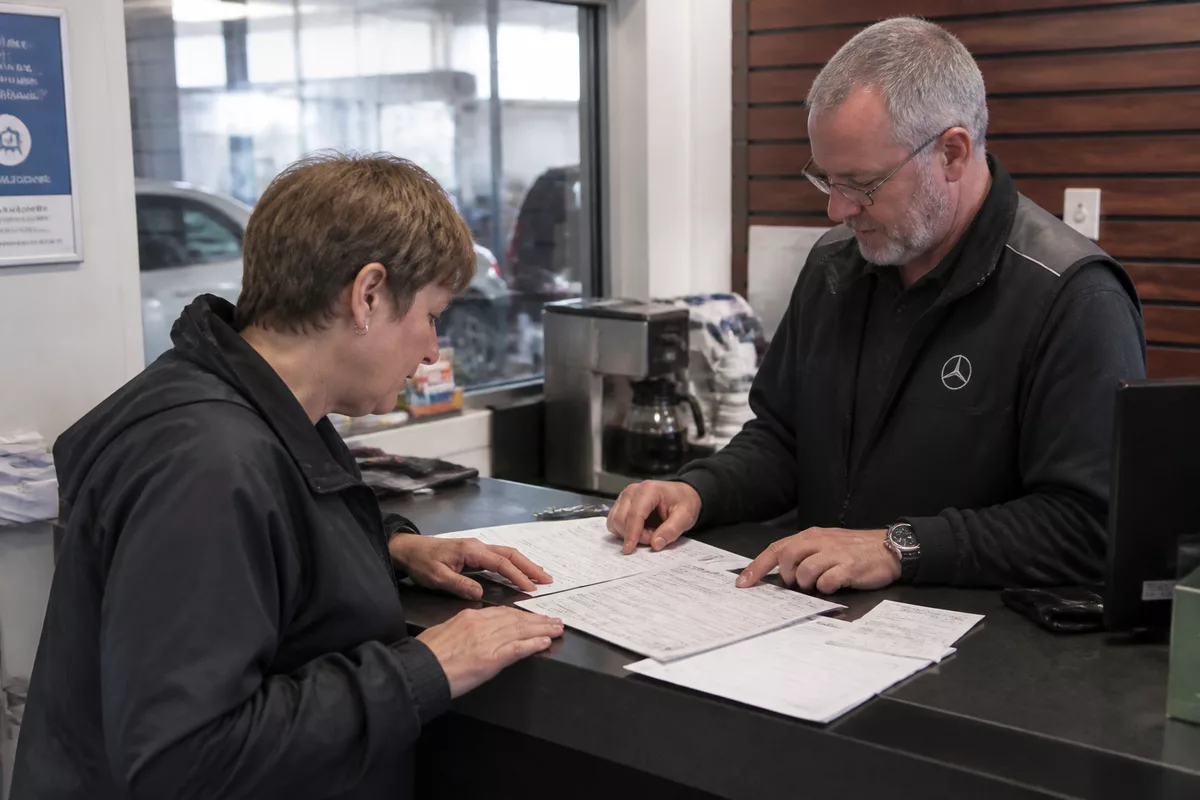
When you speak to the dealer, use plain language: explain what failed, when it failed, and what maintenance you can prove. Ask whether the claim will be submitted under factory warranty, a dealer-backed plan, or a third-party service contract, because the route changes the paperwork and the decision-maker.
- Book a diagnosis and keep the repair order number.
- Ask the service adviser to identify the failed component and the likely cause.
- Provide receipts, maintenance records, and any photos or warning lights.
- Request the warranty decision in writing if the answer is yes or no.
- If the claim is denied, ask for the exact clause that was used.
- Escalate to the manufacturer or contract administrator if the denial does not match the booklet.
The strongest claim file is short, factual, and documented: symptom, mileage, service history, and the exact clause that supports coverage.
If the claim is denied, do not assume the answer is final. Ask for the denial reason, compare it with the booklet, and keep every repair order. A clear paper trail helps if you need to escalate the issue to the manufacturer, an ombudsman program, or a consumer protection office.
Key points
- 🧾 Coverage follows the booklet, not assumptions, dealer folklore, or the car’s age alone.
- 🔩 Defects and premature failures are usually covered; normal wear and neglect usually are not.
- 📍 Time, mileage, and maintenance records can decide a borderline claim.
- 📞 Get the diagnosis and denial reason in writing before you approve a large repair.
- 🔁 Extended car warranty often means a service contract, so read the contract language carefully.
FAQ
Are brakes covered under warranty?
Brake pads and rotors are usually wear items, so they are normally not covered. A brake caliper, hydraulic fault, or sensor problem may be covered if the booklet lists the part and the failure is linked to a defect.
Is a battery covered under warranty?
A starter battery may be covered for a limited time, but the term is often shorter than the main bumper-to-bumper warranty. Check whether the battery is a 12-volt accessory battery, a hybrid battery, or an EV traction battery, because those terms are often different.
Does warranty coverage transfer to a new owner?
Sometimes yes, sometimes no. Factory warranties often continue with the vehicle if the term is still active, but third-party extended car warranty contracts may require a transfer fee, paperwork, or an approval deadline.
Is an extended car warranty the same as factory warranty?
No. A factory warranty comes from the manufacturer and is part of the original vehicle promise. An extended car warranty is often a service contract sold separately, with its own exclusions, deductible, and claim process.
What should I do if the dealer says no?
Ask for the exact clause that supports the denial and compare it with your booklet. Then collect your service records, request a second review if available, and contact the manufacturer or contract administrator before paying a large bill.