Car Advice Customer Service Number: What to Expect Before You Call and How to Get Faster Help
Car Advice Customer Service Number: What to Expect Before You Call and How to Get Faster Help
If you are searching for a car advice customer service number, you are probably trying to solve something quickly: a billing question, a service issue, a complaint, or a follow-up that has already taken too long. Before you dial, it helps to know what kind of support you can expect, what information you may need to verify, and which steps make the conversation faster and more productive.
This guide gives you a practical overview of what usually happens when you call customer service, what the team can solve on the spot, and how to avoid the most common delays. Whether you are a first-time caller or returning after a previous contact, a little preparation can save time and reduce frustration.
What a Car Advice Customer Service Number Is Usually Used For
A customer service phone line exists to help with common questions and to guide you toward the right next step. In many cases, the car advice customer service number is the fastest way to speak with a real person when online information is not enough.
Common reasons people call
Most callers reach out for one of a handful of reasons. The exact menu options may vary, but the topics are usually similar across support teams.
- Billing and account questions such as charges, subscriptions, renewals, or payment updates
- Product or service support when something is not working as expected
- Complaint handling if a previous interaction did not resolve the issue
- Status updates for an open request, repair, claim, or case
- Escalation after you have already contacted support once and need a stronger follow-up
For many people, the main goal is not just to “get through” but to get a clear answer. That is why calling with the right details matters. The more specific you are, the easier it is for the agent to identify the issue and route you correctly.
What the call can and cannot solve
A phone call is great for issues that need clarification, quick verification, or immediate guidance. An agent may be able to confirm account details, check a status, reset something, or explain the next steps in plain language.
- Usually solvable on the spot: simple account questions, missing information, basic troubleshooting, and status checks
- May require follow-up: complex complaints, technical reviews, refund approvals, or cases needing specialist input
- Better handled online: requests that need uploads, written evidence, or a formal record through an official form
In other words, the phone is often best for speed and clarification, while written channels are better for documentation. Knowing the difference helps you choose the right path from the start.
What to Prepare Before You Dial
One of the easiest ways to get faster help is to gather everything you might need before the call begins. Agents usually move more quickly when they do not have to wait while you search for reference numbers or documents.

Information to have ready
Keep the following items nearby so you can answer verification questions without delay:
- Account or policy details if you have an active account
- Order, case, or reference number connected to the issue
- Vehicle or product details if the request involves a specific item
- Recent messages, screenshots, or documents that support your case
- A short summary of the problem in one or two clear sentences
If possible, write down the timeline too. For example, note when the issue started, when you last contacted support, and what was promised. That kind of context can help the agent understand the situation faster and avoid repeating questions later.
Questions to write down in advance
Before you call the car advice customer service number, take a minute to define your goal. A short list of questions keeps the conversation focused.
- What exactly do I need help with?
- What outcome am I hoping for?
- Is there a deadline or urgency I should mention?
- What proof or follow-up information might I need?
It also helps to think about your preferred result. For example, do you want a correction, a refund, a status update, or a callback from someone higher up? If you know your ideal outcome, you can communicate it more clearly.
What to Expect During the Call
Many callers feel frustrated because they do not know what will happen after they press “call.” In reality, support calls usually follow a predictable pattern: menu selection, wait time, identity verification, then the conversation with the agent.
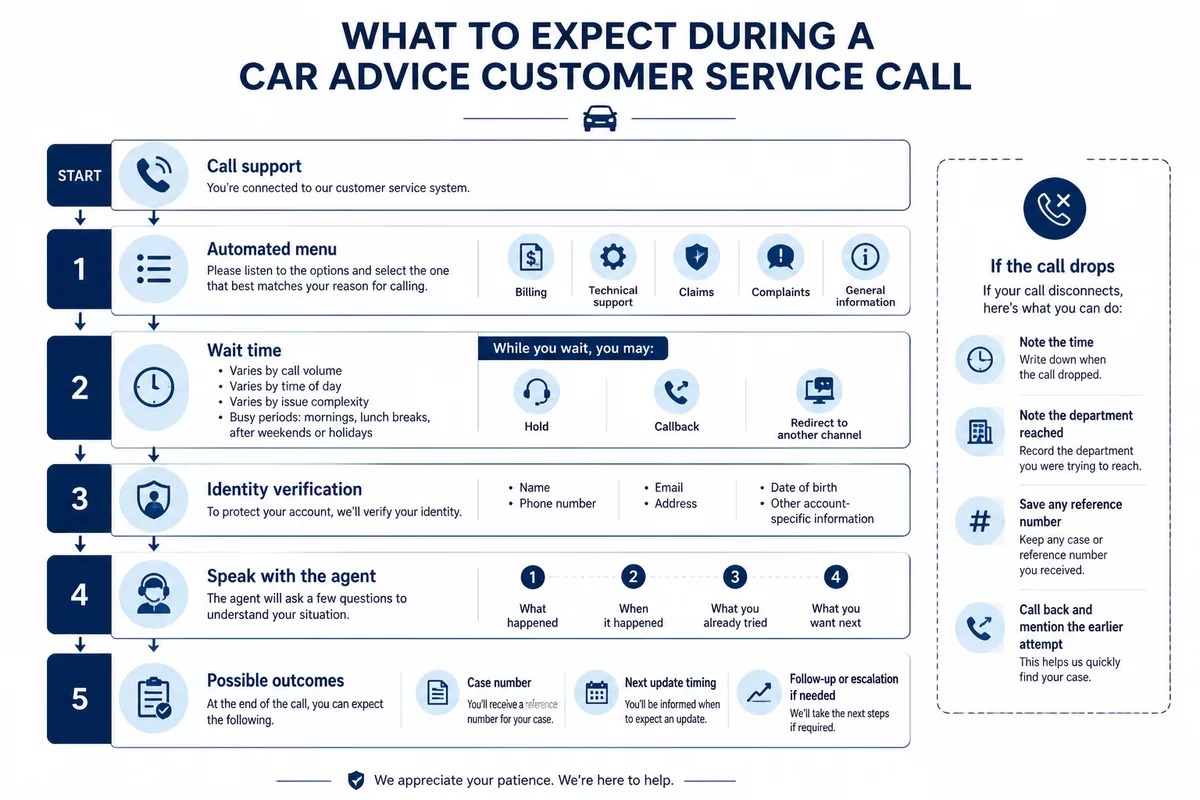
Automated menu and waiting time
Most support lines start with a voice menu that routes callers to the right department. You may hear options for billing, technical support, claims, complaints, or general information. Listening carefully can save time, because choosing the right path prevents transfers later.
Wait times vary based on call volume, time of day, and how complex the issue is. Busy periods often include mornings, lunch breaks, and days after weekends or holidays. If the line is overloaded, you may be placed on hold, offered a callback, or redirected to another channel.
If the call drops or disconnects, note the time, the department you reached, and any reference number you were given. If the system allows it, call back and mention the earlier attempt right away.
Identity verification
To protect your account, the agent may ask security questions before sharing any details. This can include confirming your name, phone number, email, address, date of birth, or other account-specific information.
Verification is not meant to slow you down; it is there to keep your data secure. Still, it helps to have your details ready so you do not have to scramble for them while the agent waits.
If you cannot verify your identity immediately, stay calm and ask what alternative options are available. In some cases, the agent may direct you to submit a form, send documentation, or call back after updating your account information.
Speaking with the agent
Once you reach a live agent, the best approach is to be concise, factual, and polite. Start with the problem, not the backstory. A short summary is usually more effective than a long explanation.
A useful structure is:
- What happened
- When it happened
- What you already tried
- What you want next
It is also a good idea to ask for a case number early in the conversation. If the issue requires follow-up, that number becomes your record of the interaction. You should also ask when and how you can expect the next update.
How to Get Faster Help
Calling support does not have to mean waiting forever. If you plan ahead and use the right strategy, you can often reduce the time spent on the line and improve the odds of a faster resolution.
Best practices before calling
A few simple habits can make a big difference:
- Call during off-peak hours when fewer people are likely to be in queue
- Use the correct department number or extension if the company provides one
- Keep all documents open and ready on your desk or screen
- Focus on the main issue first before bringing up secondary questions
If the company has an online help center, check it before you call. Sometimes the answer you need is already posted, which can save a long wait. You may also discover a direct line, a callback feature, or a department that handles your issue more efficiently.
Useful phrases to use
What you say matters. Clear, respectful phrases often help agents move the case forward with less back-and-forth.
- I would like to confirm the next step.
- Can you please provide a case number?
- Is there a faster way to resolve this?
- Could you transfer me to the right department?
If you feel the conversation is drifting off-topic, gently bring it back. For example, you can say, “I want to make sure I understand the next action we are taking.” That keeps the call productive without sounding confrontational.
Common Problems and How Support May Handle Them
Even with good preparation, some calls do not go perfectly. A support line may be busy, an agent may need more information, or the first contact may not be enough to resolve the issue. Knowing how these situations are usually handled can help you respond calmly.
If the line is busy or the wait is long
When the queue is heavy, do not assume phone support is your only option. Many companies provide other ways to get help, especially for non-urgent issues.
- Try the official website or help center for basic answers
- Request a callback if the option is offered
- Check whether live chat or an online form exists
If your issue is urgent, mention the urgency once you reach an agent. Keep it factual: explain why time matters and what deadline you are facing.
If the first agent cannot resolve the issue
Sometimes the person you speak with can only take the case partway. That does not necessarily mean the call failed. It may simply mean the issue needs review by a specialist team or a supervisor.
- Ask what information is needed next
- Request escalation to a supervisor or specialist if appropriate
- Confirm the expected response time before ending the call
Before you hang up, repeat the key points back to the agent. This helps confirm that you both understood the next step in the same way. It also reduces the chance of confusion later.
Alternative Contact Options
Calling is not always the best choice. In many situations, written support is more efficient, especially when your case involves attachments, detailed explanations, or documentation that should be stored for future reference.
When calling is not the best choice
- Non-urgent questions that can wait for an email reply
- Issues that require documents such as receipts, photos, or forms
- Problems that need a written record for clarity or proof
If you want a trail of communication, a phone call may still be useful, but it is often best to follow up in writing. That way, you have a record of what was discussed, what was promised, and what comes next.
Other channels to consider
Depending on the company, you may also have access to:
- Live chat for quick questions
- Email for detailed explanations and attachments
- Online contact form for formal requests
- Account portal messages for logged-in support
- Official FAQ or help center for self-service answers
As a rule, use the channel that best matches the complexity of your issue. Fast questions may fit chat or phone support, while documentation-heavy issues often do better in writing.
FAQ
What should I have ready before calling?
Keep your account details, reference numbers, and a short summary of the issue nearby. If you have supporting documents, screenshots, or recent messages, have those ready too. The goal is to avoid pauses while the agent waits for information.
How long will the call take?
There is no fixed time. It depends on call volume, how many verification steps are needed, and whether the issue can be solved immediately or requires escalation. Simple requests may take only a few minutes, while complex cases can take much longer.
What if I cannot reach a live agent?
If you cannot get through, try the official website, request a callback, or use the contact form if phone support is overloaded. You can also check the help center to see whether your question has already been answered online.
Can the first agent solve everything?
Not always. Some issues require a specialist team, a supervisor, or a written review. If that happens, ask for the next step, the case number, and the expected response time so you know what to expect.
Conclusion
Calling a car advice customer service number can be an efficient way to solve a problem, but the experience is usually smoother when you prepare first. Gather your account details, write a short summary of the issue, and decide what result you want before you dial.
Remember the basics: expect an automated menu, possible wait time, and identity verification. If the first agent cannot fully resolve the matter, ask for a case number, an escalation path, and a clear timeline for follow-up. In most situations, a focused call and the right documents can save time and lead to better results.
Whenever possible, use official contact information only, and choose the support channel that best matches your issue. That simple approach can make customer service faster, calmer, and far more effective.