Personal Finance Tips 2026: Habits Worth Keeping for a Smarter Money Year
Personal Finance Tips 2026: Habits Worth Keeping for a Smarter Money Year
Personal finance tips 2026 are the habits that automate saving, keep spending visible, reduce expensive debt, and make investing routine. In a year shaped by higher prices and tighter borrowing costs, the smartest move is not a complicated strategy. It is a simple system you can repeat every week without relying on motivation.
This guide focuses on the money habits that still work, what should be updated for 2026, and how to turn them into a low-stress routine for budgeting, emergency savings, debt payoff, and long-term investing. It is written for beginners and intermediate readers, and it uses practical examples rather than theory. This guide reflects June 2026 conditions and keeps the focus on habits, not predictions.
Quick summary
🧭 Automate first. Automatic savings, bill payments, and investing reduce the chance that good intentions disappear.
🧾 Review money often. A weekly check-in and a monthly reset catch leaks before they become a bigger problem.
🛡️ Protect your base. An emergency fund, basic insurance, and a debt plan matter more when costs move up quickly.
📈 Keep investing steady. Regular contributions usually beat trying to guess the perfect time to invest.
Why do these personal finance tips still work in 2026?
These personal finance tips 2026 still work because the fundamentals have not changed: spend less than you earn, save before you spend, keep expensive debt under control, and invest on a schedule. The 2026 update is mostly about pace, automation, and flexibility, not inventing a new money philosophy.
Higher living costs, more digital spending, and more financial apps make simple habits even more valuable. The Federal Reserve, the CFPB, the FDIC, and other consumer finance agencies still point people back to the same basics because the basics hold up when life gets messy.
Higher costs make routine more valuable
Inflation does not affect every category equally, but it tends to show up first in groceries, transport, insurance, utilities, and subscriptions. A budget that worked last year can feel stale fast, so the useful habit in 2026 is not constant reinvention. The useful habit is a short review that keeps the budget close to reality.
What has not changed
The strongest money habits still reduce friction. Automatic transfers move money before it is mentally available. A debt payoff plan limits interest costs. Regular investing keeps you exposed to long-term growth instead of waiting for perfect market conditions that never really arrive.
A good budget is a spending plan, not a guilt system.
The habits worth keeping
The best personal finance tips 2026 are boring in the best possible way. They work because they are repeatable, and repeatable habits survive busy weeks, surprise bills, and income that does not always arrive on the same day.
- Automate savings before money sits in checking.
- Track cash flow on a weekly or monthly rhythm.
- Build and protect an emergency fund.
- Pay down high-interest debt first.
- Invest on a schedule, not on a mood.
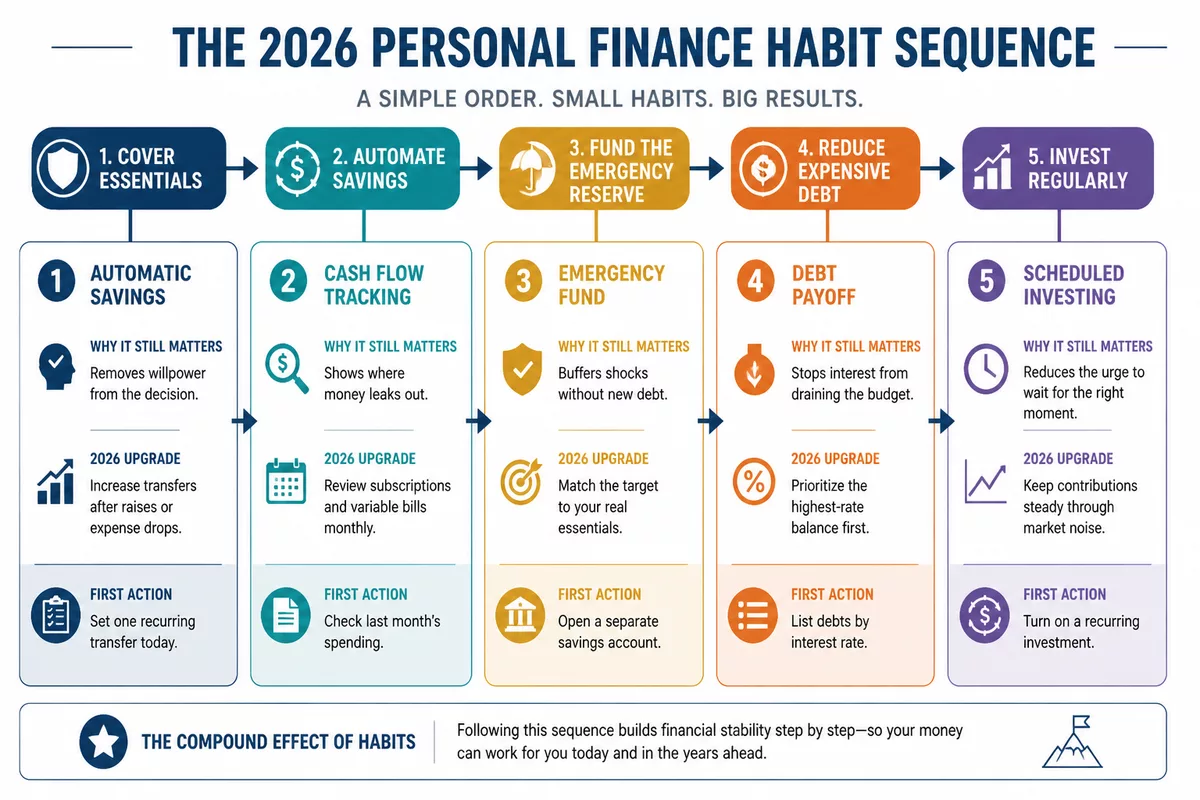
| Habit | Why it still matters | 2026 upgrade | First action |
|---|---|---|---|
| Automatic savings | Removes willpower from the decision | Increase transfers after raises or expense drops | Set one recurring transfer today |
| Cash flow tracking | Shows where money leaks out | Review subscriptions and variable bills monthly | Check last month’s spending |
| Emergency fund | Buffers shocks without new debt | Match the target to your real essentials | Open a separate savings account |
| Debt payoff | Stops interest from draining the budget | Prioritize the highest-rate balance first | List debts by interest rate |
| Scheduled investing | Reduces the urge to wait for the “right” moment | Keep contributions steady through market noise | Turn on a recurring investment |
1. Automate savings before the money sits in checking
Automatic savings is still one of the simplest personal finance habits because it separates your decision from your mood. The most useful setup in 2026 is a transfer that moves money on payday into a savings account, a sinking fund, or an investment account before spending has a chance to expand.
- Start small if needed, then raise the transfer when your budget stabilizes.
- Split savings into separate buckets so emergency cash is not mixed with vacation money.
- Use automation for both savings and recurring bills to reduce late fees and missed transfers.
2. Track cash flow on a weekly or monthly rhythm
Cash flow tracking means knowing what comes in, what must go out, and what is left over. The habit matters more than the tool, because even a simple spreadsheet or notes app can reveal patterns in spending, such as a rising grocery bill or repeated delivery orders.
- Use a weekly check-in if your income varies or your spending changes quickly.
- Use a monthly review if your pay is steady and your bills are predictable.
- Track net worth once a quarter so you can see progress beyond one month’s cash balance.
3. Build and protect an emergency fund
An emergency fund is a separate cash reserve for surprise costs such as car repairs, medical bills, travel disruption, or temporary income loss. A practical target is a starter cushion first, then a larger reserve that matches your essential monthly spending. For example, if essential expenses total $2,500 a month, a three-month emergency fund would be $7,500, which is an illustrative calculation rather than a universal target.
4. Pay down high-interest debt first
High-interest debt is one of the few money problems that quietly gets worse while you wait. Credit card balances are the usual priority because interest can eat into future savings, and a debt payoff plan gives you a clear finish line. The exact method can be the avalanche method, the snowball method, or a simple extra payment schedule, as long as the payments stay consistent.
If savings only happens when you remember it, the system is too weak for a busy year.
5. Invest on a schedule, not on a mood
Scheduled investing still matters in 2026 because time in the market is usually more helpful than guessing the perfect entry point. Regular contributions to retirement accounts or brokerage accounts can be especially useful for readers who already cover basic bills, have a cash buffer, and want long-term growth without constant decision-making.
If an employer offers a retirement match, capturing the full match is often the first investing milestone to protect. That is not a prediction of returns. It is simply a way to avoid leaving free compensation on the table.
How should you upgrade your budget for 2026?
A 2026 budget should be flexible, not fragile. The goal is to keep the structure of the budget while adjusting the categories that move most, such as groceries, transport, insurance, and subscriptions. The best upgrade is usually a small monthly reset instead of a full budget rebuild every time prices shift.
Use apps, but keep a human check
Budgeting apps and AI tools can help sort transactions, but they are not a replacement for a real review. A quick human check catches misclassified purchases, duplicate subscriptions, and category drift. The CFPB’s budgeting guidance still points people toward simple systems that they can actually maintain.
Run a subscription audit every month
A subscription audit is one of the easiest ways to save money in 2026 because small recurring charges add up quietly. Review streaming services, cloud storage, delivery memberships, fitness apps, and trials that turned into paid plans. If a subscription has not been used in the last month, it deserves a real decision.
Use sinking funds for predictable bills
A sinking fund is money set aside in advance for expenses you already know are coming, such as travel, car maintenance, annual insurance, school fees, or holiday spending. This habit keeps predictable costs from breaking the budget, and it works especially well for people who hate being surprised by irregular bills.
Direct part of every raise on purpose
A salary increase is easier to lose than to keep, because lifestyle creep tends to expand with income. A useful rule in 2026 is to assign the raise before it reaches spending habits: some to savings, some to investing, and some to current life upgrades. That approach lets you enjoy the raise without letting it disappear.

What should your monthly money system look like?
A repeatable money system beats a perfect one-time reset. The simplest structure is weekly for awareness, monthly for decisions, and quarterly for bigger checks such as debt progress, net worth tracking, and retirement contributions.
Weekly check-in
A weekly money check-in takes about 10 to 15 minutes and helps you spot trouble before it grows. Look at account balances, upcoming bills, recent card spending, and any unusual expense. The purpose is not to judge yourself. The purpose is to stay oriented.
Monthly reset
A monthly reset is the right time for a subscription audit, a savings transfer, and a budget adjustment for the next cycle. This is also a good moment to move money into sinking funds and to check whether your emergency fund is still separate from everyday spending.
Quarterly review
A quarterly review is where longer-term progress becomes visible. Check net worth, debt balances, retirement contributions, and any account you use for goals that are not urgent. If your numbers are moving in the right direction, the system is working even if one month felt messy.
Financial progress is easier to maintain when the routine is smaller than the problem.
Which habits matter most by life stage?
Personal finance tips 2026 work best when they match the life you are actually living. A student, a family, and a freelancer all need the same fundamentals, but the order of priorities is different because the risks and cash flow patterns are different.
Students and first-job earners
Students and new earners should focus on a starter emergency fund, basic budgeting, and avoiding unnecessary debt. A simple cash flow habit matters more than a perfect investment strategy at this stage. If your income is still small, the biggest win is building the discipline that protects future income.
Families and shared households
Families benefit from shared calendars, shared bill reviews, and clear goals for recurring expenses. A household that talks about money once a month usually does better than a household that only reacts when a bill surprises everyone. Shared sinking funds can be especially helpful for school costs, travel, and seasonal spending.
Freelancers and variable-income workers
Freelancers need a larger cash buffer and more conservative spending assumptions because income can swing from month to month. A practical example is to base essential spending on the lower end of recent average income, then use the surplus for taxes, reserves, and debt reduction. That keeps a good month from creating a false sense of security.
What mistakes should you avoid in 2026?
The most common money mistakes in 2026 are not dramatic. They are small habits that seem harmless until they repeat for twelve months. The fix is usually a better process, not more self-criticism.
- Confusing budgeting with restriction. A budget should support goals, not create guilt.
- Waiting for the perfect month to start. A small system today is better than a perfect plan next quarter.
- Ignoring high-interest debt. Interest charges make delay expensive.
- Letting subscriptions grow unchecked. Small recurring costs can slowly crowd out savings.
- Skipping retirement because cash feels tight. Even a modest habit can matter over time.
- Checking accounts without tracking patterns. Balance watching is not the same as financial planning.
Sources useful to consult
If you want to verify the basics or go deeper, these official and widely used sources are a good next step. They are especially helpful for budgeting, credit, debt, savings, and retirement planning.
- Consumer Financial Protection Bureau (CFPB) — budgeting, debt, credit, and consumer tools.
- FDIC — savings basics, deposit account safety, and emergency fund guidance.
- IRS — tax rules that affect retirement contributions and savings accounts.
- SEC Investor.gov — investing basics, risk, and long-term planning.
- FINRA — credit, investing education, and common financial scams.
- AnnualCreditReport.com — access to your credit reports for error checking and monitoring.
Key takeaways
- 🟢 Automate saving so good money moves happen before spending decisions.
- 🟢 Review cash flow weekly or monthly to catch leaks early.
- 🟢 Keep an emergency fund separate from everyday money.
- 🟢 Attack expensive debt before it drains more of your budget.
- 🟢 Invest on a schedule and keep contributions steady.
FAQ
How much emergency fund should I have in 2026?
A starter emergency fund can be a few hundred dollars, then you can build toward several months of essential expenses. The right target depends on rent, debt, income stability, and family obligations. A separate account makes the money easier to protect from everyday spending.
Is the 50/30/20 rule still useful?
Yes, if it helps you organize your money without making the budget rigid. A needs-wants-savings split can be a useful starting point, but your real-life numbers matter more than the exact formula. If housing, debt, or childcare is expensive, the split may need adjustment.
Should I pay off debt or invest first?
High-interest debt usually comes first because interest costs are certain and immediate. At the same time, many people still try to capture an employer retirement match or keep a small investing habit going. The best answer is often a balanced plan, not an all-or-nothing choice.
How often should I review my finances?
A short weekly check-in and a deeper monthly review work well for most people. A quarterly review is useful for net worth, debt progress, and retirement contributions. The right cadence is the one you can keep through busy months.
What is the fastest way to save more money in 2026?
The fastest low-stress wins are usually automatic savings, a subscription audit, and a small increase in every savings transfer after payday. Those habits do not require a big lifestyle change. They work because they reduce the amount of decision-making you need to do.