Budgeting Tips for Young Professionals: Save More Without Feeling Restricted
Budgeting Tips for Young Professionals: Save More Without Feeling Restricted
Budgeting tips for young professionals work best when they protect savings first, then leave room for rent, commuting, food, and a social life. A realistic system starts with your take-home pay, automates a transfer on payday, and uses a flexible spending limit for everything else. That way, you save more without feeling like your money has been locked away.
The early career years are the ideal time to build strong money habits because small choices compound quickly. The guide below shows you how to map your real monthly cash flow, choose a simple budgeting method, cut the biggest leaks, and handle debt and savings at the same time without turning your budget into a punishment.
Quick summary
💡 Start with net pay. Budget from take-home income so your plan matches real spending power.
🧭 Automate savings first. Move money on payday before discretionary spending has a chance to win.
🧾 Cut the big leaks first. Housing, transport, delivery, and subscriptions usually matter more than tiny sacrifices.
⚖️ Keep it flexible. A good budget leaves room for fun, which makes it easier to keep going for months.
Why saving feels hard in the early years of your career
Saving feels harder in early adulthood because your expenses arrive fast, while your salary often feels smaller than expected after taxes, benefits, and commuting costs. A first full-time paycheck can also create lifestyle inflation, where a raise quietly turns into better meals, more subscriptions, and more expensive weekends instead of bigger savings.
Budgeting for young adults becomes easier when you name the real pressure points. The biggest ones are usually rent, transportation, student loan payments, food delivery, and social spending. Once you see which category is expanding, you can fix the right problem instead of cutting random expenses that do not move the needle.
A budget is not a punishment. A good budget buys you more calm, more choices, and fewer surprise expenses.
- Rent and housing usually absorb the largest share of a young professional budget.
- Transport can climb quickly when gas, parking, rideshares, or train passes are added together.
- Convenience spending often hides in delivery fees, takeout, and coffee runs.
- Subscriptions are easy to ignore because each one feels small on its own.
What are the best budgeting tips for young professionals?
The best budgeting tips for young professionals are the ones you can repeat every month without thinking too hard. Start with your net income, keep fixed bills stable, automate savings, and give yourself a clear spending limit for the rest. That mix is simple enough for beginners and strong enough to stop money leaks.
For many first-salary budgets, the goal is not perfect control. The goal is a system that makes savings happen automatically while still leaving enough flexibility for dinner out, a weekend trip, or an occasional splurge. A budget that feels normal is more useful than a strict plan you quit after two weeks.
Use a budget method that matches your personality
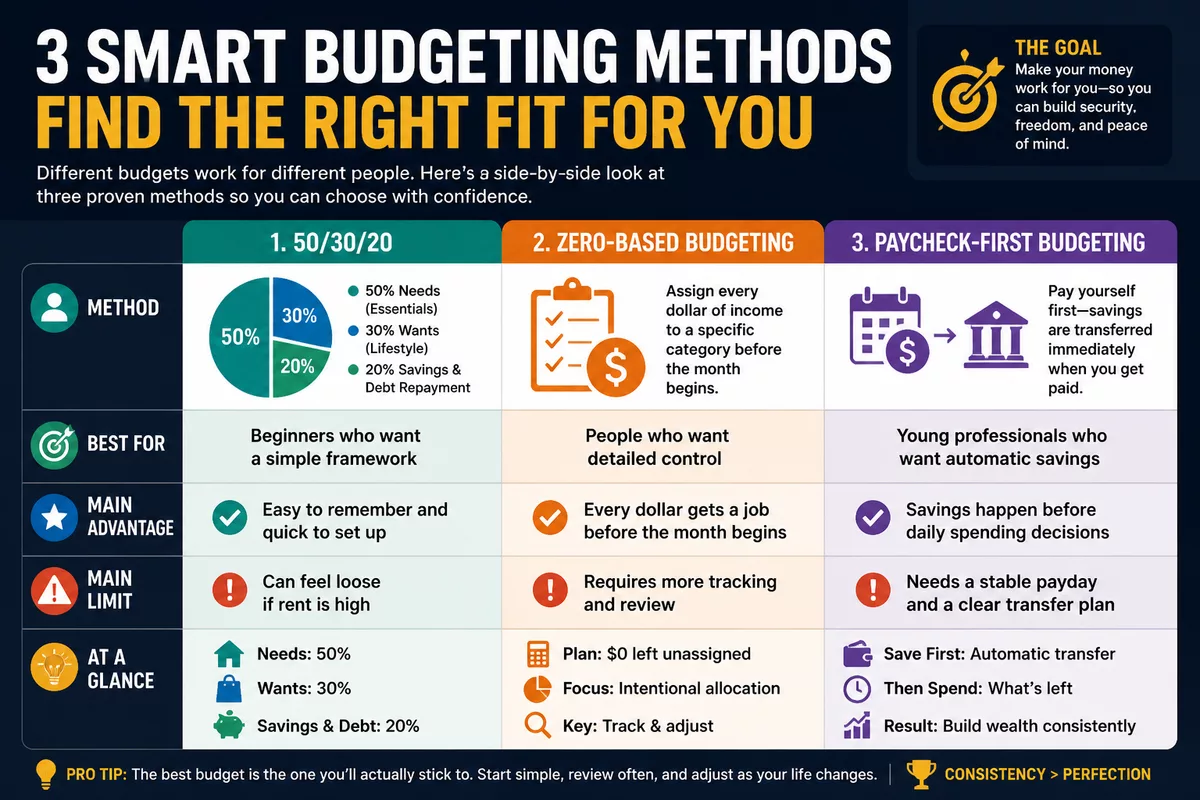
Different budgeting methods work for different people, but the best one is the one you will actually check. The 50/30/20 rule is easy to understand, while zero-based budgeting gives you tighter control if your income is stretched. A paycheck-first system sits in the middle and works well when you want saving to happen automatically.
| Method | Best for | Main advantage | Main limit |
|---|---|---|---|
| 50/30/20 | Beginners who want a simple framework | Easy to remember and quick to set up | Can feel loose if rent is high |
| Zero-based budgeting | People who want detailed control | Every dollar gets a job before the month begins | Requires more tracking and review |
| Paycheck-first budgeting | Young professionals who want automatic savings | Savings happen before daily spending decisions | Needs a stable payday and a clear transfer plan |
Set your budget in three layers
- Fixed costs: rent, utilities, debt payments, and transport.
- Flexible spending: groceries, dining out, clothes, and social plans.
- Goals: emergency fund, short-term savings, and long-term investing.
How much should you save from your first salary?
A realistic starting point is to save a small amount you can sustain, then raise it as your budget settles. If money is tight, 5% to 10% of take-home pay is a workable first target. If your fixed costs are under control, 15% or more becomes easier to reach without feeling squeezed.
The right savings rate is the one you can automate and keep. For example, if your monthly take-home pay is $3,800, a 10% savings rate sends $380 to savings each month. If you also cut $90 of delivery spending and $60 of subscriptions, your monthly savings rise to $530 without touching rent or groceries.
Build savings in this order
- Starter emergency fund: enough to cover a real surprise expense without using credit.
- Short-term goals: moving costs, a trip, professional courses, or a car repair fund.
- Long-term savings: retirement contributions and investment accounts once basic safety is in place.
Saving works best when the transfer happens before you have time to negotiate with yourself.
How can you cut spending without feeling restricted?
You do not need to delete all fun from your budget to save more. The easiest way to reduce spending is to target the habits that repeat every week, especially delivery meals, impulse purchases, and subscriptions you rarely use. A few controlled changes usually create more room than a blanket ban on everything enjoyable.

Focus on the largest leaks first
- Housing: reassess whether a roommate, a smaller unit, or a different neighborhood changes the math.
- Transport: compare car ownership, transit passes, biking, and commute time before assuming the current setup is cheapest.
- Food: cook a few repeat meals, pack lunch twice a week, and cap delivery to one planned day.
- Subscriptions: cancel anything you did not actively use in the last month.
Use a weekly discretionary cap
A weekly fun-money limit is easier to follow than a vague monthly promise. When you know you have a set amount for coffee, drinks, takeout, and weekend plans, you stop making guilt-based decisions every day. This also helps you enjoy spending because the limit is already built into the plan.
How do you save and pay off debt at the same time?
You can do both by separating high-interest debt from low-risk savings goals. Keep minimum payments current, then direct extra cash toward the debt with the highest interest rate while still building a small emergency fund. That approach protects you from new debt when something unexpected happens.
For young professionals with student loans, credit card balances, or a car payment, the main mistake is waiting until debt disappears before saving anything. A small cash buffer is useful even when you are focused on repayment because it reduces the chance that one repair bill pushes you back into borrowing.
A simple priority order
- Pay minimums on every required debt.
- Build a starter emergency fund so surprises do not become new debt.
- Attack high-interest debt with every extra dollar you can free up.
- Capture employer benefits if your workplace retirement plan offers matching contributions.
High-interest debt quietly taxes your future, so reducing it often creates a guaranteed return before you invest more aggressively.
Protect your income, not just your spending
A higher salary helps, but income protection matters too. Ask for raises with evidence, keep your resume current, and make sure your benefits package works for you. If you build side income, treat it as a bonus until it becomes reliable enough to support regular expenses.
What should you do in your first 30 days?
The first month is about visibility, not perfection. Track what you spend, choose one savings target, and remove one or two obvious leaks. That first month should make your money easier to understand, not turn your life into a spreadsheet you hate opening.
Week 1: Track everything
- Review bank and card statements from the last 30 days.
- Group spending into fixed costs, flexible spending, and goals.
- Spot the categories that are larger than you expected.
Week 2: Set one clear target
- Pick a savings rate or a fixed dollar amount.
- Choose an emergency fund goal you can explain in one sentence.
- Decide what “good enough” looks like for this month.
Week 3: Automate and simplify
- Set automatic transfers for savings on payday.
- Turn off or cancel one low-value subscription.
- Cap delivery, rideshares, or impulse purchases for the week.
Week 4: Review and adjust
- Check whether you stayed within your flexible spending limit.
- Increase transfers slightly if your month felt easier than expected.
- Keep what worked and drop what felt too rigid.
Sources worth checking
These official or widely trusted resources are useful if you want to verify budgeting basics, emergency savings guidance, or employer retirement rules:
- Consumer Financial Protection Bureau budgeting tools — useful for simple budgeting and savings habits.
- FDIC Money Smart — helpful for emergency savings and everyday money management.
- U.S. Department of Labor retirement plan information — useful for understanding workplace retirement plans and matching contributions.
Key takeaways
- 💼 Budget from take-home pay, not salary headlines.
- 🤖 Automate savings on payday before spending decisions pile up.
- 🏠 Cut housing, transport, and delivery before trimming every small pleasure.
- 🛡️ Build a starter emergency fund while you pay down expensive debt.
- 📈 Raise your savings rate slowly after each budget review.
FAQ
How much should a young professional save each month?
A good starting point is 5% to 10% of take-home pay if money is tight, then more once your budget feels stable. The best number is the one you can automate consistently without missing bills or creating new debt.
Should I save or pay off debt first?
High-interest debt should usually get extra attention first, but a small emergency fund still matters. A starter cushion helps you avoid borrowing again when a surprise bill shows up, which makes debt repayment more effective over time.
What if my income changes every month?
Base your budget on your lowest predictable income and treat extra income as a bonus. During stronger months, split the extra money between savings, debt repayment, and a buffer for slower months.
What is the easiest way to save money consistently?
Automatic transfers are usually the simplest method because they remove daily decision-making. Once savings move on payday, you can spend the rest with more confidence because the important part is already done.
How do I stop feeling restricted while budgeting?
Keep a planned amount for fun money, meals out, and social plans. A budget feels less restrictive when you choose the amount in advance instead of trying to avoid spending altogether.