The 5 Cs of Wellbeing Explained: A Practical Everyday Guide
The 5 Cs of wellbeing are a flexible way to think about connection, contribution, coping, confidence, and character. They offer a simple language for noticing what supports your personal, emotional, and social wellbeing without turning everyday life into a test.
The model is not a universal clinical standard, and different sources use other five-C combinations. Used carefully, it can help you choose one manageable action, recognise existing strengths, and identify when general wellbeing habits are not enough and professional support is needed.
Quick Summary
🌱 The five Cs used here are connection, contribution, coping, confidence, and character. Other wellbeing and mental health models may use terms such as competence, caring, compassion, community, clarity, or commitment.
🧭 Use the framework as a flexible reflection tool, not as a scorecard or diagnosis. A small action in one area may make another area easier to approach.
🫶 Start with one realistic action that matches your current capacity. Persistent distress, major disruption to daily life, hopelessness, self-harm thoughts, or immediate safety concerns require qualified or emergency support.
What are the 5 Cs of wellbeing?
The five Cs in this guide are connection, contribution, coping, confidence, and character. Together, they describe relationships, meaningful participation, responses to difficulty, realistic self-belief, and values-led behaviour.
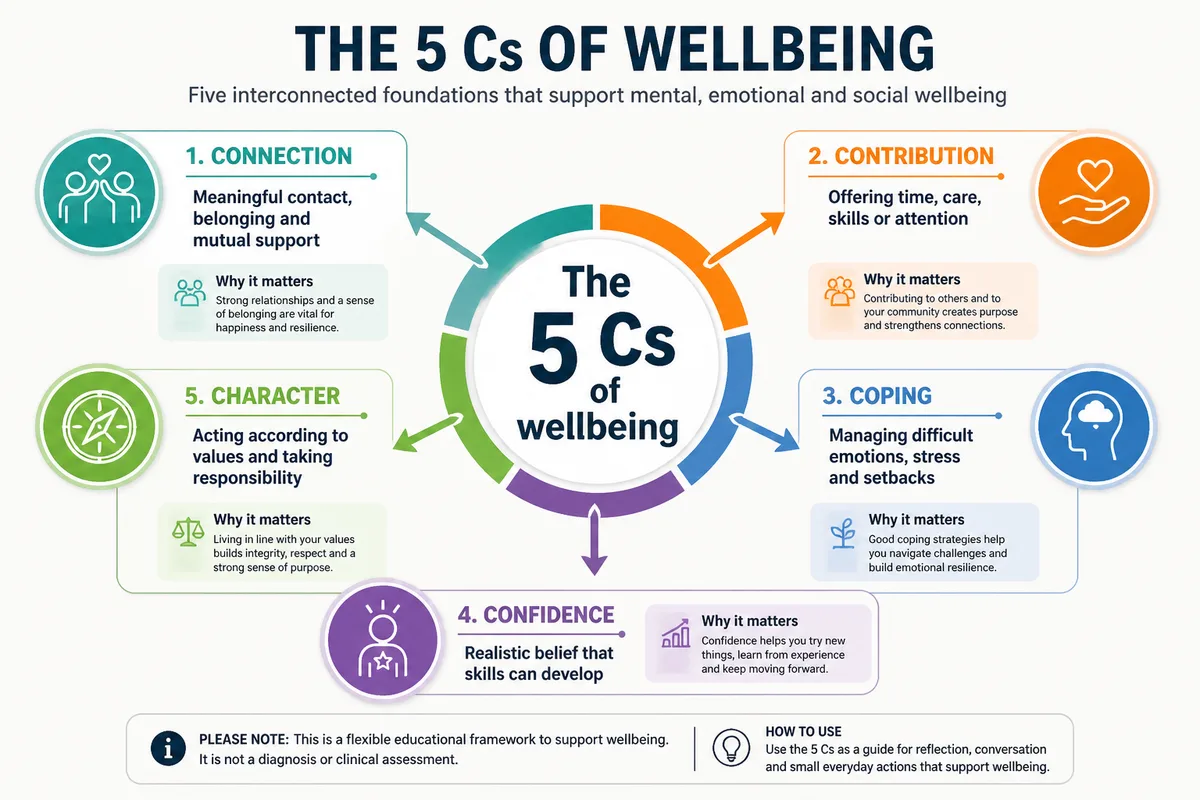
There is no single officially standardised list called the 5 Cs of wellbeing. In positive youth development research, a widely used model includes competence, confidence, character, connection, and caring. Other sources describe combinations such as connection, compassion, community, care, and coping. Naming the chosen version matters because the same label can refer to different ideas.
The interpretation used here is designed for general adult wellbeing, while remaining adaptable for young people, families, workplaces, and schools. It does not diagnose, prevent, or treat depression, anxiety, burnout, addiction, or any other mental health condition.
Progress also does not require equal attention to all five areas. One week may call for support and rest; another may leave more room for learning, contribution, or social contact. The useful question is not whether you are doing every C perfectly, but which small experiment could support you now.
| C | Plain-English meaning | Everyday example | Useful boundary |
|---|---|---|---|
| Connection | Meaningful contact, belonging, and mutual support | Sending a thoughtful message or asking for help | Contact should not require staying in a harmful relationship |
| Contribution | Offering time, care, skills, or attention | Helping with one practical task at home or locally | Being useful is not a condition of self-worth |
| Coping | Managing difficult emotions, stress, and setbacks | Grounding yourself and breaking a task into smaller steps | Coping is not the same as suppressing feelings |
| Confidence | Realistic belief that skills can develop | Attempting a manageable challenge and reviewing what happened | Confidence does not mean constant certainty |
| Character | Acting according to values and taking responsibility | Making an honest, kind, or accountable choice | Reflection should not become self-punishment |
How do the five Cs work together?
The five Cs can support different parts of wellbeing at the same time: belonging through connection, purpose through contribution, resilience through coping, self-belief through confidence, and values-based choices through character.
A small change in one area can make another feel more achievable. For example, asking a trusted person for practical support may improve connection while also making a difficult task easier to cope with. Completing that task may then provide evidence that supports confidence.
Wellbeing is shaped by health, relationships, work, finances, culture, housing, discrimination, caring responsibilities, and access to support. The framework can help identify where support is needed, but it should never imply that someone’s circumstances are caused by a lack of effort or character.
Do not use the five Cs as a scorecard. A low point in coping or confidence is information about current needs, not a verdict about your personality.
The 5 Cs explained with everyday actions
Each C becomes useful when it leads to a specific action that fits your energy, resources, and circumstances. The aim is supportive behaviour, not pressure disguised as self-improvement.
Connection: supportive relationships and a sense of belonging
Connection means meaningful contact, mutual support, and a sense of belonging; it is not simply being surrounded by people. A thoughtful message, an attentive conversation, an interest-based group, or a clear boundary with a draining relationship may all support connection.
Asking for help belongs here as much as offering it. If social contact feels demanding, begin with a low-pressure option such as replying to one person, attending for a short time, or telling someone what kind of support would be useful.
Contribution: taking part in ways that feel meaningful
Contribution involves offering time, care, skills, or attention at home, at work, in education, or in local life. Sharing knowledge, preparing part of a meal, helping with one practical task, or supporting a colleague can create purpose without requiring a formal volunteering role.
Contribution becomes unhelpful when usefulness is treated as proof of personal worth. Do not overcommit to earn approval or neglect rest to remain dependable.
Coping: responding to stress, uncertainty, and setbacks
Coping skills are practical and emotional ways to manage difficult moments. Helpful options may include grounding, movement, rest, breaking a task down, naming an emotion, or contacting a trusted person.
Persistent avoidance, harmful substance use, and harsh self-talk may reduce discomfort briefly while making problems harder to address later. Coping does not mean suppressing emotions or handling everything alone.
Confidence: trusting that skills can grow
Confidence is realistic self-belief, not fearlessness or permanent certainty. You can support it by choosing a small stretch goal, recording evidence of past progress, requesting constructive feedback, and using kinder self-talk after mistakes.
Confidence and self-esteem overlap but are not identical. Confidence often concerns belief in handling a task, while self-esteem relates more broadly to a sense of personal worth. Both can be affected by relationships, health, exclusion, and past experiences, not just personal effort.
Character: acting in line with values
Character can be expressed through integrity, kindness, responsibility, accountability, and other values that guide everyday choices. It is visible in small decisions, such as admitting an error, keeping a reasonable promise, or communicating honestly under pressure.
Values-based reflection can strengthen purpose and self-respect when it is honest and compassionate. It should not become a search for evidence that you are a bad person.
How can you use the 5 Cs in a realistic weekly wellbeing routine?
Use the five Cs as a repeatable check-in, not five new obligations every day. Choose one area that needs support, one existing strength, and an action small enough to attempt during the week.
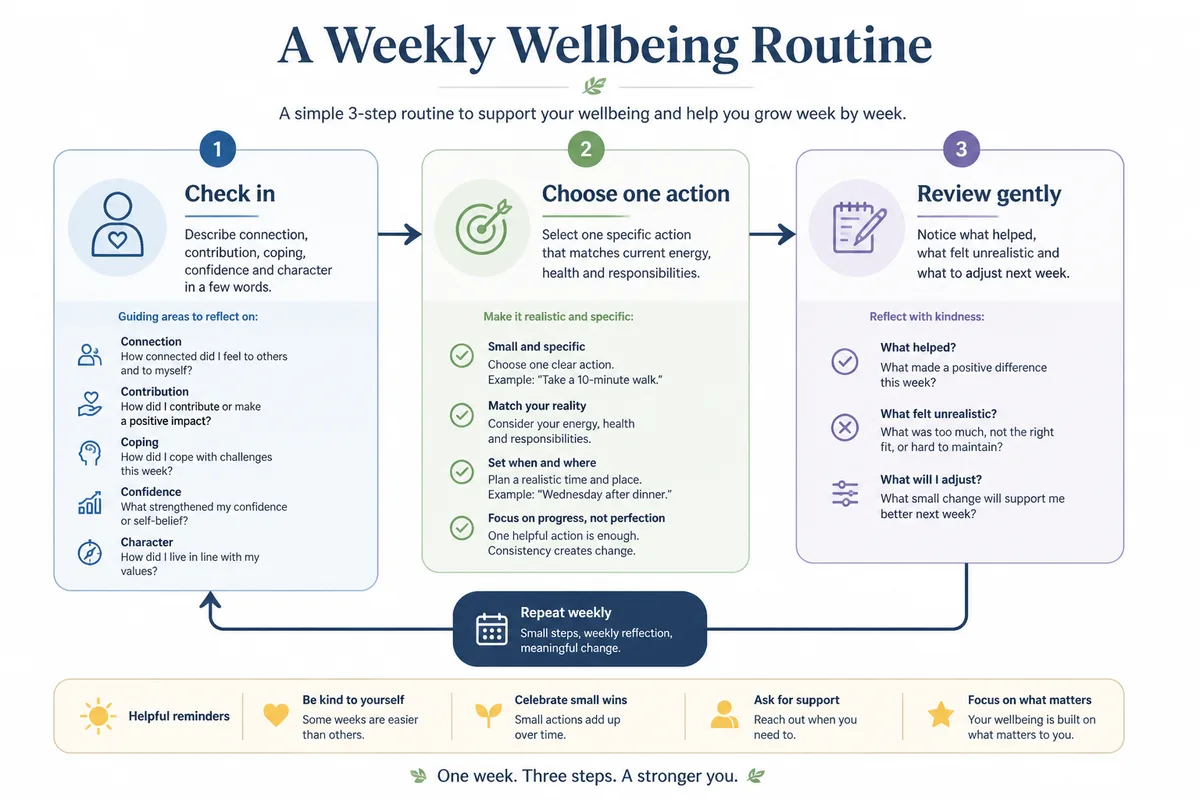
- Check in with each C. Write a few words about your current connection, contribution, coping, confidence, and character. Notice practical barriers, available support, and the area where a small change could matter most.
- Choose one action for the week. You might arrange a short call, help with one task, practise a grounding activity, attempt a manageable challenge, or make one decision that reflects your values. During a demanding week, focusing on only one C is enough.
- Review without judgement. Ask what felt useful, difficult, or unrealistic. Adjust the next action to your energy, health, caring responsibilities, and changing circumstances rather than treating a missed action as failure.
For example, someone with limited energy might choose to send one message for connection, ask for help with a household task, and stop there. A larger routine is not automatically a better routine.
How can the framework adapt when life feels different from usual?
The same five Cs can look different at work, during a major change, when motivation is low, or when support is being offered to a child. Adaptation is more useful than rigidly applying the same routine in every situation.
At work or school
Connection may involve peer support, contribution may involve sharing knowledge, coping may involve realistic planning, confidence may involve a learning goal, and character may guide respectful communication. Productivity is only one part of wellbeing and should not become its measure.
During stress, loss, or major change
Prioritise safety, basic needs, rest, and trusted support before ambitious self-improvement goals. Reduce the plan to the smallest useful action, such as drinking water, sending one support message, attending an essential appointment, or completing one necessary task.
When feeling isolated, low in motivation, or overwhelmed
Start with low-demand connection or coping: contact one safe person, sit somewhere calmer, name five things you can see, or complete one grounding task. Difficulty starting can be a reason to seek additional support rather than a reason to push harder.
For children and teenagers
Use age-appropriate examples involving friendships, play, learning, responsibility, and trusted adults. A young person’s wellbeing is strongly influenced by the adults and environments around them, so the five Cs should not be presented as a responsibility they must manage alone.
What are the limits of the 5 Cs, and when does professional support matter?
The five Cs can organise everyday wellbeing goals, but they cannot replace qualified assessment or treatment. The model is educational and non-diagnostic, and evidence from one population or framework should not automatically be generalised to everyone.
A 2021 peer-reviewed study of Malaysian undergraduate students examined the relationship between the five Cs of positive youth development, wellbeing, and purpose in life. The study began with 400 participants and reported a final analytical sample of 393; its reported relationships are associations, not proof that practising a C causes better wellbeing. The findings therefore provide context, not a universal prescription.
Seek help from a healthcare professional when distress persists, worsens, or significantly disrupts sleep, work, study, relationships, self-care, or daily functioning. Contact a local crisis service or emergency service immediately if there are thoughts of self-harm or suicide, an immediate risk of harm, inability to stay safe, severe confusion, or another urgent safety concern; in Europe, call 112, or use the appropriate emergency number where you live.
Persistent difficulty does not show a lack of effort, confidence, or character. Health conditions, trauma, poverty, discrimination, unsafe relationships, and limited access to care can all affect wellbeing and may require support beyond self-guided habits.
Frequently Asked Questions About the 5 Cs of Wellbeing
What are the 5 Cs of wellbeing?
The five Cs used in this guide are connection, contribution, coping, confidence, and character. Terminology varies, so other sources may use competence, caring, compassion, community, clarity, or commitment instead.
Which of the 5 Cs should I focus on first?
Start with the area causing the greatest strain or with the easiest small win, depending on your current capacity. If you are overwhelmed, coping and connection may be more practical starting points than a demanding confidence goal.
Can the 5 Cs help with stress and anxiety?
Connection and coping practices may support general wellbeing during everyday stress. Severe, persistent, worsening, or disabling symptoms require advice from a qualified healthcare professional rather than relying on the framework alone.
How can I practise the 5 Cs every day?
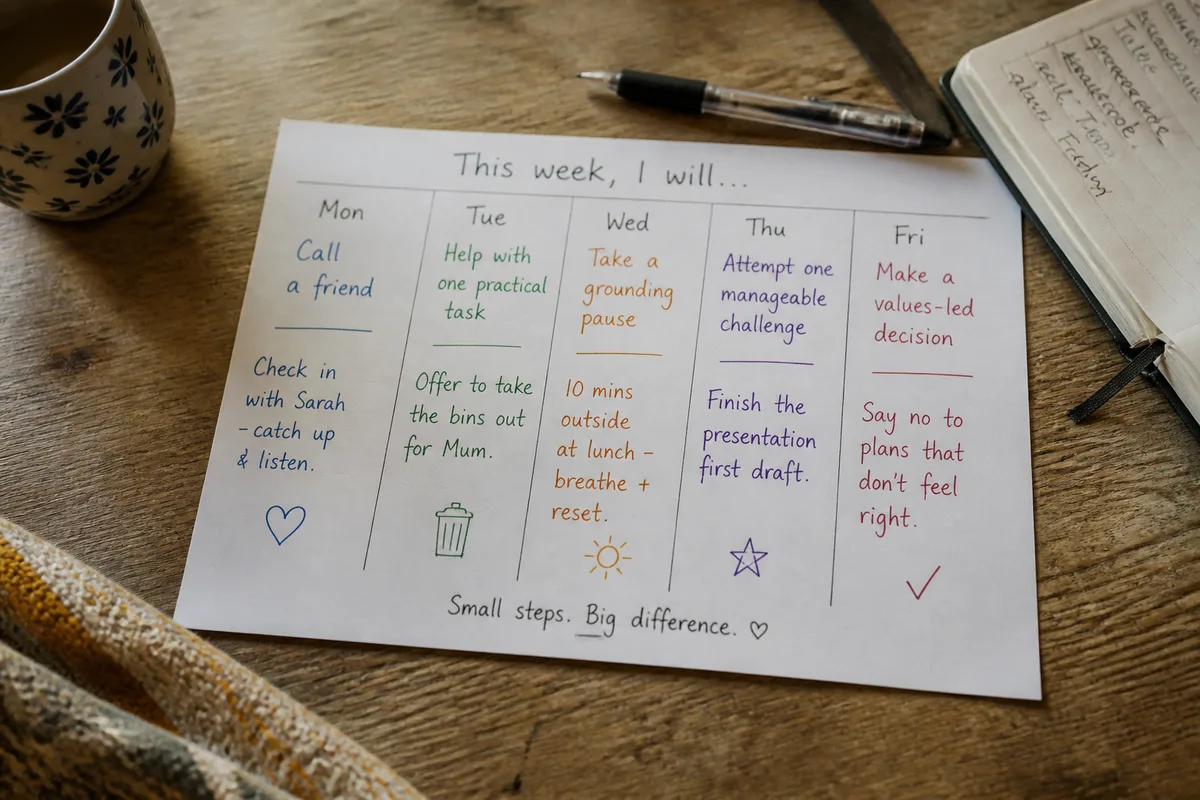
Choose one small action for each C across a week or rotate the focus from day to day. A short call, one helpful task, a grounding pause, a manageable challenge, and one values-led decision are enough to create a practical starting point.
How long does it take to improve wellbeing?
There is no reliable universal timetable. Progress varies with health, circumstances, support, and the sustainability of the actions, and professional care may be needed when distress is persistent or severe.
Choose one compassionate action that is genuinely achievable today, then let the five Cs remain a flexible guide rather than a test you can pass or fail.