How to Start a Marketing Business From Home and Land Your First Client
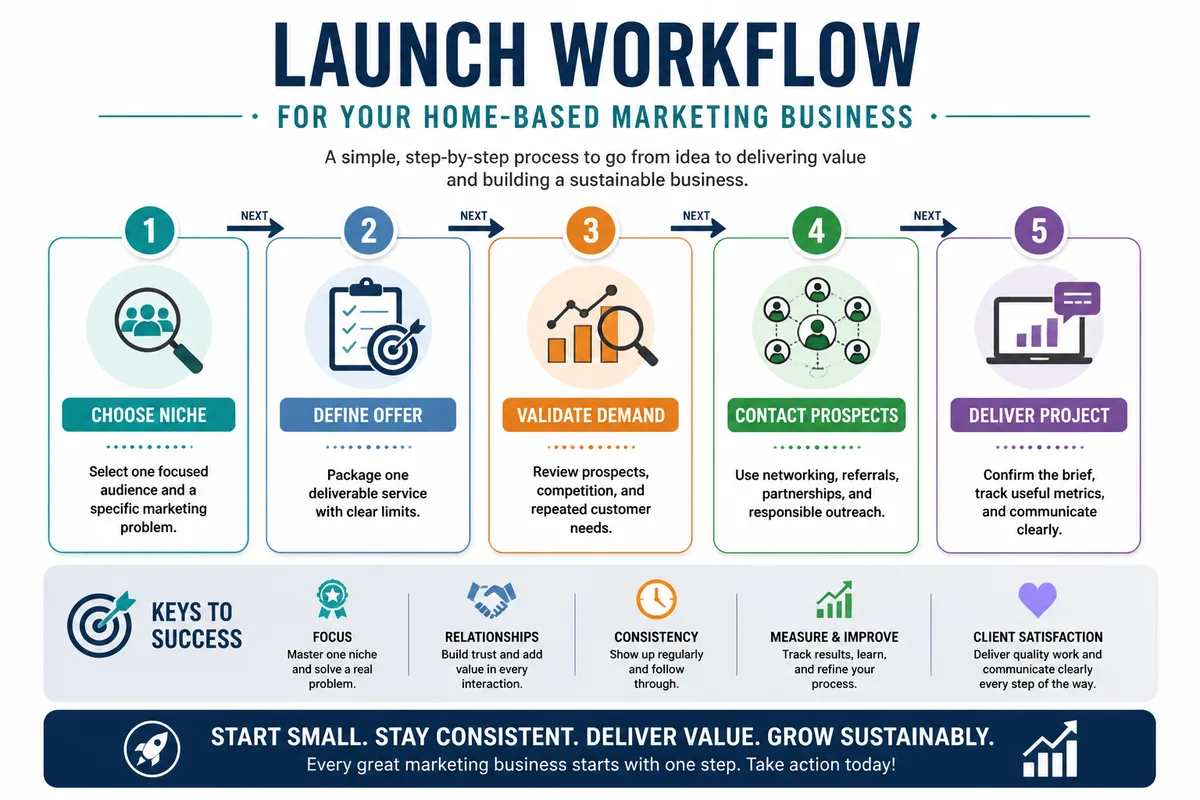
Want to start a marketing business from home? Begin with one specific audience, one practical service, and one clear business outcome instead of presenting yourself as a full-service agency. Validate demand, handle the legal and financial basics for your location, create credible proof of ability, then approach prospects through networking, referrals, partnerships, and responsible outreach.
Your first client rarely arrives because a website exists. A focused offer, a relevant sample, a short prospect list, and a useful conversation create a more realistic path to paid work than expensive software or a broad list of marketing services.
What You Need Before Starting a Home-Based Marketing Business
A home-based marketing business needs a defined customer, a deliverable service, a way to communicate, a simple operating process, and a method for collecting payment. Digital marketing is one possible specialization, including SEO, social media, content, websites, email marketing, and pay-per-click advertising.
Start small.
Choose one outcome first.
Before contacting prospects, write down the following:
- Audience: the type of customer you want to serve.
- Problem: the marketing obstacle that customer faces.
- Offer: the specific work you will complete.
- Evidence: samples, relevant experience, training, or a carefully disclosed demonstration project.
- Process: how a prospect becomes a client and receives the work.
A solo service business is usually the leanest starting model because it avoids premature hiring, complicated management, and software costs that demand has not yet justified; contractors or employees can enter the picture after workload, cash flow, and quality requirements are clear.
Basic marketing knowledge helps.
How to Choose a Niche, Audience, and First Service
Pick a niche where your existing skills connect with a visible business need, such as helping local service companies improve lead generation, supporting an online retailer with email campaigns, or managing social content for a professional practice.
Specific beats broad.
Test demand before branding.
Assess your skills and experience
List tasks you can perform without extensive supervision: writing landing-page copy, planning social posts, auditing website pages, preparing email sequences, researching keywords, interpreting analytics, or coordinating paid campaigns. Training and certifications may strengthen your foundation, yet neither replaces a clearly scoped service or honest evidence of capability.
Separate learning from selling.
Do not sell a service that you cannot deliver responsibly. For a beginner, content planning, basic social media management, email copywriting, and a defined SEO audit may be easier to control than promising complete advertising growth.
Research demand and competition
Review local directories, business websites, professional groups, job listings, and public social profiles to identify repeated problems: irregular publishing, unclear calls to action, outdated service pages, weak local visibility, or inconsistent follow-up.
Look for repeated pain.
Compare competing providers by audience, service, proof, price presentation, and response time. The goal is not to copy their positioning; it is to find a narrow gap where your offer is understandable and deliverable.
Select a target customer
A target customer should be identifiable in one sentence. “Independent dental practices with outdated service pages” gives you a prospecting direction, while “businesses that need marketing” gives you no useful list or message.
Name the buyer.
Identify who approves the work, what result matters to them, and what information they need before spending money. This focus improves outreach because each message can refer to a relevant business situation.
How to Turn a Marketing Skill Into a Clear Offer
Package a skill around an outcome that a client understands, then define the work, limits, timing, inputs, and success measures in plain language. A starter offer might combine a website audit, prioritized recommendations, and one review call rather than an undefined promise to improve online visibility.
Sell a defined result.
Scope protects both sides.
Create a simple starter package
A useful package contains a named deliverable, a fixed scope, a communication method, and a clear handoff. For example, a hypothetical local SEO starter package could include a review of selected website pages, a list of prioritized improvements, suggested local content topics, and a recorded explanation.
Limit revisions.
State what the package excludes. Advertising budget, website development, photography, extensive copywriting, and ongoing reporting should appear as separate items when they are outside the initial agreement.
Choose a pricing model
Marketing businesses commonly use hourly pricing, project pricing, recurring retainers, subscriptions, performance-related arrangements, or value-based pricing; the suitable model follows the work’s predictability, client risk, and ability to measure the outcome.
Start with a project.
For an illustrative calculation, ten hours of work at an assumed rate of $60 per hour produces a $600 project price before taxes, payment fees, software, and other business costs. This is a planning example, not a market rate or personalized recommendation.
Performance-based pricing requires special care.
Do not tie payment to outcomes controlled by the client, market conditions, tracking quality, or advertising platforms unless the contract defines attribution, access, timing, and failure conditions precisely.
How to Set Up the Business From Home
Complete the legal, tax, financial, workspace, and communication setup required in your jurisdiction before taking paid work. Business structures may include a sole proprietorship or equivalent, a limited-liability structure, a partnership, or a corporation, with consequences that vary by country and location.
Check local rules.
Keep business money separate.
Handle legal and financial basics
Verify registration, tax registration, invoicing, record-keeping, insurance, home-business permissions, and zoning with the relevant business registry, tax authority, local government, and qualified adviser. Requirements cannot be treated as universal because the correct answer changes with your residence, business structure, clients, and work location.
For a United States business, the Internal Revenue Service states that an eligible business may request an EIN through its official process; confirm eligibility and current instructions directly with the IRS before applying.
Use a dedicated business bank account where appropriate, retain invoices and receipts, and reserve money for taxes according to advice from the relevant tax authority or an accountant. A business name or structure can carry legal consequences, so obtain professional advice before choosing one for liability or tax reasons.
Build a lean home setup
A functional setup needs a reliable computer, secure file storage, a professional email address, video-call capability, a calendar, a document-signing process, and a backup routine. Add paid software only when it removes a proven bottleneck or supports a contracted deliverable.
Keep tools simple.
Examples mentioned in digital marketing workflows include Google Analytics for analysis, Semrush for SEO and PPC research, and email marketing platforms; compare current features, access rules, and prices directly before purchasing because tools and plans change.
How to Build Credibility Before You Have Clients
Build proof without inventing results by showing how you think, what you deliver, and how you handle limits. A portfolio may include work from previous employment where permission exists, clearly labeled practice projects, public audits, educational samples, or volunteer work disclosed accurately.
Show the process.
Never fabricate testimonials.
A credible portfolio page can contain:
- A short description of the customer type.
- The marketing problem examined.
- The method or framework used.
- A sample deliverable or anonymized excerpt.
- The limits of the exercise.
- The next action a real client could take.
For example, create a clearly labeled sample audit of a public local-business website, identify three observable conversion obstacles, and suggest improvements without claiming that the business adopted them or generated additional revenue.
Proof reduces uncertainty.
Your website only needs focused pages: services, about, selected work, process, contact, and a privacy notice where applicable. A polished site with vague promises is weaker than a simple site that explains exactly who receives which deliverable.
How to Find Your First Marketing Client
Use a sequence rather than scattering effort across every channel: start with people who already know your work, contact carefully selected businesses, ask for relevant introductions, and publish a small useful asset that demonstrates your expertise.

Begin with warm contacts.
Ask for introductions.
Step 1: Prepare a focused prospect list
Build a list of businesses that fit your chosen audience and show a relevant, observable need. Record the business name, decision-maker when publicly available, current marketing signal, likely service fit, and a specific reason for contacting them.
Step 2: Start warm outreach
Contact former colleagues, professional acquaintances, community organizations, suppliers, and people who understand your work. Use a direct message such as: “I am helping local service businesses improve their website conversion path. Do you know an owner whose service pages need clearer calls to action?”
Keep the request specific.
Do not ask everyone to “send clients.” Ask for one relevant introduction or permission to share a short audit.
Step 3: Approach local and online prospects
For a local business, mention one concrete observation and offer a useful next step without pretending to know its internal results. For LinkedIn or freelance platforms, match the proposal to the posted need and show one relevant sample rather than copying a generic agency pitch.
Personalize the opening.
Respect platform rules.
Step 4: Send responsible cold email
Use an identifiable sender, a truthful reason for contact, a short message, and an easy way to decline further communication, while following applicable privacy and electronic-marketing rules. Avoid purchased lists, misleading subject lines, automated volume, and repeated follow-ups after a clear refusal.
One useful message is enough.
A simple structure works:
- State the relevant observation.
- Explain the business consequence you suspect.
- Offer one specific way to investigate it.
- Ask whether a short conversation is appropriate.
Step 5: Offer a small useful asset
Create a short checklist, landing-page review, content plan, or keyword opportunity note for the audience you selected. Label it as an example when it is based on public information, and use it to begin a conversation rather than giving away an entire client project.
Teach before pitching.
How to Run the Discovery Call and Close the First Deal
A discovery call should establish the client’s objective, current activity, constraints, decision process, deadline, budget approach, and definition of success before you recommend a service. A proposal follows only when the problem fits your skills and the client can provide the access, information, and cooperation required.
Ask before presenting.
Qualify the fit.
Useful questions include:
- What result would make this project worthwhile?
- What has already been tried?
- Which audience or offer matters most?
- Who approves the work?
- What materials, accounts, or access are available?
- What deadline and budget process apply?
Recommend one suitable package when the evidence supports it. Do not push SEO when the immediate problem is an unclear offer, and do not sell paid advertising before confirming tracking, landing pages, compliance, and the client’s ability to fund the campaign itself.
That is a firm boundary.
Choose fit over volume.
Include the essential proposal sections
Your proposal should identify the client’s objective, agreed scope, deliverables, schedule, responsibilities, price, payment terms, revision limits, assumptions, cancellation terms, ownership or usage rights, confidentiality expectations, and the process for approving completed work.
Put exclusions in writing.
Use a contract before beginning substantial work and confirm the payment process in advance. A deposit, milestone payment, or other arrangement may be appropriate, yet the correct terms depend on local law, client risk, and the agreement you both accept.
How to Deliver the First Project Professionally
Professional delivery begins with an onboarding message that confirms the objective, contacts, access, deadlines, approval stages, file locations, and communication rhythm. Track a small number of meaningful measures connected to the agreed goal rather than reporting every available platform statistic.
Confirm the brief.
Track useful metrics.
- Collect inputs: gather brand material, account access, existing data, approvals, and restrictions.
- Confirm the baseline: record the current page, traffic, engagement, lead, or conversion information available.
- Deliver the first milestone: send a draft, audit, calendar, or campaign asset for review.
- Resolve feedback: consolidate comments and apply only changes covered by the agreed scope.
- Report the outcome: explain completed work, observed movement, unresolved limits, and the next decision.
Conversion rate can help evaluate a digital campaign when tracking is configured correctly, yet the figure requires context such as traffic source, landing-page changes, attribution window, and sample size.
Report limits plainly.
Contact the client before a missed deadline becomes a surprise. Early notice gives both sides time to change the sequence, provide missing material, or approve a revised delivery date.
How to Turn One Client Into Ongoing Work
Recurring revenue follows a demonstrated need, reliable delivery, and a next service that logically extends the completed project. After the first engagement, ask for specific feedback, request a truthful testimonial if the client is satisfied, and identify the next unresolved marketing task.
Document the result.
Ask for permission.
A useful follow-up conversation connects the completed work to the client’s next priority: ongoing content production after a content plan, monthly reporting after an analytics setup, or landing-page testing after a conversion audit.
Do not force a retainer.
Referral requests work best when the client knows exactly who fits your offer. Explain the audience, problem, and service in one sentence, then provide a short introduction message they can forward without editing.
Scale delivery only after demand makes the decision rational. A contractor may help with repeatable production, while strategy, quality control, client communication, and scope decisions remain with the business owner until responsibilities are clearly assigned.
A Practical 30-Day Launch Sequence
A 30-day launch sequence creates momentum without pretending that a first client is guaranteed. Use the period to validate a focused offer, assemble proof, contact suitable prospects, hold conversations, and improve the message based on real objections.
Work in weekly blocks.
Review evidence.
- Week one: choose a niche, interview or contact potential buyers, define one service, and write the problem it solves.
- Week two: prepare a simple website or profile, create one disclosed sample, define your process, and verify local setup requirements.
- Week three: contact warm connections, build a qualified prospect list, send personalized outreach, and publish one useful asset.
- Week four: run discovery calls, send tailored proposals, review objections, and improve the offer instead of adding unrelated services.
Measure activity and learning separately from revenue. Record the number of relevant conversations, replies, calls, proposals, objections, and completed next actions, then use the pattern to decide whether the niche, offer, message, or qualification process needs adjustment.
Do not rush the brand.
Beginner-Friendly Marketing Services Compared
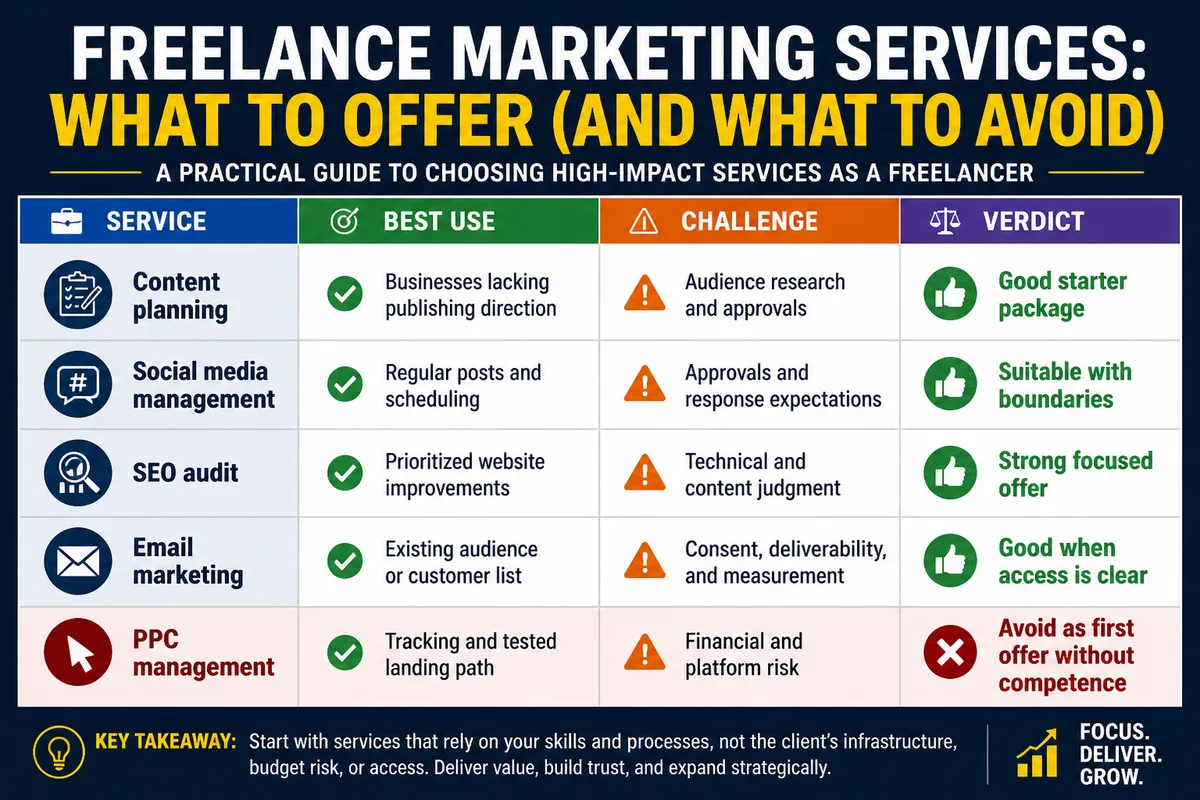
Different services carry different delivery risks, access requirements, and measurement challenges, so the easiest first offer is the one you can complete consistently for a defined customer. A narrow audit or production package usually gives a beginner more control than a promise covering every marketing channel.
Choose control first.
Reject vague scope.
| Service | Best starting use | Main delivery challenge | Beginner verdict |
|---|---|---|---|
| Content planning | Businesses lacking a consistent publishing direction | Requires audience research and approval discipline | Good first package when strategy is clearly limited |
| Social media management | Organizations needing regular posts and scheduling | Frequent approvals, brand voice, and response expectations | Suitable with a fixed calendar and response boundaries |
| SEO audit | Businesses seeking prioritized website improvements | Recommendations require technical and content judgment | Strong starter offer when recommendations are specific |
| Email marketing | Businesses with an existing audience or customer list | Consent, deliverability, copy, and measurement | Good fit when list access and compliance are clear |
| PPC management | Businesses with tracking, budget, and a tested landing path | Financial risk and platform-dependent performance | Do not make it the first offer without campaign competence |
Common Mistakes to Avoid
Early marketing businesses usually lose time through unclear positioning, uncontrolled scope, weak qualification, or unsupported claims rather than through a lack of sophisticated software. Each mistake increases delivery pressure or makes the first sales conversation harder.
Fix the process early.
Protect your reputation.
- Offering every service: prospects cannot understand your specialty, so they struggle to connect your work with their problem. Start with one primary offer and add services only after repeated demand.
- Using fabricated proof: invented results or testimonials create ethical, contractual, and reputational risk. Label practice work clearly and describe only outcomes you can verify.
- Sending generic outreach: copied messages feel irrelevant and encourage spam-like behavior. Mention one genuine, public observation and contact only relevant prospects.
- Accepting undefined revisions: endless changes consume unpaid time and damage the relationship. Set revision limits, approval stages, and change-request terms in the proposal.
- Buying tools before validating demand: subscriptions create fixed costs before revenue exists. Use a lean setup and purchase specialized software when a real project requires it.
The strongest early decision is often a refusal. Do not accept a project whose result depends on access, skills, compliance, or budget that neither side has confirmed.
Protect the first relationship.
Final Checklist for Launching From Home
You are ready to begin prospecting when your business has a focused audience, a defined offer, honest proof, a basic operating process, and a verified local setup. The first client still requires a sales conversation, so treat outreach as a process of learning and qualification rather than a promise of immediate income.
Check each item.
Start with one offer.
- Choose one niche or clearly defined customer group.
- Describe one problem your service addresses.
- Define deliverables, exclusions, revisions, and approval stages.
- Create one truthful sample or portfolio example.
- Verify registration, tax, zoning, insurance, and privacy requirements locally.
- Separate business records and payment administration.
- Prepare a short prospect list with a reason for each contact.
- Use warm outreach before increasing cold outreach volume.
- Qualify access, authority, timeline, budget process, and success measures.
- Use a written proposal and contract before substantial delivery.
- Track meaningful baseline and outcome data.
- Ask for feedback and referrals only after delivering useful work.
A home-based marketing business becomes easier to manage when every promise has a matching process, every service has a defined boundary, and every client conversation begins with a real business problem.