First Job Money Tips for Your First Full-Time Paycheck
First Job Money Tips for Your First Full-Time Paycheck
First job money tips work best when you treat your first full-time paycheck like a system, not a reward. Start by checking your take-home pay, covering fixed bills, sending money to savings automatically, and keeping debt payments on schedule. That order gives you control before lifestyle creep and surprise costs take over.
A starter salary does not need a perfect spreadsheet. You need a simple budget, a small emergency cushion, and one retirement habit that is easy to repeat. The practical steps below show how to split pay, handle student loans, and avoid common first-year mistakes without advanced finance knowledge.
Quick summary
💡 Start with take-home pay: your budget should be based on what actually reaches your bank account.
🧾 Cover the basics first: rent, food, transport, insurance, and minimum debt payments come before lifestyle upgrades.
🛟 Build a cushion early: a small emergency fund prevents one broken car or medical bill from becoming credit card debt.
📈 Capture free retirement money: if your employer matches 401(k) contributions, try not to leave that match unused.
How should you read your first paycheck?
Your first paycheck is the amount you can actually spend after taxes and deductions, not the salary in your offer letter. The number that matters for first job money tips is take-home pay, because rent, groceries, and savings all come from that net amount. If the paycheck looks smaller than expected, the reason is usually withholding, benefits, and retirement contributions.
| Paycheck line | What it means | What to do |
|---|---|---|
| Gross pay | Your salary before deductions | Use it to compare job offers, not to budget daily spending |
| Federal and state tax withholding | Money set aside for income taxes | Check your W-4 if the withholding looks far off |
| Payroll taxes | Social Security and Medicare contributions in the US | Expect these to reduce your net pay every period |
| Health insurance and benefits | Premiums for medical, dental, or vision plans | Read the benefits guide so you know what is covered |
| Retirement contributions | Money sent to a 401(k) or similar plan | Keep this if you can, because it builds the habit early |
| Net pay | The amount deposited into your account | Base your budget on this figure only |
- Check the pay frequency: weekly, biweekly, or monthly changes how fast money arrives.
- Confirm the deposit account: make sure your direct deposit goes where you expect.
- Review the first paystub: compare the gross pay, deductions, and net pay line by line.
- Look for one-time items: sign-on bonuses, relocation help, or reimbursements may not repeat.
Your first salary is not permission to spend every new dollar in week one. It is the raw material for a system that has to cover bills, savings, debt, and the life you want next year.
How should you split your first paycheck?
A good starting split is to pay essentials first, then savings, then debt, then flexible spending. A simple first paycheck budget often works better than a rigid rule because your rent, loan payment, and commute may eat a larger share of income in the first year. For many beginners, a 50/30/20-style framework is useful as a guide, not a law.
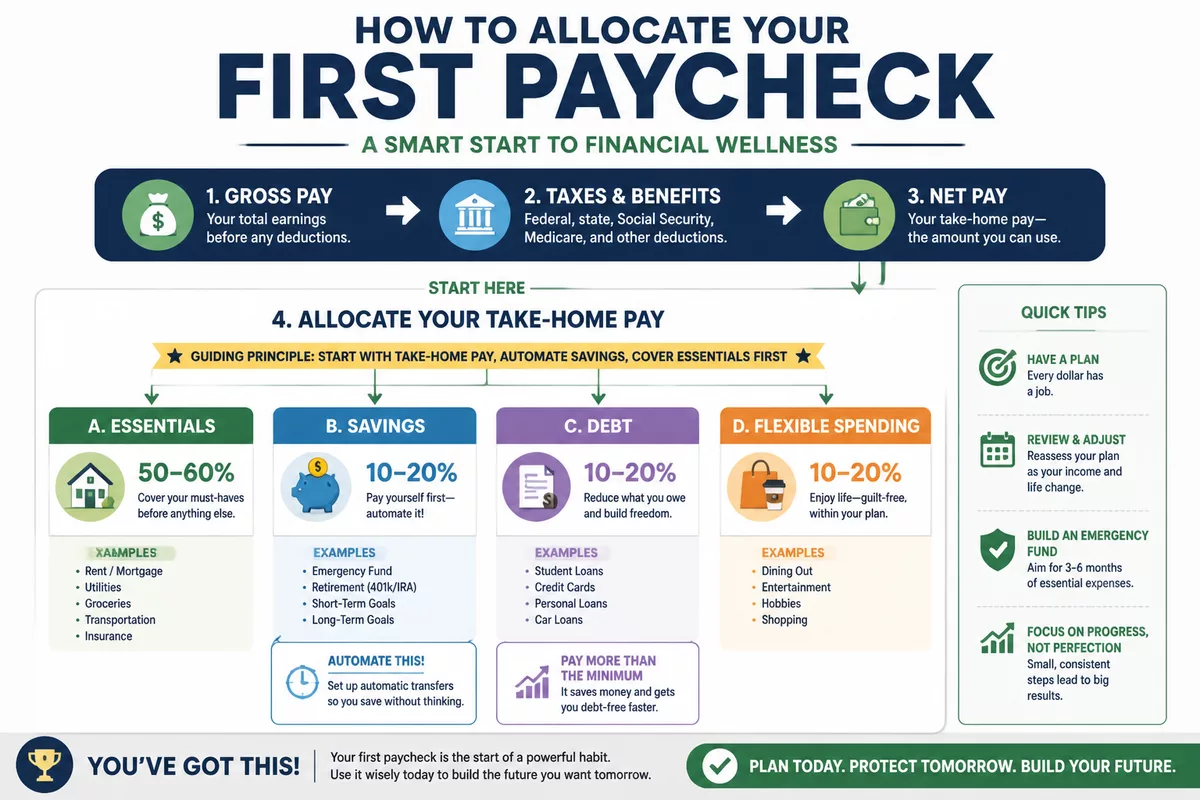
For example, if your take-home pay is $2,500 a month, a simple starter budget could look like this: $1,400 for essentials, $500 for savings, $300 for debt payments, and $300 for flexible spending. That example is only a planning tool, but it helps you see whether your current lifestyle fits your actual income.
| Budget model | Best for | Main risk |
|---|---|---|
| 50/30/20 | People with moderate fixed costs | Can feel tight if rent is high |
| 60/20/20 | First-job earners with expensive basics | Less room for wants in the short term |
| Essentials-first custom budget | Anyone with student loans or high rent | Requires honest tracking of fixed costs |
- List your fixed bills first: rent, utilities, transport, insurance, and minimum debt payments.
- Set a savings transfer on payday so the money moves before you can spend it.
- Cap flexible spending for restaurants, shopping, and entertainment.
- Review the budget after one month and adjust the numbers that are too optimistic.
- Repeat the same process every payday so the plan becomes automatic.
How much emergency savings should you build first?
An emergency fund is the cash you keep for shocks such as car repairs, medical bills, or a gap between jobs. For first job money tips, the best starting target is enough to cover three to six months of essential expenses, which matches guidance commonly shared by personal finance educators and employers’ financial planning resources. If your essentials run $2,400 a month, a three-month cushion is about $7,200.

The most useful version of an emergency fund is boring and easy to reach. Keep it in a separate savings account, not in your checking account where daily spending can eat it by accident. Many young adults start by saving a small amount every payday until the balance becomes large enough to absorb a real surprise.
A small emergency fund does one simple job: it stops one bad month from becoming a credit card balance that follows you for years.
- Keep the money separate from spending accounts.
- Use a liquid account so you can access it quickly.
- Fund it with automatic transfers after each payday.
- Pause nonessential upgrades until you have at least a starter cushion.
How should you handle student loans and other debt?
Debt management works best when you keep the minimums current and avoid late fees, then send extra money to the highest-cost debt you have. For many first-job earners, student loans are the biggest question, and the right move is usually to know your repayment start date, monthly amount, and servicer before the first bill arrives.
| Debt type | First move | Why it matters |
|---|---|---|
| Student loans | Confirm the repayment date and payment amount | Missed timing can lead to unnecessary stress and fees |
| Credit card balance | Pay more than the minimum whenever possible | Card interest can grow fast if the balance stays open |
| Auto loan | Keep the payment on schedule | A car payment plus insurance can take a big share of a starter salary |
| Buy-now-pay-later plans | Track due dates carefully | Multiple small payments can crowd out your budget |
If your student loans are still in a grace period, use that time to prepare instead of ignoring the debt. Confirm whether interest is building, set up reminders, and decide how much extra you can pay once the official repayment begins. A first-job budget works better when student loan repayment basics are handled before the first surprise bill.
- Pay at least the minimum on every debt to protect your credit history.
- Send extra money to the highest-interest balance if you can afford it.
- Ask your servicer about autopay discounts and repayment options.
- Avoid using credit cards to cover ordinary monthly living costs.
Should you start retirement saving right away?
Yes, if your employer offers a retirement plan and the budget allows even a small contribution. A 401(k) is an employer-sponsored retirement account, and any company match is part of your compensation. The cleanest first-job money tip here is simple: get the match if you can, then increase your contribution later as your pay grows.
Starting small beats waiting for a perfect month. A tiny retirement contribution today can become a lifelong habit, and the habit is often more valuable than the first percentage point itself.
When cash flow is tight, a modest contribution is still useful because it teaches your paycheck to work for the future. If your employer matches contributions, that match is usually worth more than leaving the money unclaimed in checking. If your budget is extremely tight, start low, but keep the plan active so you can raise it after your next review.
- Read the employer benefits guide and check the matching rule.
- Choose a contribution rate you can keep without missing bills.
- Increase the rate after raises, bonuses, or lower fixed costs.
- Verify whether your account uses pre-tax or Roth contributions.
- Revisit the rate once a year so it does not stay stuck forever.
What money habits should you automate in month one?
Automation is one of the strongest first job money tips because it removes the need to make the same decision every payday. If savings, bill payments, and retirement contributions happen on schedule, you are less likely to spend first and regret later. A beginner-friendly system usually needs only one checking account, one savings account, and a few scheduled transfers.
- Direct deposit your paycheck into checking or split it between checking and savings.
- Auto-pay fixed bills so you do not miss due dates.
- Automatic transfers move money to savings on payday.
- Auto-increase retirement contributions after a raise if your plan allows it.
- Calendar reminders help you review your budget once a month.
A clean setup also reduces mental load. You do not need to guess whether you can afford a restaurant dinner when the savings transfer already happened and the rent money already moved out of the spendable account. That structure is what gives many young adults control during the first six to twelve months of work.
What money mistakes should you avoid in your first year?
The biggest mistake is lifestyle inflation, which means upgrading every expense the moment income rises. A first job can make it tempting to rent a more expensive apartment, buy a newer car, and spend more on nights out at the same time. A stronger move is to upgrade slowly so your budget grows under control instead of racing ahead of your pay.
| Mistake | Why it happens | Better move |
|---|---|---|
| Spending the first paycheck too fast | It feels like free money after a long search for work | Wait until the budget is written and the bills are listed |
| Ignoring retirement benefits | Retirement feels far away | Check the match and contribute enough to capture it if possible |
| Carrying a credit card balance | Minimum payments feel manageable at first | Pay in full when you can, or reduce the balance aggressively |
| Forgetting irregular costs | Annual fees and travel are easy to overlook | Create a sinking fund for predictable but nonmonthly expenses |
| Upgrading housing too quickly | Rent feels like the obvious sign of adulthood | Keep housing within a range that still leaves room for savings |
Another easy mistake is treating every raise like a license to spend more immediately. A better pattern is to split each raise into three parts: one part improves your lifestyle, one part boosts savings, and one part strengthens debt repayment or retirement. That way, your money management improves every time your income grows.
Which sources should you check for your exact numbers?
Use official or employer-specific sources for anything that changes by payroll, state, benefit plan, or loan type. Your paystub, benefits portal, tax forms, student loan servicer, and retirement provider will give you the numbers that matter for your situation. Generic advice is useful for direction, but these sources are better for exact deductions and deadlines.
- Your payroll portal: confirms gross pay, deductions, and direct deposit details.
- Your benefits guide: explains health insurance, retirement match, and payroll deductions.
- IRS or local tax resources: help you understand withholding and tax forms.
- Your student loan servicer: shows repayment dates, balances, and plan options.
- Your 401(k) or retirement provider: shows match rules, investment options, and contribution limits.
That source check is especially useful if your paycheck looks lower than expected, if your student loan bill is about to start, or if your employer match has a vesting rule. Those details can change the best decision quickly, so it pays to verify them before you adjust your budget.
A first year of work is not about being perfect with money. It is about building a repeatable order that keeps bills paid, savings growing, debt under control, and retirement on track. Once that order is in place, every raise becomes easier to manage.
Key points
- 💳 Base your budget on take-home pay, not the salary shown in the offer letter.
- 🧩 Cover essentials first, then savings, then debt, then flexible spending.
- 🛟 Build an emergency fund in a separate account and fund it automatically.
- 📈 Take any employer match on retirement contributions whenever your budget allows.
- 🚫 Avoid lifestyle inflation and credit card balances that turn into long-term drag.
FAQ
How much should I save from my first paycheck?
A practical starting point is to save something right away, even if the amount is small. Many first-job money tips use 10% to 20% of take-home pay as a target range, but the right number is the one that still lets you pay essentials and avoid new debt. If that feels too high, start lower and raise it after one or two pay cycles.
Should I save or pay off debt first?
Do both in a balanced way. Keep minimum payments current, then build a starter emergency fund so one surprise expense does not force more borrowing. After that, send extra money to the highest-interest debt. That order protects you from fees, late payments, and new credit card balances.
Is the 50/30/20 rule good for a first job?
Yes, as a rough guide. The 50/30/20 rule can help beginners separate needs, wants, and savings, but a first salary may not fit it perfectly if rent or student loans are high. Use it as a starting framework, then adjust the percentages to match your real fixed costs.
How much rent can I afford on a starter salary?
A simple rent rule is to keep housing low enough that you can still save, pay debt, and cover daily living costs. A cheaper apartment often gives you more room to build an emergency fund and handle irregular expenses. If rent leaves you unable to save anything, the apartment is probably too expensive for your current stage.
What if my first paycheck is smaller than expected?
That usually means taxes, insurance, or retirement contributions were withheld from gross pay. Review the paystub line by line, compare it with your offer letter, and ask payroll if anything looks wrong. A smaller paycheck is not always a mistake, but it should be understood before you build your budget around it.