The 50/30/20 Budget Rule Explained: A Simple Monthly Example
The 50/30/20 Budget Rule Explained: A Simple Monthly Example
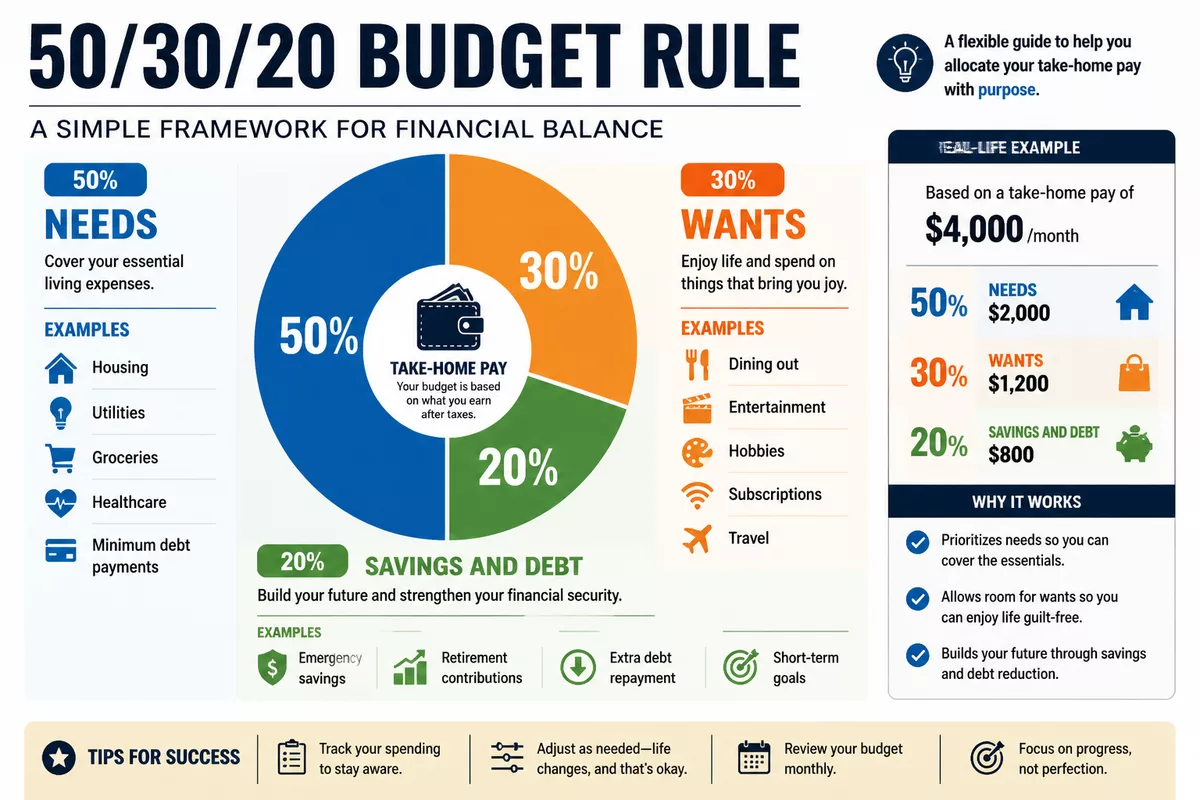
The 50/30/20 budget rule divides take-home income into three flexible targets: 50% for needs, 30% for wants, and 20% for savings or extra debt repayment. The percentages are guidelines, not requirements, so a household can adjust them when housing, childcare, healthcare, debt, or income makes the standard split unrealistic.
This guide shows how to calculate the amounts, classify common expenses, and compare the targets with a real monthly spending plan. The $4,000 example is hypothetical and educational; your own budget should reflect the cash that reaches your account and the priorities you must handle first.
Quick Summary
💵 Start with monthly take-home pay, not gross salary, for most household spending plans.
🏠 The standard targets are 50% needs, 30% wants, and 20% savings or extra debt repayment.
🧭 Treat the 50/30/20 budget rule as a diagnostic guide. A different split may be more realistic when essential costs are high.
📅 Review actual spending monthly and use sinking funds for annual bills, repairs, gifts, and other irregular costs.
What Is the 50/30/20 Budget Rule?
The 50/30/20 budget rule is a monthly budgeting framework that assigns take-home income to essential costs, discretionary spending, and financial goals. The method gives each dollar a broad purpose without requiring every purchase to fit a rigid universal formula.
The 50/30/20 split is a starting point for comparing your spending with your priorities, not a pass-or-fail test.
The framework works best when the categories reveal where money is going and what could be adjusted. A household with high rent may exceed 50% for needs, while a household with lower essential costs may direct more than 20% toward savings or debt repayment.
The Three Budget Percentages at a Glance
| Category | Target | Typical contents | Important limit |
|---|---|---|---|
| Needs | 50% | Housing, groceries, utilities, healthcare, insurance, transportation, and minimum debt payments | Essential costs may exceed the target |
| Wants | 30% | Dining out, entertainment, hobbies, travel, subscriptions, and nonessential shopping | Wants are planned choices, not automatically wasteful spending |
| Savings and debt | 20% | Emergency savings, retirement contributions, other goals, and extra debt repayment | The exact mix depends on cash reserves, debt costs, and household priorities |
Needs are expenses required for basic living, health, work, or contractual obligations. Wants are flexible purchases that improve lifestyle but can usually be postponed or reduced. Savings and debt repayment cover money directed toward future security or payments above required minimums.
How Do You Calculate a 50/30/20 Budget From Take-Home Pay?
Use monthly after-tax income as the clearest starting point for most spending plans. Multiply that amount by 0.50, 0.30, and 0.20 to calculate the three target amounts before comparing them with actual expenses.
- Identify take-home pay: use the amount that reaches your bank account after taxes and regular payroll deductions.
- Calculate the needs target: multiply monthly take-home pay by 0.50.
- Calculate the wants target: multiply monthly take-home pay by 0.30.
- Calculate the savings and debt target: multiply monthly take-home pay by 0.20.
- Compare actual spending: classify expenses honestly, then decide whether the difference requires a change.
For example, a hypothetical monthly take-home income of $4,000 produces a $2,000 needs target, a $1,200 wants target, and an $800 savings and debt target. The arithmetic is simple; the judgment comes from deciding what each expense represents in your household.
Take-Home Pay Versus Gross Income
Gross income is pay before taxes and deductions. Take-home pay, also called net income, is the amount available after deductions have been applied.
Budgeting from take-home pay is usually more practical because the figure reflects cash available for current bills. Payroll deductions such as retirement contributions, health insurance, or flexible spending accounts may already support financial goals or essential costs, so record them consistently rather than counting the same money twice.
People with freelance, seasonal, commission-based, or irregular income can estimate an average monthly amount from several recent months. A conservative estimate or lower-income baseline is safer for essential bills than assuming every future month will match the highest recent payment.
Bonuses, tax refunds, gifts, and other one-time income should not automatically be treated as regular monthly pay. Assigning those amounts separately can help fund an emergency reserve, annual bill, debt repayment, or short-term goal without overstating recurring income.
What Counts as a Need, a Want, or Savings and Debt Repayment?
An expense belongs in a category according to its purpose and the household’s circumstances, not only its payment frequency. Rent is usually a need, a restaurant meal is usually a want, and a payment above a required debt minimum is commonly tracked with savings and other financial goals.
The 50% Needs Category
Needs generally include housing, basic utilities, groceries, essential transportation, insurance, healthcare, work-related childcare, and minimum contractual debt payments. A rent or mortgage payment remains a need even when the amount is higher than the 50% guidepost.
- Housing and basic household utilities
- Essential groceries and household supplies
- Transportation required for work, education, or necessary appointments
- Health insurance, medical care, and essential prescriptions
- Childcare required to maintain employment
- Minimum payments required by loan or credit agreements
Food classification requires some judgment. Basic groceries generally support the needs category, while restaurant meals, delivery fees, convenience purchases, and premium upgrades are usually wants. A mixed grocery trip can be divided when the distinction matters for decision-making.
The 30% Wants Category
Wants are planned discretionary spending rather than evidence of irresponsible behavior. Dining out, entertainment, hobbies, nonessential clothing, subscriptions, travel, and lifestyle upgrades commonly fit this category.
Recurring does not mean essential. A streaming subscription may be a want even though it appears every month, while a mobile plan may contain both an essential service and an optional upgrade. Classifying only the necessary portion as a need can produce a more useful budget.
Wants can also be reduced temporarily when essential costs rise or debt repayment becomes urgent. The purpose is not to eliminate all enjoyment, but to make flexible spending respond to more pressing priorities.
The 20% Savings and Debt Category
The savings and debt category can include emergency savings, retirement contributions, other savings goals, and extra payments on debt. Required minimum payments are often treated as needs because they protect the account from becoming delinquent, while additional repayment is commonly assigned to the financial-goal category.
Minimum debt payments protect current obligations; extra payments represent a separate decision about future financial progress.
The appropriate mix depends on the household’s emergency cushion, debt interest rates, employer benefits, and short-term needs. A person with no cash reserve may prioritize building a basic buffer, while another household may direct more available money toward expensive debt after considering its full circumstances.
Common Expenses That Need Judgment
Some expenses cannot be classified correctly without understanding their purpose. A basic insurance policy may be a need, while additional coverage may be optional; childcare may be essential for work, while occasional babysitting for leisure may be a want.
| Expense | Possible classification | Useful question |
|---|---|---|
| Mobile plan | Need plus want | Which portion provides necessary communication, and which portion is an upgrade? |
| Annual insurance premium | Need with sinking fund | Can the yearly bill be divided into monthly contributions? |
| Vacation | Want or savings goal | Is the money being spent now or set aside for a future trip? |
| Home repair | Need or planned reserve | Is the repair required for safety or merely an optional improvement? |
| Subscription | Usually want | Is the service necessary for work, education, communication, or health? |
A sinking fund is a monthly amount reserved for a bill that does not arrive every month. Setting aside one-twelfth of an expected annual cost is a useful planning approach when the annual amount is known, although the contribution should be adjusted when the bill or timing is uncertain.
A $4,000 Monthly 50/30/20 Budget Example
For a hypothetical $4,000 monthly take-home income, the standard targets are $2,000 for needs, $1,200 for wants, and $800 for savings and debt repayment. The figures below are illustrative assumptions, not a recommended spending plan or a prediction of typical household costs.
| Category | Example line items | Monthly total | Share of income | Comparison with target |
|---|---|---|---|---|
| Needs | Housing $1,250; utilities $180; groceries $350; transportation $120; insurance $70; healthcare $30 | $2,000 | 50% | At target |
| Wants | Dining out $250; entertainment $150; subscriptions $60; clothing $140; hobbies $200; flexible spending $400 | $1,200 | 30% | At target |
| Savings and debt | Emergency fund $250; retirement $300; extra debt payment $150; short-term goal $100 | $800 | 20% | At target |
Example Needs Budget: $2,000 Target
The example assigns $1,250 to housing, $180 to utilities, $350 to groceries, $120 to transportation, $70 to insurance, and $30 to healthcare. The total is exactly $2,000, although many households would face different housing, healthcare, family, or regional costs.
When essential costs exceed the target, the result is information rather than failure. The next step is to review flexible spending and recurring commitments without assuming that housing, healthcare, or childcare can be reduced immediately.
Example Wants Budget: $1,200 Target
The example preserves discretionary spending through dining out, entertainment, hobbies, clothing, subscriptions, and flexible purchases. If essential costs increase, flexible spending such as dining out, subscriptions, or unplanned shopping could be reviewed before cutting basic food or required medical care.
The 30% figure is not an entitlement that must be spent. A household can spend less on wants and redirect the difference toward a reserve, debt repayment, or a planned expense.
Example Savings and Debt Budget: $800 Target
The example divides $800 between an emergency fund, retirement savings, an extra debt payment, and a short-term goal. The exact allocation depends on the household’s current cash reserve, debt terms, employer benefits, and upcoming obligations.
Savings do not have to equal exactly 20% every month for the framework to remain useful. A lower amount may be realistic during a difficult period, while a higher amount may be possible after essential costs fall or income rises.
What Should You Do When Your Budget Does Not Fit 50/30/20?
Use the 50/30/20 budget rule as a diagnostic tool rather than a test that a household must pass. When needs exceed 50%, protect essential bills first, identify flexible costs, and set a temporary ratio that reflects reality instead of forcing the numbers to look balanced.
When Needs Are More Than 50%
High housing costs, childcare, healthcare, family size, and regional price differences can push needs above the guideline. A household might temporarily use a higher needs share and a lower wants or savings share while reviewing available changes over time.
Reducing flexible subscriptions, restaurant spending, premium services, or optional transportation costs may help, but not every essential expense can be cut quickly. The budget should show the constraint clearly so that decisions focus on realistic changes rather than guilt.
When High-Interest Debt Is the Main Priority
High-cost debt may change how available money is divided between extra repayment, savings, and wants. Maintaining some emergency cushion can help prevent a small unexpected bill from creating new debt, while additional repayment decisions should account for the debt terms and household cash flow.
Track minimum payments separately from extra payments. A debt payoff strategy that suits one household may not suit another, especially when income is unstable, essential bills are overdue, or several obligations have different terms.
When Income Changes Each Month
Variable-income households can base the core budget on a conservative average or minimum expected income. Essential bills should be funded first, while surplus income can be assigned after the month ends to savings, debt repayment, annual expenses, or carefully planned wants.
Sinking funds reduce the impact of uneven pay and irregular bills. A shared household budget can use the same categories, but partners should agree on whether shared expenses, personal spending, and individual debts are tracked together or separately.
Common Mistakes to Avoid
- Using gross pay: gross income can make the targets look larger than the cash actually available for bills.
- Calling every recurring expense a need: a monthly payment can still be a discretionary subscription or upgrade.
- Counting all debt payments the same way: minimum obligations and extra repayment have different budgeting purposes.
- Ignoring annual expenses: insurance renewals, repairs, gifts, and travel can disrupt a monthly plan when no sinking fund exists.
- Protecting the percentages over essential bills: the framework should not encourage skipping housing, healthcare, food, utilities, or required minimum payments.
For readers building a budget from scratch, these beginner personal finance steps can provide useful background before applying percentage targets.
How Can You Build and Review Your Own 50/30/20 Budget?
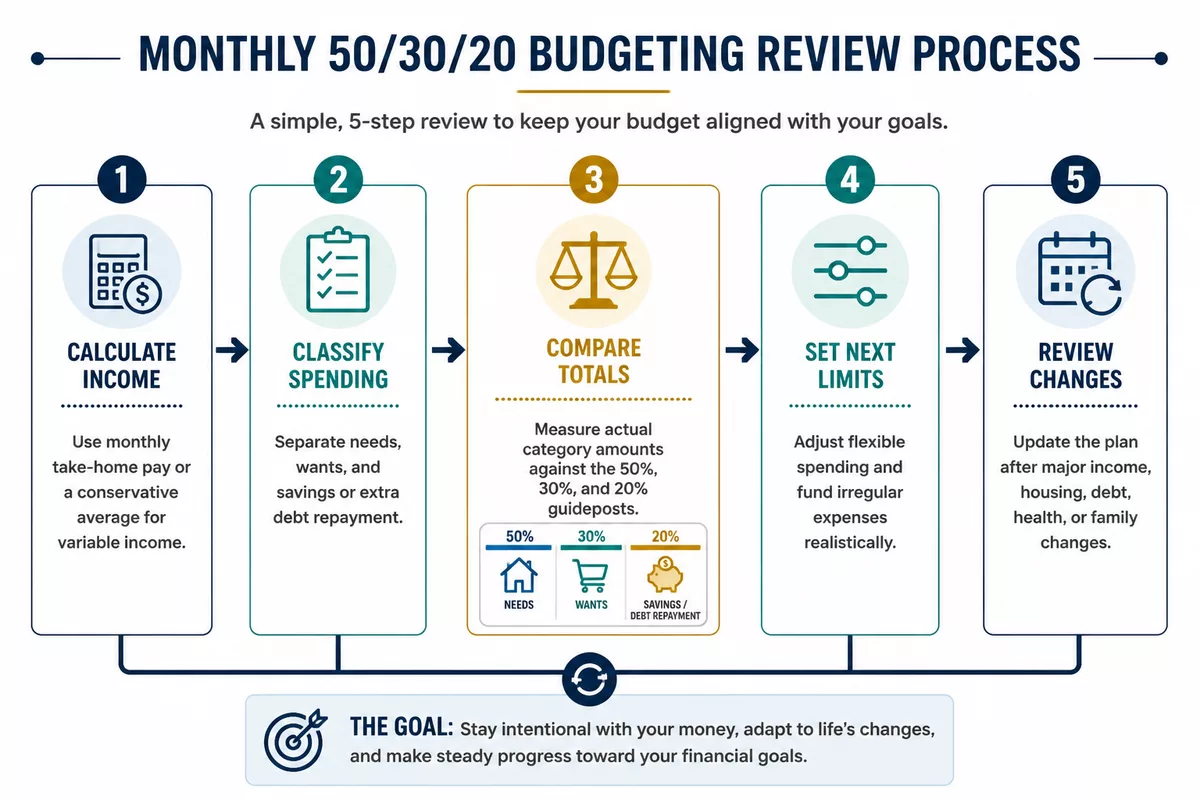
Build the plan by calculating available income, classifying recent spending, comparing actual totals with the guideposts, and assigning a realistic limit for the next month. A short review each month is usually enough to identify changes, while a more detailed review helps after a major shift in income, housing, debt, health, or family responsibilities.
A Practical Monthly Review Checklist
- Calculate or update average take-home income.
- List current expenses and classify each item as a need, want, or savings and debt repayment.
- Compare actual category totals with the 50/30/20 guideposts.
- Set realistic limits for the next month and add irregular expenses to sinking funds.
- Record what changed and adjust the percentages when circumstances require it.
Automation can help direct money toward savings or debt goals, but transfers should match actual cash flow. Essential bills and near-term obligations need to be covered before an automated transfer creates an avoidable shortfall.
A simple spending tracker may be enough for stable income, while a zero-based budget can offer more control when every dollar has a specific assignment. A priority-based budget or spending cap may suit someone whose income varies sharply from month to month.
Readers starting a first full-time job can also review these first-paycheck budgeting considerations before setting recurring transfers or lifestyle limits.
Which Budget Method Should You Compare With 50/30/20?
The 50/30/20 budget rule is useful when you want broad boundaries, but other methods may fit different cash-flow problems. The right comparison depends on whether your main challenge is overspending, irregular income, complex bills, or the need to assign every dollar.
| Method | Best suited to | Main strength | Limitation |
|---|---|---|---|
| 50/30/20 | People seeking broad monthly guideposts | Simple categories and quick comparisons | May not fit high essential costs |
| Zero-based budget | Households with tight or complex cash flow | Assigns every dollar a specific purpose | Requires more tracking and maintenance |
| Priority-based budget | People with variable income or changing obligations | Funds urgent needs and goals before lower priorities | May provide less routine spending structure |
| Spending-cap method | People who need a simple limit for discretionary spending | Easy to operate without detailed categorization | Can overlook annual bills and savings goals |
Choose the 50/30/20 budget rule when percentage guideposts make planning easier. Choose a zero-based approach when unassigned dollars repeatedly disappear, and use a priority-based structure when income or essential expenses change too much for stable percentages.
Key Takeaways
- 💵 Use take-home pay as the practical starting point for most monthly spending plans.
- 🏠 Treat 50% needs, 30% wants, and 20% savings as flexible guideposts.
- 🧾 Separate minimum debt payments from extra repayment when classifying expenses.
- 📊 Compare actual spending with the targets before deciding what to change.
- 🔁 Review the plan monthly and adapt it after major financial or household changes.
Frequently Asked Questions
Should I use gross income or take-home pay for the 50/30/20 budget rule?
Use take-home pay for most monthly spending plans because it reflects the cash available after taxes and regular deductions. Record payroll deductions consistently so retirement contributions or insurance costs are not counted twice.

Is rent part of the 50% needs category?
Rent is generally a need because housing is an essential expense. If rent pushes needs above 50%, use a customized split rather than treating the guideline as a reason to compromise essential housing.
Does debt repayment belong in the 20% category?
Minimum required payments are often treated as needs because they are contractual obligations. Extra payments above the minimum are commonly assigned to the 20% savings and financial-goal category, provided the classification remains consistent throughout the budget.
Is the 50/30/20 rule realistic for everyone?
No. Housing costs, income level, family responsibilities, healthcare, childcare, and debt can make the standard percentages impractical. The rule is more useful as a flexible benchmark than as a universal standard.
How often should I update my 50/30/20 budget?
A short monthly review helps compare actual spending with the planned categories. Complete a more detailed review after a major change in income, housing, debt, health, or household responsibilities.