Is $5,000 Enough for a Trip? Realistic Budgets for Every Travel Style
Is $5,000 enough for a trip? In many cases, yes—but the answer changes sharply with the destination, number of travelers, trip length, airfare and travel style. A solo traveler may turn that amount into a comfortable international trip or several weeks of slower travel, while a family may use most of it on flights, rooms and transportation.
For the examples below, the $5,000 travel budget includes round-trip transport, accommodation, food, local transportation, activities, travel insurance, connectivity, fees and a contingency reserve. These are planning scenarios rather than current price promises, so you should replace each estimate with live quotes for your departure city and dates.
Quick Summary
- ✈️ $5,000 can fund a one-week comfortable trip for one person, a value-focused couple trip or a carefully planned family vacation.
- 🧮 Flights, accommodation and traveler count matter more than small daily savings. A low-cost destination can still become expensive when airfare is high.
- 🛏️ Couples can share some costs, but flights, meals, insurance and attraction tickets remain largely per person.
- 🛡️ Reserve roughly 10% to 15% when feasible instead of treating the entire amount as spending money.
The short answer: what a $5,000 travel budget can realistically cover
A $5,000 budget can cover many trips, but not the same trip for every traveler. It may support a one-week mid-range vacation for one person, a comfortable couple trip in a moderate-cost destination, or a shorter family vacation with controlled transport and accommodation costs. A high-cost destination, peak season or several travelers can reduce the duration quickly.
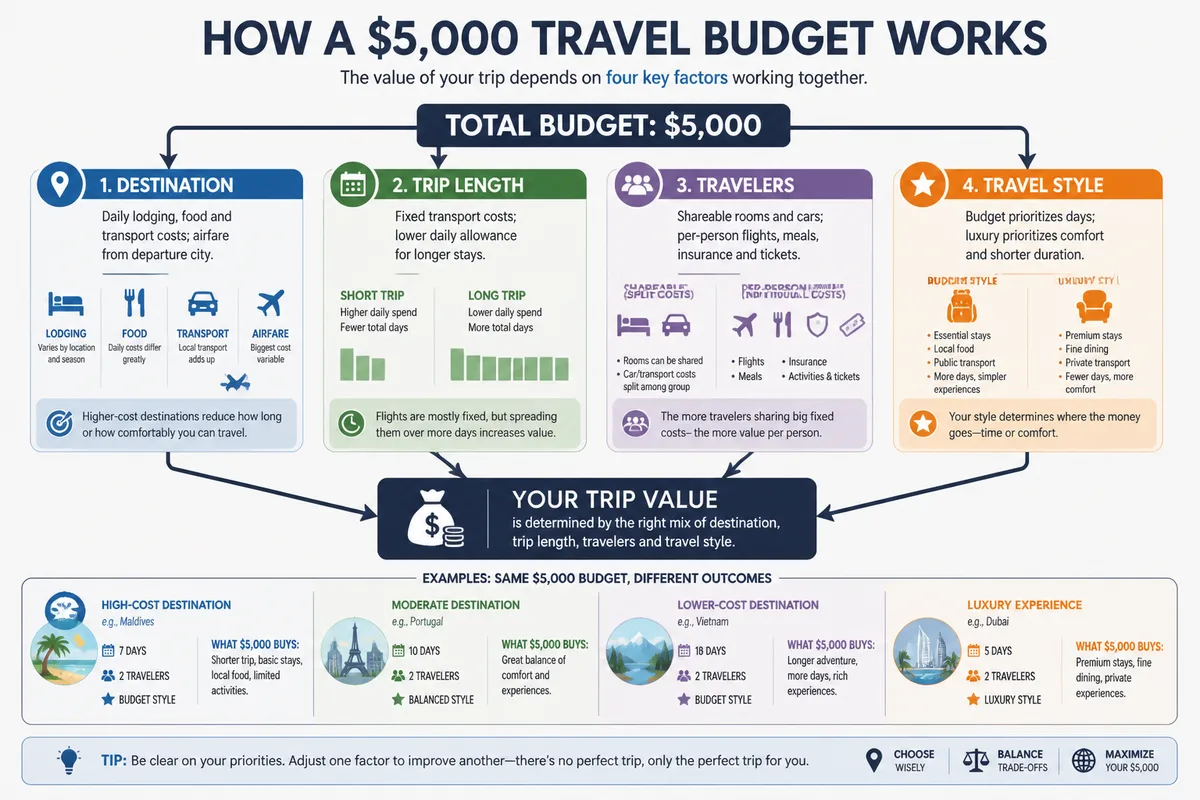
For a useful comparison, treat $5,000 as the complete trip fund rather than the amount available after booking flights. That means including airfare or other long-distance transport, lodging, meals, local travel, activities, insurance, mobile data, taxes, baggage and an emergency reserve. If flights are already paid, record them separately and do not compare that trip directly with an airfare-included example.
A solo traveler generally has the greatest flexibility because one room, one airfare and one set of meals can be adjusted independently. Two travelers can share a room or rental car, but four travelers multiply transport, food and admission costs. Families also need to account for larger rooms, child fares, school-holiday pricing and activities suitable for different ages.
The four variables that decide how far $5,000 goes
Destination cost, trip length, traveler count and travel style interact. A cheap room does not compensate for four expensive airfares, and a short luxury stay may cost more than a month of simple travel. Season, exchange rates, departure airport and booking lead time can shift the result before you choose a restaurant or excursion.
Destination and season set the baseline daily cost
Lower-cost, moderate-cost and high-cost destinations can all produce viable $5,000 trips, but they do so through different compromises. Parts of Southeast Asia, Central America, Eastern Europe and selected domestic regions may offer lower lodging, food and local transportation costs, while major cities, islands and high-cost countries often require a shorter itinerary or fewer paid experiences.
Peak season, major events and last-minute bookings can affect both flights and accommodation at the same time. A shoulder-season visit with fewer internal flights may preserve more money than choosing a distant destination that appears inexpensive once you arrive. Check official tourism pages, airline prices and accommodation totals for the exact dates before treating a destination as affordable.
Travelers and trip length change the daily math
Use this calculation after identifying unavoidable costs: daily allowance = ($5,000 − fixed costs − contingency reserve) ÷ trip days. Fixed costs include flights, deposits, visas or entry requirements, insurance and major transfers; the daily allowance then covers lodging, food, local transport, activities, tips, mobile data and exchange fees.
For example, a hypothetical solo traveler who sets aside $600 for a reserve and $1,400 for transport and other fixed costs has $3,000 left. Over 14 days, that equals about $214 per day for accommodation, food, local travel and activities. This is a planning illustration, not a current destination price.
Couples often reduce the accommodation cost per person by sharing a room, but the saving is limited when both travelers need separate airfares, meals, insurance and attraction tickets. Families can exhaust the budget faster because airfare and room requirements grow with each additional traveler.
Travel style determines where compromises happen
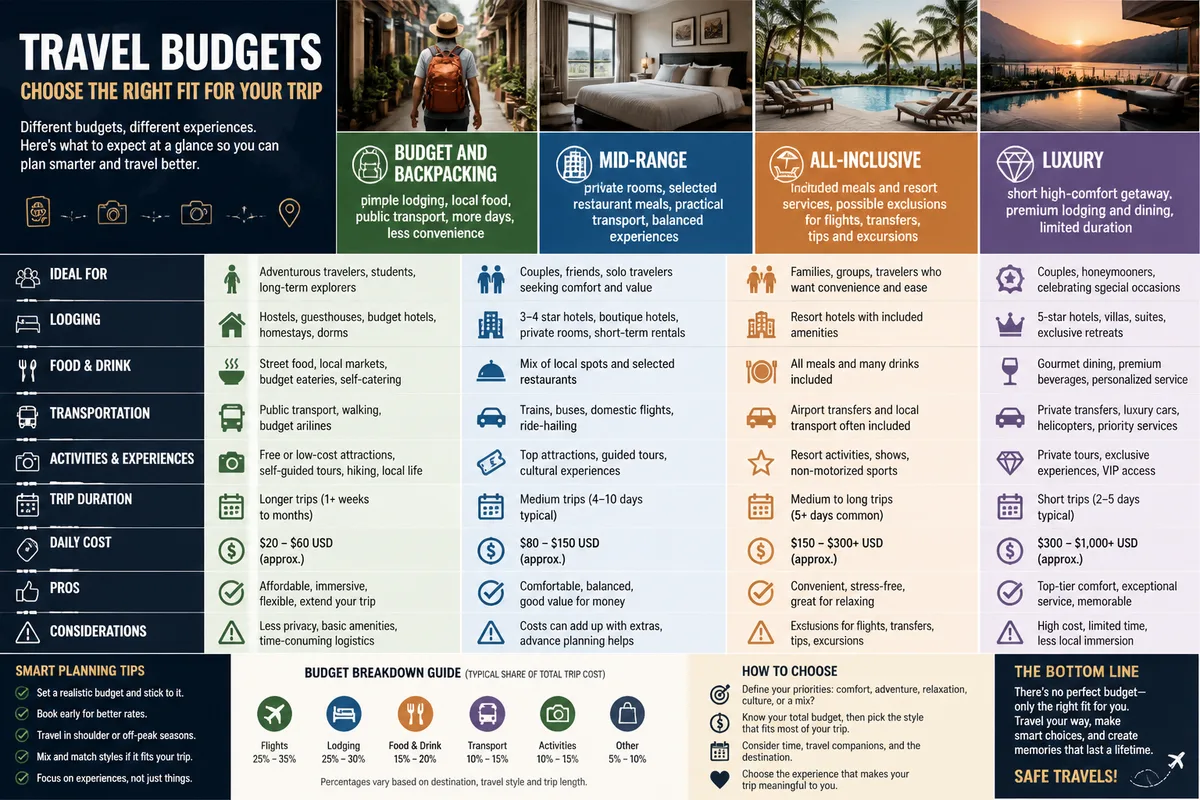
Budget travel usually means hostels or simple guesthouses, public transportation, local food and fewer paid tours. Mid-range travel adds private rooms, selected restaurant meals and practical guided activities. All-inclusive travel exchanges flexibility for predictable resort services, while luxury travel concentrates the budget on premium rooms, transfers, dining and curated experiences.
A luxury label is meaningful only when the calculation includes airfare, transfers, taxes, resort fees, tips and excursions. A premium hotel price shown without those costs can make a $5,000 trip look more generous than it really is.
Sample $5,000 budgets by trip length and traveler profile
The allocations below are illustrative scenarios designed to show the trade-offs inside a $5,000 travel budget. They assume current prices must be checked for the specific destination, departure point, dates and group size. The ranges are planning envelopes, not guaranteed quotes or universal averages.
| Scenario | Travel profile | Illustrative allocation | Main trade-off |
|---|---|---|---|
| One week | Solo, mid-range | Transport $900–$1,500; lodging $1,000–$1,500; food and local travel $600–$900; activities $400–$700; insurance, fees and reserve $400–$700 | More comfort is possible, but airfare can dominate the total. |
| One week | Couple, moderate-cost destination | Transport $1,400–$2,000; shared lodging $1,000–$1,400; food and local travel $800–$1,100; activities $400–$700; insurance, fees and reserve $300–$600 | Shared accommodation helps, while two airfares remain significant. |
| One week | Family, nearby or domestic trip | Transport $600–$1,200; lodging $1,200–$1,800; food and local travel $900–$1,300; activities $500–$800; insurance, fees and reserve $300–$600 | Keeping transport short may matter more than choosing a cheaper hotel. |
| Two weeks | Solo, international mid-range | Transport $900–$1,500; lodging $1,400–$2,000; food and local travel $900–$1,300; activities $400–$700; insurance, fees and reserve $400–$700 | Longer stays require a moderate daily rate and limited internal travel. |
| Two weeks | Couple, affordable destination | Transport $1,400–$2,000; shared lodging $1,200–$1,700; food and local travel $900–$1,200; activities $400–$700; insurance, fees and reserve $300–$600 | Fewer stops and a shared room protect the budget. |
| One month | Solo, slow travel | Transport $800–$1,400; long-stay lodging $1,200–$1,800; food and local travel $1,000–$1,500; activities $300–$600; insurance, fees and reserve $400–$700 | Frequent flights, resorts and multi-city routes are usually incompatible. |
One week: comfort is possible, even in many pricier destinations
A one-week trip leaves more room for a private room, better restaurants or a guided activity because fixed transport costs are spread over fewer days. A solo traveler can target a mid-range international itinerary, while a couple can make a moderate-cost destination work by sharing accommodation and limiting internal transfers.
For a family, a nearby domestic trip, road trip or short-haul destination is usually more realistic than a long-haul vacation with several paid attractions. The strongest family budget is built around one base, predictable transport and activities that do not require a separate ticket for every traveler.
Two weeks: destination choice matters more than small daily savings
Two weeks can work well for one solo traveler or a couple in an affordable destination, especially when the itinerary uses one or two bases. It becomes restrictive for a family, a peak-season island trip or a high-cost city because accommodation and daily expenses accumulate after the initial airfare.
Do not assume that moving between several inexpensive places saves money. Each change can add trains, flights, baggage, transfers, meals during transit and unplanned purchases.
One month: usually a solo or slow-travel budget proposition
A month-long plan is possible only when the traveler accepts a lower daily spend, longer stays and fewer transport connections. A simple apartment or guesthouse, local meals and public transport can support more days than a resort itinerary, but the exact feasibility must be tested with live accommodation and airfare quotes.
A year-long trip on $5,000 would be an exceptional ultra-budget model rather than a normal vacation plan. It would require unusually cheap destinations, free or work-exchanged accommodation, very slow travel and strict limits on entertainment and transport.
What $5,000 buys across different travel styles
The same budget can buy more days, more certainty or more comfort, but it rarely buys all three at once. Budget travel stretches time, mid-range travel balances comfort and experiences, and all-inclusive or luxury travel concentrates spending into a shorter, more controlled stay.
Budget and backpacking travel: maximize days, not convenience
Hostels, simple guesthouses, public transportation, local food and fewer excursions can extend a solo trip. The largest gain usually comes from staying longer in one place rather than collecting destinations, because each transfer consumes both money and time.
This style suits travelers who value duration and flexibility over private space. It is not the right choice if daily comfort, guaranteed transfers or a full schedule of guided activities matters more than the number of days.
Mid-range travel: balance private comfort and experiences
Mid-range travel can include private rooms, a mix of local and sit-down meals, practical local transportation, a city pass or a small number of guided tours. For one traveler or a couple in an affordable destination, this is often the most balanced use of $5,000.
Protect the high-value choices first: a convenient location, one memorable activity or a reliable transfer may matter more than upgrading every meal. This is where a deliberate budget beats indiscriminate cutting.
All-inclusive and luxury travel: maximize certainty or intensity, not duration
An all-inclusive package may cover accommodation, meals, selected drinks and some resort activities, but flights, transfers, premium dining, excursions, tips and resort fees can remain outside the advertised price. Check the written inclusions before comparing a package with an independent trip.
Luxury travel fits $5,000 best as a short getaway, a nearby escape or a selective splurge. Do not choose a luxury itinerary if it requires ignoring airfare, taxes or the contingency reserve.
Where $5,000 goes furthest—and where it disappears quickly
Relative destination cost is a useful starting point, not a guarantee. Lower daily costs in parts of Southeast Asia, Central America, Eastern Europe or selected domestic regions may leave more money for time and experiences, while airfare from your home airport can erase that advantage.
Popular European cities, beach destinations and major North American trips often sit in a moderate-cost category. Staying outside the center, traveling in shoulder season and limiting internal flights can preserve the budget without forcing the cheapest possible choice in every category.
High-cost cities, peak-season islands and expensive countries usually require fewer stops, advance planning and selective splurges. In these cases, shorten the trip or narrow the itinerary; do not try to make an expensive route work by removing insurance and emergency money.
Build a personal $5,000 trip budget before you book
Start with unavoidable costs, reserve money for disruption, then calculate the daily amount available for normal spending. This order works for solo travel, couples and families because it prevents an attractive daily estimate from hiding expensive flights, deposits, baggage or entry requirements.
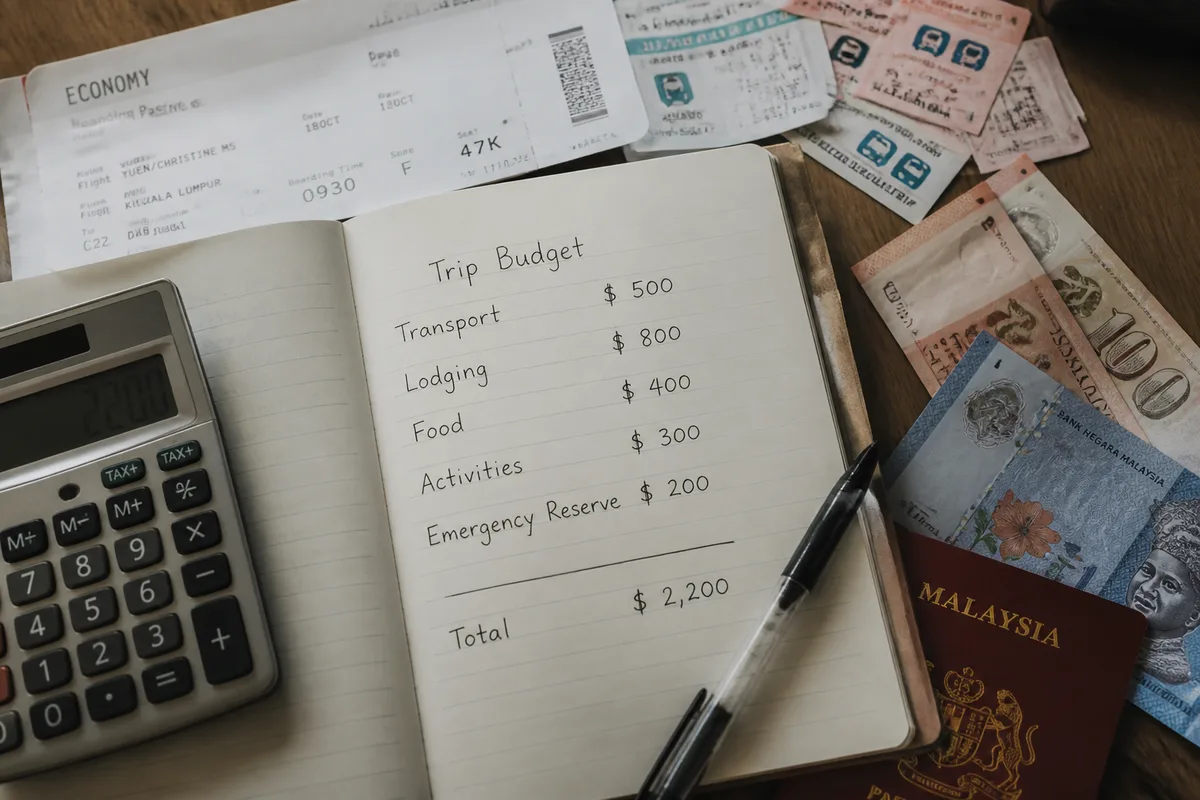
Step 1: price fixed and pre-trip costs
Collect current prices for long-distance transport, checked baggage, lodging deposits, visas or entry requirements, travel insurance and airport transfers. Add a buffer when a cost is volatile or quoted in another currency, and record whether each amount applies per person, per room or per group.
Step 2: calculate a realistic daily allowance
Subtract fixed costs and the contingency reserve from $5,000. Divide the remainder by the number of days, then check whether that daily amount covers lodging, meals, local transport, activities, tips, mobile data and card or exchange fees.
- Choose the destination, dates, traveler count and departure airport.
- Price flights or other long-distance transport, baggage and transfers.
- Price accommodation for the full stay, including taxes and mandatory fees.
- Add insurance, entry requirements, connectivity and payment-related fees.
- Reserve 10% to 15% when feasible, then divide the remaining amount by trip days.
- Reduce trip length, change destination or adjust travel style if the daily allowance does not support the plan.
Step 3: protect a contingency reserve
Reserve roughly 10% to 15% of the total when feasible, adjusting upward when the destination involves complex transport, uncertain exchange rates or limited medical access. This money is for disruption, medical needs, a necessary last-minute change or other genuine emergencies—not routine overspending.
How to make $5,000 last longer without making the trip worse
Choose fewer destinations, flexible dates, alternate airports and shoulder-season travel before cutting basic comfort. A well-located room that reduces daily transport can be better value than a cheaper room that requires repeated paid transfers.
Match the accommodation to the group: a kitchen may help a family or long-stay traveler, while a central private room may save a couple from taxis. Pick a small number of paid experiences that matter most, then balance them with free museums, public spaces, self-guided walks, beaches, markets or nature that do not require expensive admission.
If flights are expensive, change the route before reducing the reserve. The right decision is to shorten the itinerary or choose a closer destination; do not book a long-haul trip that works only if every day goes perfectly.
Costs travelers most often forget in a $5,000 trip budget
Affordable-looking itineraries often fail because the headline price excludes the small charges that appear repeatedly. Treat taxes, resort or city fees, baggage, airport transfers, tips, data plans, card fees, visas, insurance and shopping as separate budget lines.
- Baggage: a low airfare may exclude checked luggage or seat selection.
- Transfers: airports outside city centers can require costly trains, buses, taxis or shuttles.
- Taxes and mandatory fees: accommodation and resort prices may not show the complete total at first glance.
- Connectivity and payment costs: data plans, foreign transaction fees and exchange-rate differences accumulate over a long stay.
- Shopping and tips: these are discretionary, but they still reduce the money available for planned activities.
Changing locations too often multiplies transportation costs and friction spending. Another common mistake is spending the contingency reserve before departure because it looks available; once it is gone, a delayed flight or medical issue must come from the activity budget or from money intended for home expenses.
Final verdict: is $5,000 enough for your trip?
Yes, $5,000 can be generous for a short solo trip, workable for a value-conscious couple trip and more constrained for a family or high-cost destination. The amount becomes useful only after you define the travelers, dates, departure city, destination, duration and whether flights are included.
Subtract real fixed costs and a protected reserve first, then judge the daily allowance. If that amount supports the lodging, meals, transport and activities you actually want, the trip is realistic; if not, change the itinerary rather than relying on optimistic spending assumptions.
The belief that “$5,000 can take you anywhere for as long as you want” is incomplete. It may support an exceptional slow-travel plan under strict conditions, but a conventional international vacation is governed by airfare, accommodation and the number of people sharing the budget.
Frequently Asked Questions About a $5,000 Travel Budget
A $5,000 trip budget works best when flights, accommodation, daily spending and the contingency reserve are modeled together. The answers below use the same decision factors: destination cost, season, traveler count, trip duration and travel style.
Is $5,000 enough for a two-week international trip?
It can work well for one traveler or a couple in an affordable destination, especially outside peak season. It becomes tight when several travelers need long-haul flights, the destination has high accommodation costs or the itinerary includes many internal flights and premium activities.
Can two people travel for $5,000?
Yes, particularly for a nearby trip, a moderate-cost destination or a couple sharing one room and some transport. Flights, meals, insurance and attraction tickets still apply to each person, so shared accommodation does not halve the complete budget.
Is $5,000 enough for a luxury vacation?
It can fund a short luxury stay or a nearby high-comfort getaway when airfare, transfers and extras are controlled. It is unlikely to support a long-haul premium itinerary with luxury lodging, fine dining, private transport and several paid experiences while also preserving an emergency reserve.
Should flights be included in a $5,000 trip budget?
Yes, include flights when you want to compare the true cost of one trip with another. If flights are already paid, show them as a separate sunk cost and recalculate the remaining accommodation, daily spending and reserve without claiming that the whole vacation cost $5,000.
How much emergency money should I set aside for travel?
Reserve roughly 10% to 15% of the total when feasible, then adjust for destination risk, trip complexity and access to reliable transport or medical care. Keep this amount separate from activity money so a delay, medical need or exchange-rate movement does not immediately break the itinerary.
Sources to check before booking
Use official and primary sources for information that changes frequently. Check the destination’s official tourism website for access and local guidance, the airline or rail operator for current transport conditions, the accommodation’s final checkout total for taxes and mandatory fees, and the relevant government website for entry requirements.
For personal budgeting habits, you can also review these personal finance tips for beginners, then replace every illustrative figure in this article with a live quote for your own dates.