How to Plan Your First Trip Without Feeling Overwhelmed
Planning your first trip becomes manageable when you make a few essential decisions in the right order. Start by defining where you might go, when you can travel, how long you can stay, what matters most to you, and how much you can spend.
The practical sequence is simple: choose a realistic destination, check the requirements, set a complete budget, book the essentials, build a flexible itinerary, and prepare your documents and luggage. You do not need to control every hour for the trip to go well.
Quick summary
🧭 Choose the framework first: destination, dates, trip length, priorities, travel pace, and budget.
💳 Book in the right order: verify entry requirements before paying for non-refundable transport or accommodation.
🗺️ Keep the itinerary realistic: plan one or two priority activities per day and include transfer time.
✅ Finish with a checklist: documents, money, connectivity, medication, luggage, confirmations, and arrival details.
Start with the three decisions that simplify every later choice
Before searching for destinations, decide why you are traveling, when you can leave, and what kind of pace feels comfortable. These choices narrow the search immediately and stop you from comparing options that were never suitable for your available time, budget, or confidence level.
Use a one-page trip plan
Create one note or spreadsheet with your destination options, dates, budget ceiling, booking deadlines, and outstanding tasks. Keep two columns: essential decisions and optional details. This prevents small choices about restaurants, day trips, or luggage accessories from delaying the decisions that actually shape the trip.
A useful planning rule is to handle one category at a time. Decide on the destination before comparing hotels, and confirm the dates before researching activities. Stop researching when an option meets your priorities; continued searching often creates doubt rather than a better decision.
“I need a perfect itinerary before I book anything” is a common misconception. A flexible plan with confirmed essentials is more useful than an exhaustive schedule that leaves no room for delays, rest, weather changes, or an activity that takes longer than expected.
Choose a destination you can realistically enjoy
Choose a destination by matching it to your budget, travel time, season, interests, mobility needs, and confidence level. A nearby domestic trip may be the right first experience, while an international trip can work well when the documents, route, and arrival process are manageable.

Compare destinations using five beginner-friendly criteria
Write down no more than three realistic options. For each one, compare total travel time, likely costs, weather, ease of getting around, and activities that genuinely interest you. A simple score from one to five can clarify the choice, but it is a decision aid, not an official ranking.
| Criterion | What to check | Warning sign |
|---|---|---|
| Total travel time | Journey duration, transfers, arrival time, and return journey | The route uses a large part of a short trip |
| Likely costs | Transport, accommodation, meals, activities, local travel, and baggage | The budget works only before adding basic expenses |
| Season | Weather, local holidays, opening dates, and seasonal access | Key activities are unavailable during your dates |
| Getting around | Public transport, walking distances, transfers, and accessibility | Daily plans require complicated or uncertain connections |
| Interests | Specific places, food, nature, culture, or activities you want to enjoy | The destination looks attractive but has no clear priorities |
Check entry and practical requirements before committing
For an international trip, check the current passport-validity rule, blank-page requirement, visa or electronic authorization, health guidance, and local transport information for your nationality and destination. Use the destination’s official government website, your own government’s travel advice, and the relevant embassy or consulate.
Do not book non-refundable travel until those checks are complete. Passport and entry rules are destination-specific; no single validity period applies worldwide. The same verification applies to health documentation, customs restrictions, and seasonal access to particular regions.
Build a travel budget with room for the unexpected
Build the budget in two layers: fixed costs that must be paid or reserved, and daily costs that depend on how you travel. Add a separate contingency buffer instead of treating every available dollar as spendable, because delays, price changes, medical needs, and overlooked fees can affect the final total.
Separate fixed costs from day-to-day spending
Start with the items that shape the decision to travel: primary transport, accommodation, insurance, major activities, baggage, and required documents. Then estimate food, local transport, connectivity, and small purchases for each day. Prices are highly destination- and date-dependent, so verify them with current provider or official destination information rather than using a universal trip amount.
| Budget category | How to estimate it | Booking or checking action |
|---|---|---|
| Primary transport | Compare the complete fare, including baggage, seat, and change charges | Check the transport provider’s final price and conditions |
| Accommodation | Multiply the nightly rate by the number of nights and add mandatory fees | Confirm location, cancellation policy, taxes, and check-in rules |
| Food | Estimate a daily amount based on your preferred eating style | Review local prices close to the travel dates |
| Activities | List priority attractions, tours, tickets, and equipment | Reserve only time-sensitive or capacity-limited experiences |
| Local transport | Include airport transfers, trains, buses, taxis, or car rental | Check routes, operating times, payment methods, and deposits |
| Contingency | Keep a separate amount for unexpected expenses | Do not include it in the planned daily spending |
For example, a traveler might list transport, lodging, food, activities, local travel, connectivity, and baggage as separate lines before calculating a total. That structure is more reliable than asking whether a round number such as $500 or $5,000 is enough, because the answer changes with destination, season, trip length, and travel style.
If you want a broader foundation for managing available money, these personal finance basics for beginners can help you separate travel savings from regular spending.
Set a realistic buffer
Keep the contingency amount separate from your planned daily budget. It can cover a changed connection, an unexpected night, a replacement item, a medical expense, or a price difference that was not visible during the first search. The exact amount must be based on your destination and circumstances rather than a universal percentage.
Book the essentials in the safest order
Confirm the destination, dates, budget, and entry requirements first. Then book the transport and accommodation that determine the route, followed by genuinely time-sensitive activities. Read cancellation, change, baggage, payment, check-in, and deposit conditions before confirming anything.
What to book before a trip
For a fixed or short itinerary, transport and accommodation usually deserve priority because limited availability can affect the entire route. Once the itinerary is established, reserve additional trains, ferries, rental cars, popular tours, or timed attractions only when availability is genuinely limited.
Book the complete accommodation plan in advance when the route is fixed, the season is busy, or arriving without a room would create a serious problem. For a more open-ended multi-stop trip, keeping later nights flexible can make sense after checking that suitable availability exists.
What can wait until later
Meals, casual sightseeing, and low-demand activities can usually remain flexible. Do not fill every hour simply because an option appears online. The lowest headline price is not automatically the best value if it excludes baggage, has a difficult location, or cannot be changed.
In this case, do not book the cheapest option blindly. Compare the complete cost and the conditions that matter if your plans change.
Create a flexible itinerary instead of a packed schedule
A workable itinerary is organized by area, not by an endless list of attractions. Choose one or two priority activities per day, group nearby stops, and include realistic travel time between them. Arrival and departure days need lighter plans because transport, check-in, queues, and fatigue consume usable time.
Build each day around one priority
Begin with the activity that matters most, then add optional stops nearby. If a museum, hike, attraction, or event requires a full day, do not treat the transfer to it as invisible time. Multi-stop routes need more time than a stay focused on one city because each change of location creates packing, transit, and check-in work.
For a first international trip lasting one week, limiting the route to one country is a useful recommendation, not a universal rule. The better test is whether the number of stops leaves enough complete days to enjoy them rather than merely pass through them.
Prepare simple backup options
Save a few nearby indoor activities, food options, and low-effort alternatives for bad weather or changed plans. Keep addresses, opening information, reservations, and transport details accessible offline so that a weak connection does not turn a small change into a major problem.
Prepare documents, money, connectivity, and health basics
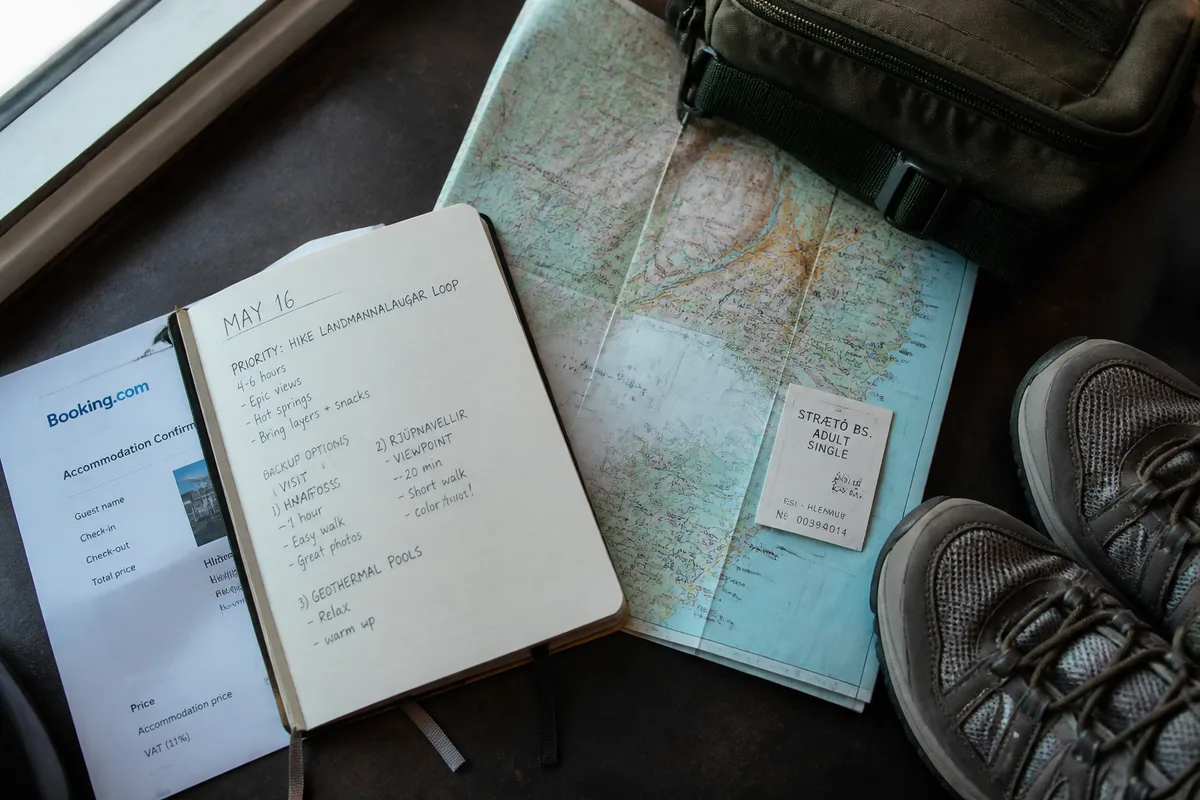
Collect the information you may need during the journey before departure, not only in an email inbox. Store identification, insurance details, booking confirmations, transport tickets, accommodation contacts, emergency numbers, and a basic itinerary securely, with offline access where possible.
Keep important travel information available offline
Save copies of your passport or identification, insurance policy, reservations, tickets, and emergency contacts. Share the basic route and accommodation details with a trusted person when appropriate. Keep original documents protected and carry only what you need during daily sightseeing.
Sort practical needs before departure
Compare roaming, local SIM, and eSIM options for the destination, your device, and the available data plans. No connection option is automatically the simplest or cheapest in every country. Confirm compatibility and activation requirements before leaving.
Check official health guidance and destination-specific medication restrictions. Pack prescribed medication in its appropriate packaging and carry supporting documentation when required. Travel insurance is not identical across policies, so read the medical, cancellation, delay, baggage, and exclusion terms instead of assuming every problem is covered.
Pack for the trip you are actually taking
Pack according to the forecast, planned activities, luggage limits, and access to laundry. Comfortable footwear, essential medication, chargers, travel documents, and a practical day bag usually matter more than equipment prepared for every hypothetical situation.
Use a beginner packing framework
Divide the packing list into five groups: wear, wash, documents, electronics, and carry-on essentials. Check the airline or transport provider’s current baggage rules before choosing a suitcase or packing liquids and restricted items.
- Wear: clothing suited to the forecast and activities.
- Wash: toiletries, laundry supplies, and reusable items.
- Documents: identification, tickets, reservations, insurance details, and required permissions.
- Electronics: phone, charger, adapters, and any essential device.
- Carry-on essentials: medication, valuables, one change of clothes, and items needed during transit.
Leave behind low-value extras
Avoid duplicates and items that are easy to buy at the destination. Keep valuables and critical items in accessible carry-on luggage when appropriate, rather than placing them in checked baggage that may be delayed or unavailable during a connection.
Follow a simple first-trip planning timeline
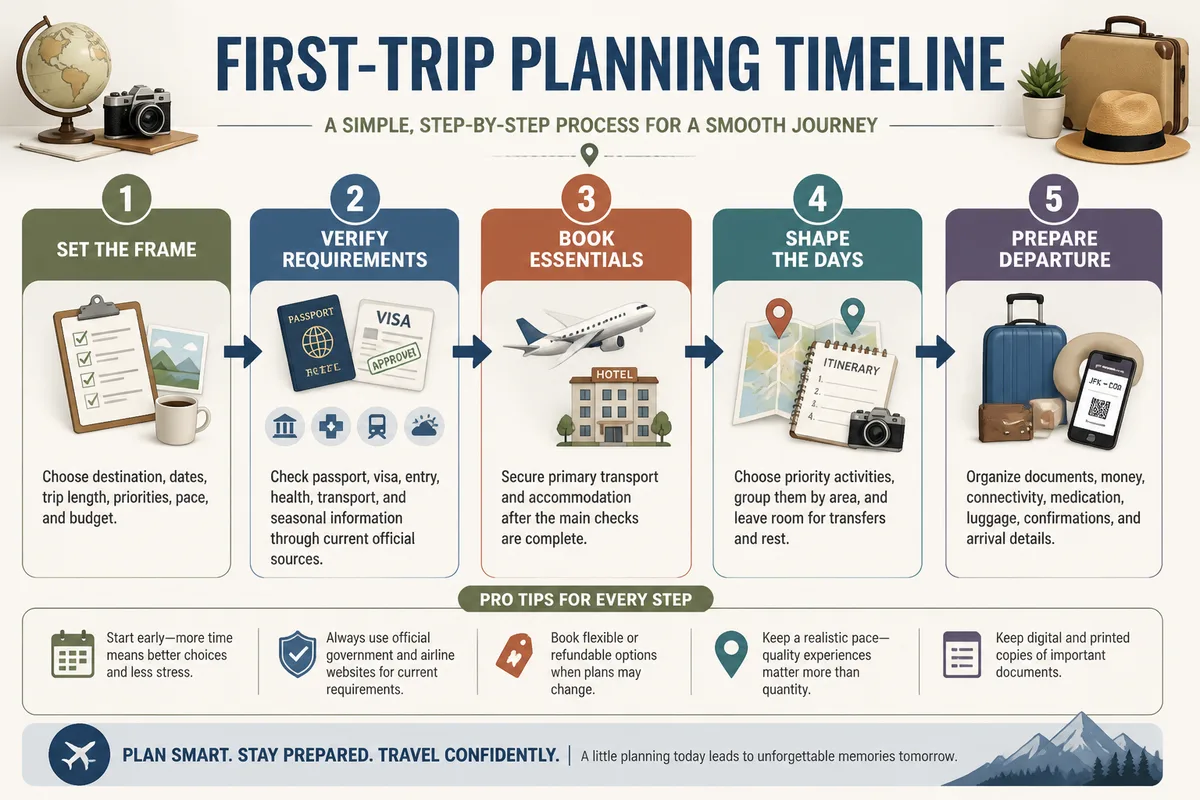
Use checkpoints instead of trying to complete the entire trip in one session. Four to eight weeks may be enough for some simple trips, but document lead times, high-season demand, destination complexity, and limited availability can require earlier planning. Treat this timeline as a working guide, not a universal deadline.
Four to eight weeks before departure
Choose the destination and dates, set the budget, verify documents and entry requirements, and book transport and accommodation. Allow more lead time when a passport, visa, electronic authorization, busy season, or limited availability requires it.
-
Choose the trip framework
Write the destination shortlist, dates, trip length, priorities, pace, and maximum budget in one place.
-
Verify official requirements
Check passport validity, entry rules, visas or electronic permissions, health guidance, and transport conditions for your nationality and destination.
-
Book the essentials
Confirm primary transport and accommodation only after the previous checks are complete.
-
Build the route
Allocate nights, add one or two priority activities per day, and include transfer time between stops.
-
Prepare the departure
Download confirmations, arrange connectivity and insurance, organize medication, and complete the packing checklist.
One to two weeks before departure
Confirm reservations, choose key activities, arrange insurance and connectivity, review payment options, and begin packing. Download essential confirmations, maps, tickets, addresses, and emergency contacts for offline access.
The day before departure
Check transport updates and check-in requirements, charge devices, and place documents, payment methods, medication, and essentials where they are easy to reach. Small changes can happen; preparation matters more than trying to eliminate every uncertainty.
Avoid the mistakes that make first-trip planning feel harder
Most first-trip stress comes from a few avoidable habits: too much research, unrealistic timing, incomplete cost comparisons, or late document checks. Identify the risk early, make one correction, and continue rather than rebuilding the entire trip.
Common planning traps
- Comparing too many destinations: endless research prevents a decision. Keep a shortlist of up to three and use the same criteria for each.
- Choosing the lowest advertised price: baggage, location, taxes, deposits, and change rules may alter the real cost. Compare the complete conditions.
- Checking documents after booking: a visa or passport issue can make a non-refundable reservation unusable. Verify official requirements first.
- Underestimating transfer time: moving between cities includes packing, transit, waiting, and check-in. Count those hours when deciding how many stops fit.
- Packing for every possible situation: extra weight adds effort without necessarily improving the trip. Pack for the forecast and confirmed activities.
Planning a first trip does not require a flawless schedule. Prepare the essentials, leave deliberate space in the itinerary, and use one checklist to decide what deserves attention next.
Frequently Asked Questions
How far in advance should I plan my first trip?
The right lead time depends on the destination, season, required documents, route complexity, and availability. Start early enough to compare options calmly and verify entry requirements before making non-refundable bookings.
What should I plan first when traveling for the first time?
Start with the trip purpose, dates, budget range, destination shortlist, and document requirements. These decisions guide transport, accommodation, itinerary length, and the preparation tasks that follow.
Should I book my entire itinerary in advance?
Secure essential transport and accommodation when the route is fixed or availability is limited. Keep meals, casual sightseeing, and lower-priority activities flexible when possible, especially on a slower multi-stop trip.
How much money should I save for my first trip?
Calculate fixed costs, estimated daily spending, and a separate contingency buffer. A universal amount is not reliable because destination, season, trip length, accommodation, transport, and travel style change the total.
How can I stop feeling overwhelmed while planning?
Work through one category at a time and keep destination options to a short list. Use a single planning note, set a research limit, and return to the next concrete task instead of reopening every previous decision.