Mental Health Day Signs: Do You Need Time to Pause?
Do you need a mental health day? Common mental health day signs include persistent exhaustion, feeling overwhelmed, irritability, reduced motivation or focus, sleep problems, work-related rumination, and unusual physical tension. These signs do not diagnose a mental health condition, but they can show that your current demands are exceeding your ability to recover.
A day away from usual responsibilities may create short-term breathing room, especially when stress has begun to affect daily functioning. It is not a cure for depression, anxiety, trauma, burnout, substance misuse, or another persistent concern; severe, worsening, or unsafe symptoms require qualified professional support.
Quick summary
🌿 A mental health day is intentional time away from usual demands. It can help you rest and reduce pressure when temporary overload is affecting your emotional, physical, or cognitive well-being.
🔎 Look for patterns rather than counting symptoms. Recurring sleep changes, emotional exhaustion, impaired concentration, withdrawal, or difficulty managing ordinary tasks deserve more attention than one isolated difficult day.
🛟 Time off is not a substitute for care. If symptoms persist, worsen, interfere with daily life, or raise immediate safety concerns, contact a qualified professional or local emergency service.
What Is a Mental Health Day—and What Can It Realistically Do?
A mental health day is intentional time away from usual work, school, or personal demands to rest, reduce pressure, and attend to well-being. It may be useful during a demanding period or temporary emotional exhaustion, but it does not diagnose or treat a clinical condition.
A mental health day is a pause, not a reward for reaching a breaking point. You do not have to prove that you are productive enough, unwell enough, or exhausted enough to deserve reasonable recovery time.
One day off can create recovery space, but it cannot resolve persistent mental health symptoms on its own. If low mood, anxiety, sleep disruption, or loss of functioning continues after rest, arrange an assessment with a doctor, therapist, counselor, or other qualified mental health professional.
A common misconception is that taking a mental health day means someone is unreliable or failing. That idea is incomplete: recognizing reduced capacity early may help a person respond more deliberately, while ignoring repeated warning signs can leave the underlying stress pattern unchanged.
Mental Health Day Signs: When a Pause May Help
Mental health day signs are patterns in mood, thinking, physical comfort, behavior, and everyday functioning—not a validated checklist or diagnosis. A pause may be worth considering when several changes accumulate, feel unusual for you, or make ordinary responsibilities harder to manage.
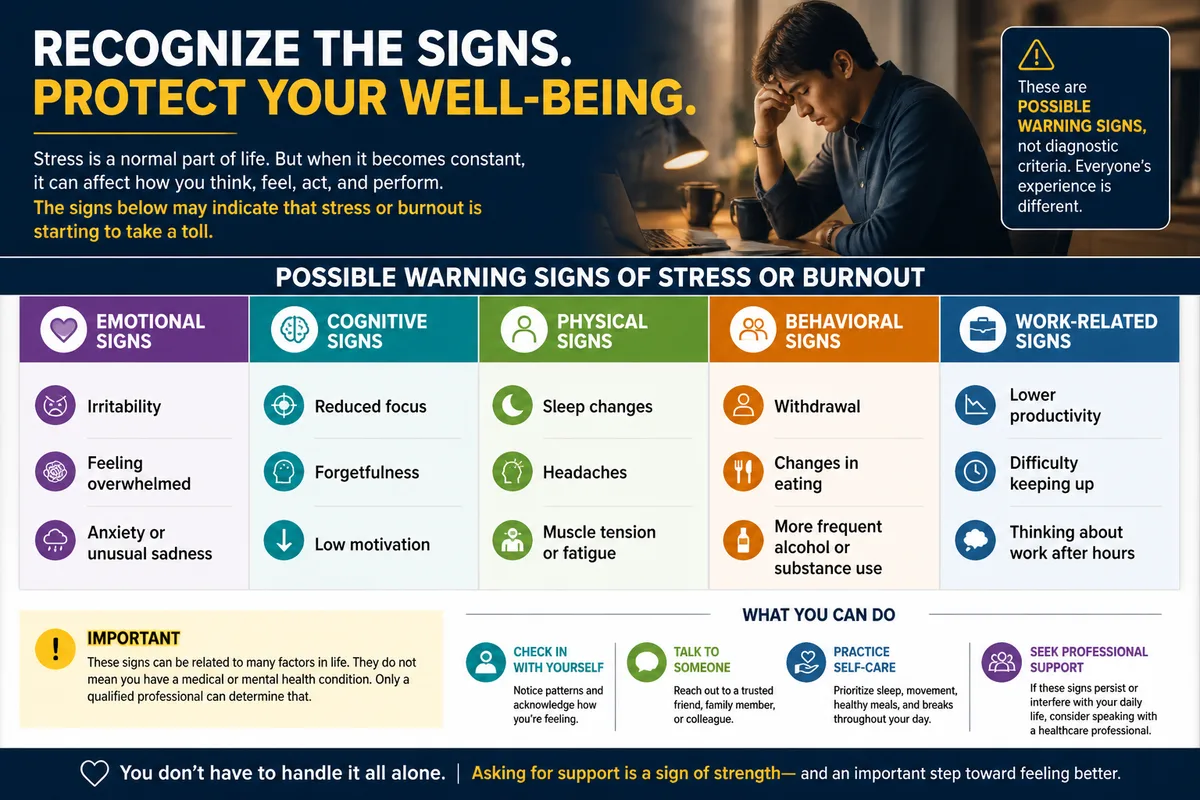
You feel emotionally drained before the day even begins
Waking up depleted, unmotivated, or unable to recover after ordinary rest can indicate that your current demands are taking more energy than you are restoring. Lower patience, reduced resilience, and difficulty making routine decisions add useful context.
This pattern matters more when it repeats or begins to affect basic responsibilities. A single poor night does not automatically mean you need time off, but persistent exhaustion is a reason to examine sleep, workload, health, and available support.
Focus and everyday tasks feel unusually difficult
Forgetfulness, indecision, repeated mistakes, difficulty starting tasks, or feeling unable to keep up can accompany high stress. Reduced productivity alone does not identify the cause, so compare the change with your usual functioning rather than judging yourself against an ideal day.
A short-lived off day may improve with rest and a lower workload. A recurring drop in concentration, especially when it affects work, school, driving, finances, or self-care, calls for closer attention and possibly professional advice.
You are persistently irritable, overwhelmed, or on edge
Routine requests may feel unusually difficult when your emotional bandwidth is low. Irritability, anger, agitation, stronger reactions, or a constant sense that everything is too much can be signs that your current coping resources are stretched.
These experiences do not establish a diagnosis. Notice what changed, how long it has lasted, and whether the reactions are damaging relationships or making ordinary decisions difficult.
Sleep, routines, or physical comfort are being affected
Insomnia, oversleeping, waking unrefreshed, skipped meals, muscle tension, headaches, stomach discomfort, and persistent fatigue are among the physical or routine changes people may notice during stressful periods. Stress can accompany these symptoms, but it should not be assumed to be their only cause.
New, severe, concerning, or unexplained physical symptoms deserve medical evaluation. Do not use a mental health day to postpone urgent assessment of chest pain, fainting, severe breathing difficulty, sudden neurological symptoms, or another immediate physical emergency.
You are withdrawing from activities or people you usually value
Pulling back from supportive colleagues, friends, hobbies, or ordinary activities may signal that your capacity is reduced. A quiet day can be restorative, but complete isolation may leave you with fewer opportunities to notice worsening symptoms or receive practical help.
Persistent withdrawal deserves attention beyond a single restorative day, particularly if it comes with ongoing sadness, anxiety, loss of interest, or difficulty managing basic needs.
Is a Mental Health Day Enough, or Is More Support Needed?
A short-term reset may help when temporary overload is the main problem and you can still manage basic needs safely. Ongoing, worsening, or function-limiting symptoms require more than time away, while thoughts of self-harm or feeling unsafe require urgent support now.
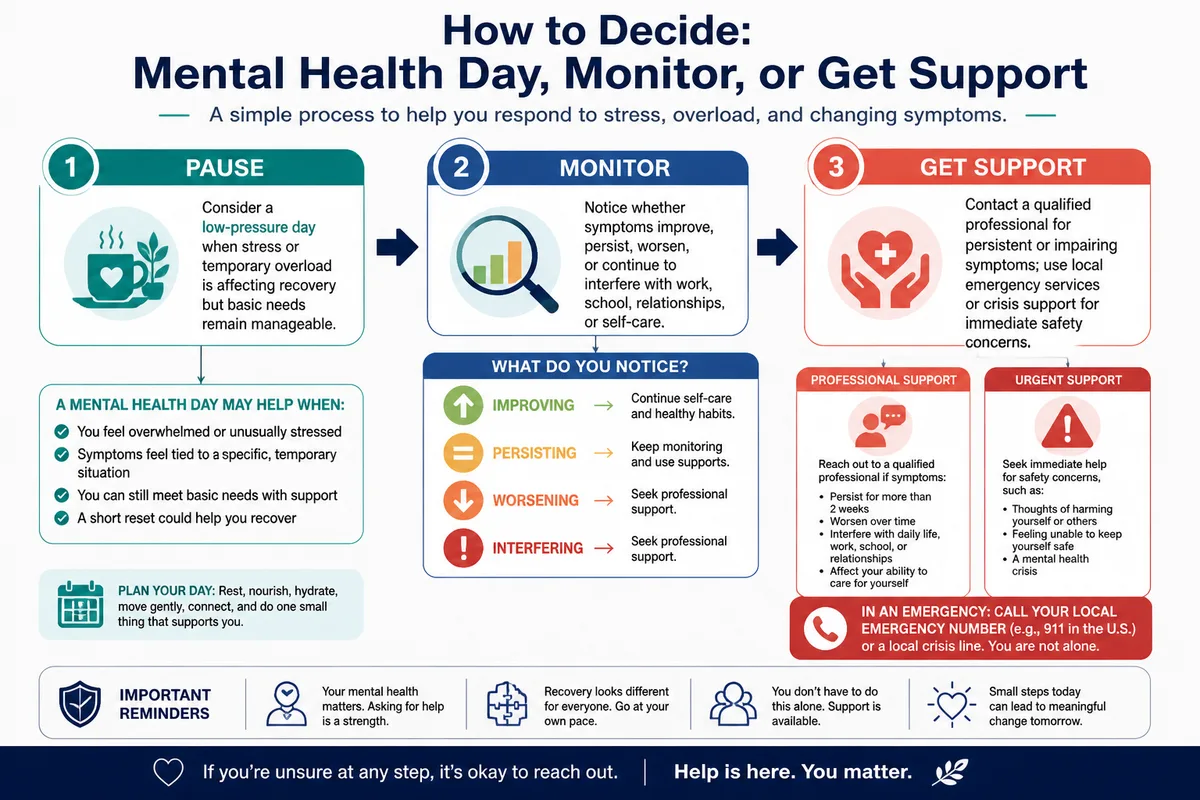
When a day off may be a helpful reset
Temporary overload, a demanding period, poor recovery, or early stress signals may respond to reduced demands and restorative time. The purpose is to create breathing room and regain capacity, not to avoid every difficult situation or force yourself into a perfect self-care routine.
Taking a mental health day is reasonable here; pushing through when you are already making repeated mistakes is not. Keep the day simple enough that recovery does not become another performance task.
When recurring symptoms call for professional support
Contact a doctor, therapist, counselor, or qualified mental health professional when symptoms persist, worsen, repeatedly affect work or school, strain relationships, or make self-care difficult. Frequent urges to escape work or responsibilities can also point to unsustainable demands or an issue that deserves discussion.
A professional can consider physical health, sleep, medication, substance use, stressors, and mental health symptoms together. Do not stop medication or replace ongoing care with a day off unless a qualified prescriber gives you specific advice.
When to seek urgent help
Thoughts of self-harm, feeling unsafe, inability to care for basic needs, severe confusion, or an immediate mental health crisis require urgent support. Contact local emergency services, such as 112 in Europe where applicable, or your country’s crisis line, and ask a trusted person to stay with you if possible.
How to Take a Mental Health Day That Supports Recovery
A restorative day lowers unnecessary demands without turning rest into another assignment. Prioritize food, water, sleep, medication routines as already prescribed, lower stimulation, and activities that leave you more grounded rather than more depleted.

Lower the pressure before the day starts
Postpone nonessential commitments where possible and choose only a few realistic priorities. Arrange practical needs in advance, including food, childcare, essential appointments, medication routines, or urgent responsibilities.
You do not need to fill every hour. A day containing sleep, a meal, a shower, and quiet time may be more useful than a tightly scheduled list of activities.
Choose restorative activities that fit your needs
Possible options include extra sleep, regular meals, gentle movement, time outdoors, reading, quiet creative activities, breathing exercises, journaling, or a supportive conversation. Restorative does not look identical for everyone, and an activity is useful only if it reduces rather than increases pressure.
Some practical tasks may help if they make your environment calmer; others may become disguised work. Choose the version that supports recovery, not the version that gives you another set of standards to meet.
Set boundaries with work and digital noise
Silence nonessential notifications and avoid checking work messages when workplace expectations allow. A brief out-of-office response can protect your time without disclosing a diagnosis or personal details.
Workplace policies, leave categories, and privacy rules vary by employer and location. Follow the applicable process and share only the information required by that process.
Avoid coping habits that may leave you feeling worse
Excessive alcohol or substance use, compulsive scrolling, complete isolation, and replacing rest with punishing catch-up tasks may provide short-term distraction while leaving you more depleted. A change in alcohol or substance use is not proof of a particular condition, but it is a useful reason to seek support.
Choose a small alternative instead: eat something, take a brief walk, reduce notifications, or contact someone trusted. If being alone feels unsafe or unmanageable, do not isolate completely.
How to Ask for a Mental Health Day at Work or School
Keep the request concise, check the relevant absence policy, and avoid sharing more personal information than required. The wording may refer to a sick day or personal day because workplace terminology differs, and a mental health day is not automatically a separate legal leave category.
Request time off simply and professionally
Check your employer’s sick leave, personal leave, attendance, or absence policy before sending the request. A neutral example is: “I need to take a sick day today and will follow the usual absence procedure. I will update you about my return according to policy.”
This wording does not claim a diagnosis or promise confidentiality. If your workplace requires documentation or uses a specific reporting channel, follow that requirement rather than relying on an informal message.
If you are a student
Contact an instructor, school counselor, student support office, or administrator as early as possible. Ask what process applies to missed work, extensions, attendance, or academic support instead of assuming that a mental health day is treated the same way as sick leave.
For a student, a short message might say: “I am unwell and may need support with today’s attendance and missed work. Could you please tell me the appropriate process for an extension or student support?”
If a full day off is not possible
Consider a protected break, reduced workload where feasible, flexible scheduling, a workload conversation, or support through an employee assistance program or student service. These options do not replace professional care, but they may reduce immediate pressure while you arrange it.
If you repeatedly cannot take a break without consequences, treat that pattern as information. The answer may involve longer-term workload changes or support rather than repeatedly using isolated days to absorb an unsustainable situation.
How to Return Without Undoing the Reset
The first day back should not become a catch-up sprint. Choose two or three priorities, defer lower-impact tasks when possible, and protect food, water, movement, sleep, and short breaks while you rebuild your routine.
Start with the few tasks that matter most
Review what genuinely needs attention and separate urgent responsibilities from tasks that can wait. If concentration remains poor or ordinary work still feels unmanageable, that is a reason to reassess support rather than simply extend the pressure.
Notice what the day revealed
Reflect on triggers, workload, sleep, boundaries, support, and the warning signs that appeared before you took time off. A brief note can help you identify whether the main issue was an unusually demanding period, inadequate recovery, conflict, unclear expectations, or a recurring mental health concern.
If the same pattern returns, change the support around it rather than relying only on another isolated day. Speak with a trusted person or qualified professional when the pattern is ongoing.
A mental health day can create valuable room to recover from temporary overload. Recurring, severe, worsening, or safety-related symptoms deserve ongoing—and, when necessary, urgent—support.
Frequently Asked Questions About Mental Health Days
Mental health days can be useful for temporary overload, but they are not diagnostic tools or universal treatment plans. The right next step depends on symptom persistence, daily impact, available support, and immediate safety.
How do you know when you need a mental health day?
Look for patterns such as emotional exhaustion, disrupted focus, irritability, sleep changes, physical stress symptoms, work-related rumination, or reduced enjoyment. Severe, persistent, worsening, or unsafe symptoms require more support than a day off.
What should you do on a mental health day?
Choose low-pressure activities that support rest, nourishment, gentle movement, lower stimulation, and meaningful connection. There is no universal schedule, so avoid turning the day into a demanding productivity or chore list.
Is a mental health day the same as a sick day?
Workplace policies and terminology vary, but mental well-being is part of overall health. Follow the applicable sick leave, personal leave, attendance, or school absence process instead of assuming that every organization uses the same category.
How often should you take a mental health day?
There is no universal frequency that suits everyone. If you regularly need time away just to cope, review the underlying stressors and consider speaking with a qualified professional or trusted support person.
When should you talk to a therapist or doctor?
Seek professional help when symptoms persist, worsen, interfere with daily life, or feel difficult to manage alone. If you feel unsafe, cannot care for basic needs, or have thoughts of self-harm, contact local emergency services or crisis support immediately.