7 Realistic Ways to Save Money Without Changing Your Life
Looking for practical ways to save money without giving up every enjoyable part of your routine? The most sustainable approach is usually to track where your money goes, remove costs that provide little value, and make small changes you can repeat.
You do not need an extreme budget to improve monthly cash flow. A cancelled subscription, fewer delivery meals, a lower recurring bill, or a modest automatic transfer can make a measurable difference when each action fits your actual income and obligations.
Quick Summary
💡 Start with one recurring cost. Review subscriptions and regular bills before trying to change every daily habit.
🧾 Track before you cut. Statements reveal where money is leaving your account and help you avoid reducing essential spending unnecessarily.
🏦 Automate only what you can afford. A small transfer is useful when rent, food, utilities, debt payments, and other required costs remain covered.
📅 Measure the result for 30 days. Keep the changes that reduce spending without creating stress, overdrafts, or constant decision-making.
Start with the easiest savings opportunity
The easiest place to begin is usually a recurring cost or repeated purchase that adds little value. These expenses can have a high impact because one decision may reduce spending every month, while automation can turn a small saving into a consistent habit.
Sustainable progress matters more than extreme frugality. Start by checking your spending, setting a realistic target, and choosing one or two actions rather than attempting all seven strategies at once.
A useful first pass includes bank statements, card statements, subscriptions, food purchases, transport costs, and regular household bills. You are looking for frictionless changes, not a reason to feel guilty about spending money on things that genuinely matter to you.
Choose one easy reduction and one automatic habit first. That combination gives you a way to reduce spending while building a repeatable saving system.
1. Audit and cancel unused subscriptions
Review the previous two or three months of bank and credit card statements for recurring charges. Look for streaming services, applications, memberships, cloud storage, delivery programs, duplicate services, and free trials that converted into paid plans.
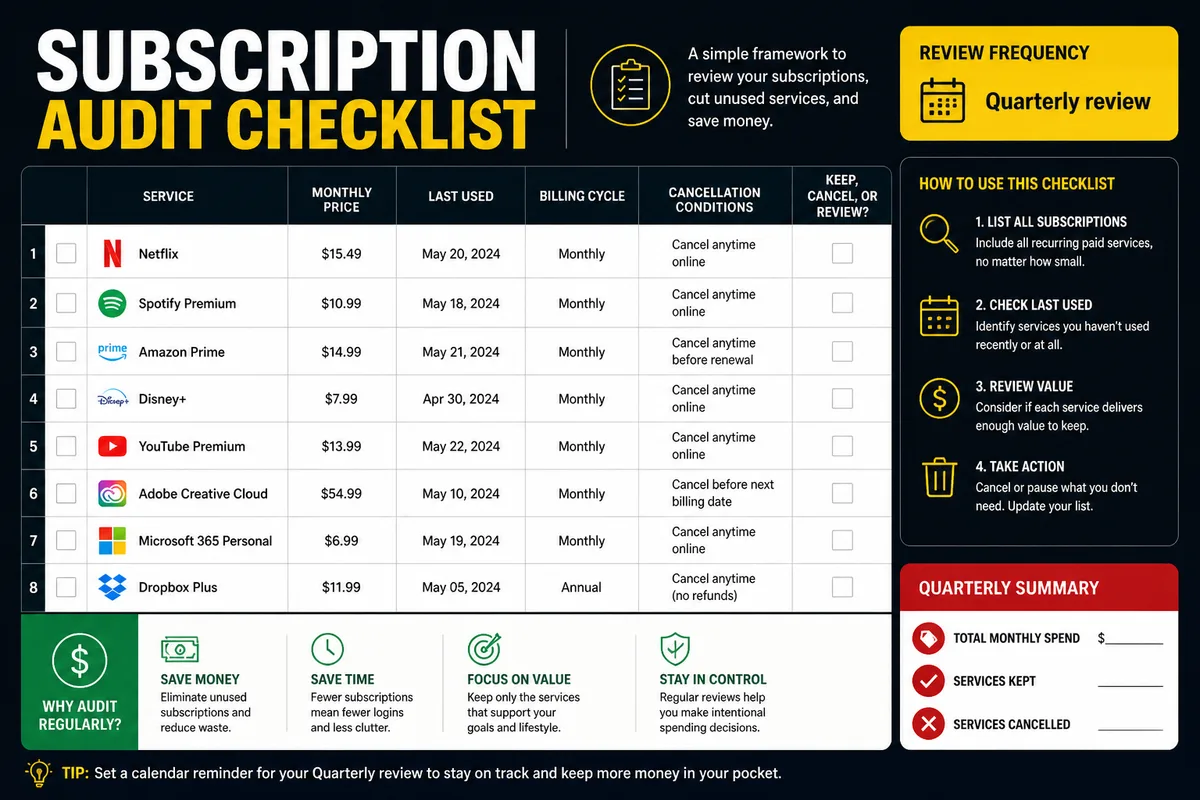
Do not cancel automatically just because a service costs money. Keep it when you use it regularly or when its value clearly exceeds the price. For everything else, cancellation, pausing, or downgrading may be more useful than trying to remember the charge later.
A small monthly charge becomes more meaningful when viewed over a year. For example, a hypothetical $12 monthly subscription costs $144 over 12 months before any tax or price change. The calculation is simple: $12 × 12 = $144.
A simple subscription review checklist
Record the service, monthly price, last date you used it, next billing date, and cancellation conditions. This makes the decision concrete instead of relying on a vague feeling that you may use the service later.
- Check whether billing is monthly or annual.
- Note the renewal date for every free trial.
- Look for cancellation fees or notice periods.
- Schedule a quarterly reminder to repeat the review.
Do not assume deleting an application cancels the payment. Confirm the cancellation through the provider, app store, bank, or card account and keep the confirmation where possible.
2. Recheck the bills you pay every month
Internet, mobile service, insurance, and other regular bills deserve a review because plans often continue after your needs change. Compare your current total cost with available alternatives and read the contract terms before contacting the provider.
Ask about lower-cost plans, loyalty options, equipment charges, activation fees, and promotional rates. Eligibility is not automatic, and a cheaper plan may remove a feature you use, such as additional data, roadside assistance, or a particular level of coverage.
Compare the price after the promotion ends, not just the opening rate. A temporary discount is not a permanent reduction if the bill rises sharply after a few months.
What to ask before switching or renegotiating
- What is the complete monthly cost, including taxes, equipment, and mandatory fees?
- How long is the contract, and what happens if you leave early?
- When does the promotional price end?
- Which features or coverage disappear with the cheaper option?
- Will the provider charge installation, activation, or equipment-return fees?
For insurance, compare coverage, deductibles, exclusions, and limits rather than choosing solely by premium. Comparing home and auto insurance offers can help identify a lower-cost policy, but the cheapest quote is not automatically the best match if it leaves a major protection gap.
3. Replace a few takeout meals with easy meals at home
You do not need to eliminate restaurants or delivery to lower food spending. Focus on the purchases that happen most often or cost the most, then replace only a few of them with simple meals you can prepare without creating a second job.
Plan three or four flexible dinners each week and build them around ingredients already in your pantry or freezer. A shopping list can reduce unplanned purchases, while generic products may lower the grocery bill when the quality and quantity meet your needs.

Keep realistic convenience options for busy days. Frozen vegetables, prepared ingredients, sandwiches, leftovers, or a repeatable one-pot meal can be less expensive than delivery without requiring elaborate cooking.
A low-pressure weekly food plan
- Choose repeatable meals that share ingredients.
- Check the pantry and freezer before shopping.
- Compare one month of food spending with a typical month.
- Avoid bulk purchases unless the product will be used before it expires.
- Prepare lunch at home on the days when buying it is most common.
Food savings should not depend on buying more than you can use. A discount is not a saving when the product expires, creates waste, or encourages a purchase you would not otherwise make.
4. Put a pause between wanting and buying
A waiting period can separate an impulse purchase from a planned decision. For a nonessential item above an amount you choose personally, wait 24 hours before paying; use a longer pause for expensive purchases that require research.
During the pause, classify the purchase as a need, a planned want, or an impulse. A necessary replacement that affects health, safety, or work should not be delayed merely to follow a rule.
Remove saved payment details and marketing emails if they make unplanned purchases too easy. Keep a wish list instead, then revisit it after the waiting period and check alternatives, total ownership costs, return terms, and available funds.
Make the pause fit the purchase
| Purchase type | Useful pause | What to check |
|---|---|---|
| Low-cost discretionary item | A few hours | Whether you still want it after leaving the page |
| Nonessential purchase above your chosen limit | 24 hours | Need, alternatives, available budget, and return terms |
| Large purchase | Several days or longer | Total ownership cost, financing cost, warranty, and cancellation terms |
Do not use a cooling-off period as an excuse to postpone essential replacements indefinitely. The purpose is to improve the decision, not to make ordinary spending feel like a failure.
5. Automate a small savings transfer
Automatic savings work by moving money shortly after payday or on a consistent weekly schedule. The transfer should be small enough to leave rent, food, utilities, required debt payments, and other essentials fully covered.
Use a separate savings account with clear access, fee, and withdrawal conditions. MyMoney.gov presents “pay yourself first” as a savings approach, but the amount still needs to match your cash flow rather than an arbitrary percentage.
Pause or reduce the transfer if it causes overdrafts or missed payments. Savings automation is useful only when it supports financial stability instead of creating new fees or payment problems.
When money is tight
A very small transfer can help establish a habit, but it is optional when essential costs are not fully covered. Prioritize basic needs and required minimum payments before increasing a savings goal.
After a bill reduction, debt payoff, or income change, you could gradually increase the transfer. Keep a clear purpose for the money, such as an emergency reserve, an upcoming repair, or a near-term expense.
MyMoney.gov also recommends building emergency savings before investing. The supplied guidance refers to three months of expenses as a minimum reference, but the appropriate target depends on income stability, dependents, essential costs, and access to other resources. It is not a universal requirement for every household.
6. Use what you already own before replacing it
A quick inventory can prevent repeat purchases of pantry food, cleaning supplies, clothing, tools, books, and entertainment. Check what is open, available, functional, and safe before adding another item to your cart.
When a product remains functional and safe, delay replacement. Borrowing, renting, repairing, or buying used may make sense for occasional needs, while a new purchase may be more appropriate when safety, hygiene, reliability, or compatibility is involved.
Do not buy storage containers, specialist tools, or supplies merely to begin a money-saving project. The project should reduce spending, not create another category of spending.
Turn an inventory into fewer repeat purchases
- Keep a simple list of household supplies and food already available.
- Check the list before grocery, household, and clothing purchases.
- Mark products that are open or nearing their use-by date.
- Replace items according to actual use rather than a feeling of being unprepared.
Libraries can also provide books and entertainment at no cost or low cost, depending on local membership rules and available services. This is a practical alternative when you want leisure without adding another recurring subscription.
7. Give each paycheck a simple job
A simple budget assigns income to broad categories before the money disappears: essential bills, flexible spending, savings, and near-term goals. You do not need to track every transaction if detailed budgeting is too difficult to maintain.
Set a realistic weekly discretionary amount from actual income and obligations. The 50-30-20 framework is sometimes described as 50% for regular expenses, 30% for personal spending, and 20% for savings, but it is a budgeting framework rather than a universal rule.
Review the plan monthly and adjust it when income, bills, or priorities change. A budget that cannot survive an ordinary month is too restrictive to be useful.
A simple way to spot opportunity cost
Connect optional spending to a specific competing goal, such as a bill cushion, travel fund, repair fund, or emergency reserve. For example, choosing fewer delivery meals may leave more money for a planned car repair, but that comparison should provide information rather than create guilt.
Leave room for enjoyable discretionary spending where possible. A plan that removes every pleasure often produces a short burst of restriction followed by overspending.
If you are starting from zero, the personal finance basics for beginners can help you organize income, expenses, and initial goals before making larger changes.
How small changes can add up over a year
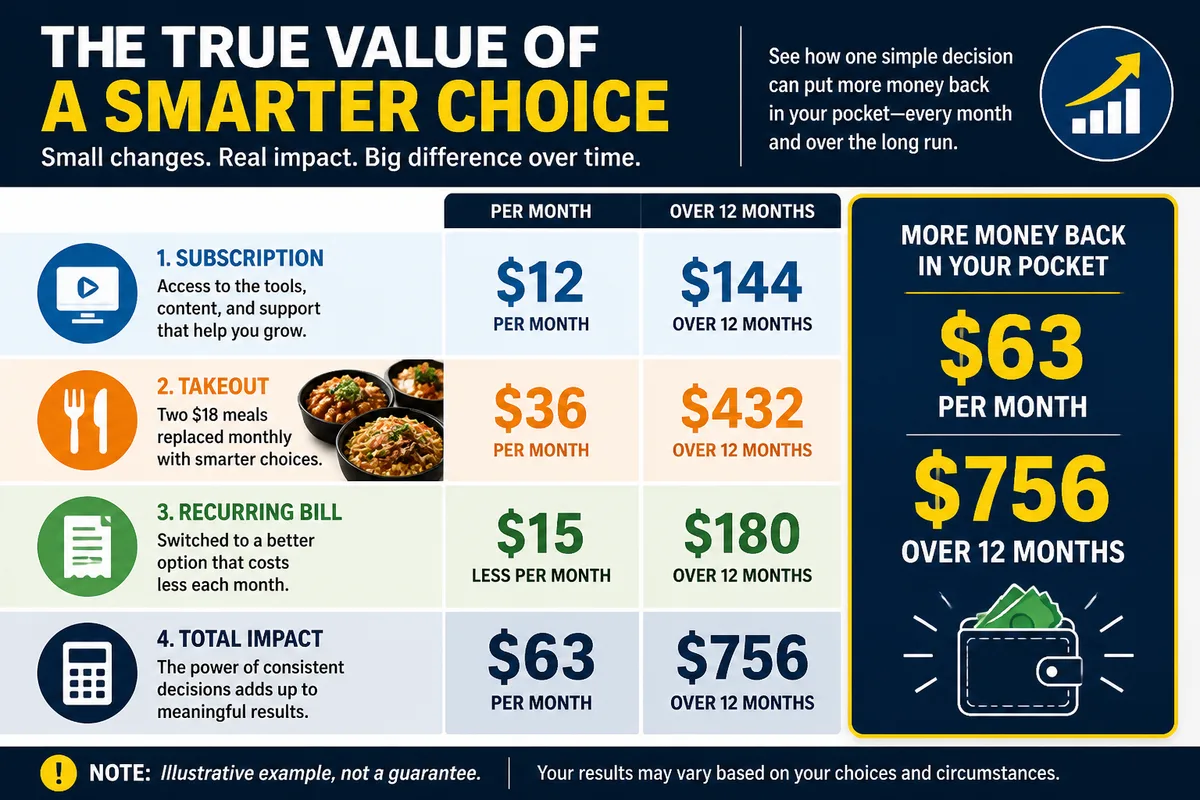
Small reductions become easier to evaluate when you separate lower spending from money moved into savings. The following example is illustrative, not a promise: it combines one cancelled subscription, fewer takeout meals, and one lower recurring bill.
In this hypothetical example, a $12 subscription is cancelled, two $18 takeout purchases are replaced each month, and a recurring bill falls by $15 after a plan change. The monthly reduction is $12 + $36 + $15 = $63, and the illustrative annual reduction is $63 × 12 = $756.
| Change | Illustrative monthly effect | Illustrative annual effect | What is not included |
|---|---|---|---|
| Cancel one $12 subscription | $12 | $144 | Taxes, annual billing, or cancellation fees |
| Replace two $18 takeout meals | $36 | $432 | The cost of ingredients prepared at home |
| Reduce one recurring bill by $15 | $15 | $180 | Temporary discounts or plan changes |
| Total spending reduction | $63 | $756 | Actual household results |
An automatic savings transfer is different from a spending reduction. If you also move $20 per month into savings, that adds $240 over a year, but it does not reduce the cost of your bills; it changes where the money is held.
Your result will vary with location, household size, income, existing habits, food prices, provider terms, and the number of changes you can maintain. Calculate your own monthly total before setting a target.
Try a 30-day money-saving reset that fits real life
A 30-day reset is a trial period, not a demand to permanently restrict your life. Use it to observe spending, test one or two changes, measure the effect, and keep only the habits that remain workable.
The aim is adjustment rather than perfection. If a tactic creates stress, overdrafts, missed payments, or excessive time demands, remove it and test a simpler alternative.
Week 1: Find recurring costs and spending patterns
Review bank and card statements, list recurring charges, and notice unplanned purchases. Do not try to change every category at once; the first week is for collecting information.
Week 2: Change one everyday spending habit
Plan a few meals at home, replace selected delivery purchases, or introduce a purchase pause. Compare the week with the previous week without treating one unusual expense as a failure.
Week 3: Make one saving action automatic
Set a sustainable transfer or schedule a recurring bill review. Confirm that essential payments remain covered before increasing the amount or adding another automatic commitment.
Week 4: Keep the changes that work
Measure the result, remove tactics that create constant stress, and choose one realistic next step for the following month. A smaller habit you repeat is more useful than a larger habit you abandon.
Common mistakes that make saving harder
Saving money becomes harder when the method creates new costs or demands more discipline than your daily life allows. The most useful corrections usually involve checking the details before acting, rather than cutting everything immediately.
- Cutting essentials first: Reducing food, medicine, transportation to work, or required payments can create larger problems. Review unused subscriptions and optional spending before touching essential costs.
- Buying to earn a discount: Coupons, cashback, rebates, and bulk prices do not create savings if they lead to an unnecessary purchase. Compare the final cost with buying nothing.
- Ignoring contract details: Cancellation charges, annual fees, equipment costs, and expiring promotional prices can erase an apparent reduction. Confirm the full cost before switching.
- Setting an unaffordable target: A savings percentage is not automatically appropriate for every income or household. If the target causes overdrafts or missed bills, reduce it.
- Comparing different lives: Income, rent, health costs, family responsibilities, and local prices vary. Use other people’s methods as ideas, not as a standard for judging your progress.
Frequently Asked Questions
The most effective starting point is usually a small change that reduces repeated spending without putting essential needs at risk. Track the result for a month, then decide whether to keep, adjust, or replace the habit.
What is the easiest way to start saving money?
Review recurring expenses and make one repeatable change, such as cancelling an unused subscription or reducing a bill. Tracking statements first helps you target a real cost instead of guessing.
How can I save money without changing my lifestyle?
Start with costs that provide little value, food waste, and impulse spending before cutting activities that genuinely improve your life. A cheaper plan, fewer unused services, or a short waiting period may preserve the parts of your routine you enjoy.
Is it better to cut expenses or automate savings?
When affordable, combine one manageable expense reduction with an automatic transfer toward a defined goal. Cut costs only when the change is real and sustainable, and reduce or pause automation if it causes overdrafts or missed payments.
How much should I try to save each month?
Choose an amount that remains after essential expenses and required payments. A smaller sustainable transfer is more useful than an ambitious target that creates financial stress, and the amount can change as your income and obligations change.
Choose one low-effort change today, measure its effect for 30 days, and build only on the saving habits that genuinely fit your life.