How to Cope When You Are Struggling With Your Mental Health
Struggling with mental health can make ordinary tasks feel unusually difficult. You do not need to solve everything today: begin with safety, one manageable action, and support from someone you trust.
Coping strategies can include grounding, comfortable breathing, regular food and sleep, gentle movement, emotional support, and professional care. These steps may help you get through a difficult period, but they do not diagnose a condition or replace treatment.
Quick Summary
- 🛟 Safety comes first: if you may harm yourself or someone else, or cannot stay safe, contact local emergency services or urgent mental health care now.
- 🌿 For the next few minutes: reduce stimulation, drink some water, notice your surroundings, and choose one small action rather than a complete solution.
- 🤝 Support is appropriate early: ongoing, worsening, or disruptive distress deserves attention from a healthcare professional even when you are unsure what is happening.
- 📱 Prepare useful contacts: keep trusted people, professional services, local crisis resources, and emergency information somewhere easy to find.
Start with safety and the next few minutes
If you are struggling right now, focus first on whether you can remain safe. Immediate danger, thoughts of harming yourself or someone else, or an inability to stay safe require urgent local help rather than a self-care exercise.
When to seek urgent help now
Contact local emergency services, an urgent mental health service, or the nearest emergency department when you may act on thoughts of harming yourself or another person, cannot control an immediate danger, or cannot stay safe without help. If you are in the United States, call or text 988 for the Suicide & Crisis Lifeline; call 911 for a life-threatening emergency. These services are not universal, so readers elsewhere should verify the correct number for their country.
Choose one small action, not a full solution
When feelings are overwhelming, lower the demand on yourself. Sit somewhere calmer, open a window, drink water, place both feet on the floor, or send a short message saying that you are having a difficult time.
Small actions are temporary support, not a cure. Doing less can be the appropriate choice when your attention, energy, or decision-making feels limited.
Use coping strategies for an overwhelming moment
Grounding, slower breathing, reducing stimulation, and compassionate self-talk are options to test gently. They may help some people feel more oriented or less overloaded, but no technique works for everyone and none should be treated as a guaranteed way to stop distress.
Ground yourself in the present
A five-senses exercise can shift attention toward immediate surroundings. Name things you can see, feel the contact between your body and a chair or floor, notice sounds, identify a smell, and take a sip of water or notice the taste of something safe.
Breathing can be slow and comfortable rather than forced into a strict pattern. If focusing on breathing increases discomfort, stop and use another option, such as describing objects in the room or pressing your hands gently against a stable surface.
Make the moment less demanding
Step away from stressful notifications, arguments, crowded spaces, or intense media if you can do so safely. Postpone non-urgent decisions until you have more support or a clearer moment.
Alcohol and recreational drugs can intensify difficult feelings for some people and may make it harder to judge risk. Do not use them as your main crisis response, particularly when you already feel unsafe.
Use neutral, compassionate self-talk
Try realistic language such as “This is hard right now” or “I only need to take the next step.” This is different from forced positivity: you can acknowledge pain without blaming yourself or pretending that everything is fine.
Common mistake: treating a coping exercise as a test you can fail. If a strategy feels more upsetting, stop, switch approaches, and contact a person or service that can offer appropriate support.
Create a gentler routine for difficult days
A flexible routine can support basic functioning without turning self-care into a demand for perfect discipline. Food, water, rest, personal care, daylight, gentle movement, and enjoyable low-pressure activities are reasonable starting points, while prescribed medication should be taken as directed and never changed alone.

Return to basic needs without aiming for perfection
Lower the bar to what is possible today: one meal, one shower, a few minutes outside, or one earlier bedtime may be enough for now. The Centers for Disease Control and Prevention identifies at least seven hours of sleep for adults as a general health recommendation, but a difficult night does not require punishment or an attempt to fix everything at once.
The National Institute of Mental Health gives 30 minutes of daily walking as an example of regular exercise that may support mood and health. You can begin below that example if 30 minutes feels unrealistic; gentle movement still counts as an action, not a performance test.
Notice what affects your wellbeing
If it feels useful, make brief notes about mood, sleep, stress, energy, appetite, substances, and what seems to help or make things harder. These observations are for communication and insight, not for proving a diagnosis from a symptom list.
Written notes can make a conversation with a healthcare professional more concrete. If tracking increases worry or self-monitoring, stop doing it and use a simpler reminder, such as noting one concern to mention at an appointment.
Make a personal coping and support plan
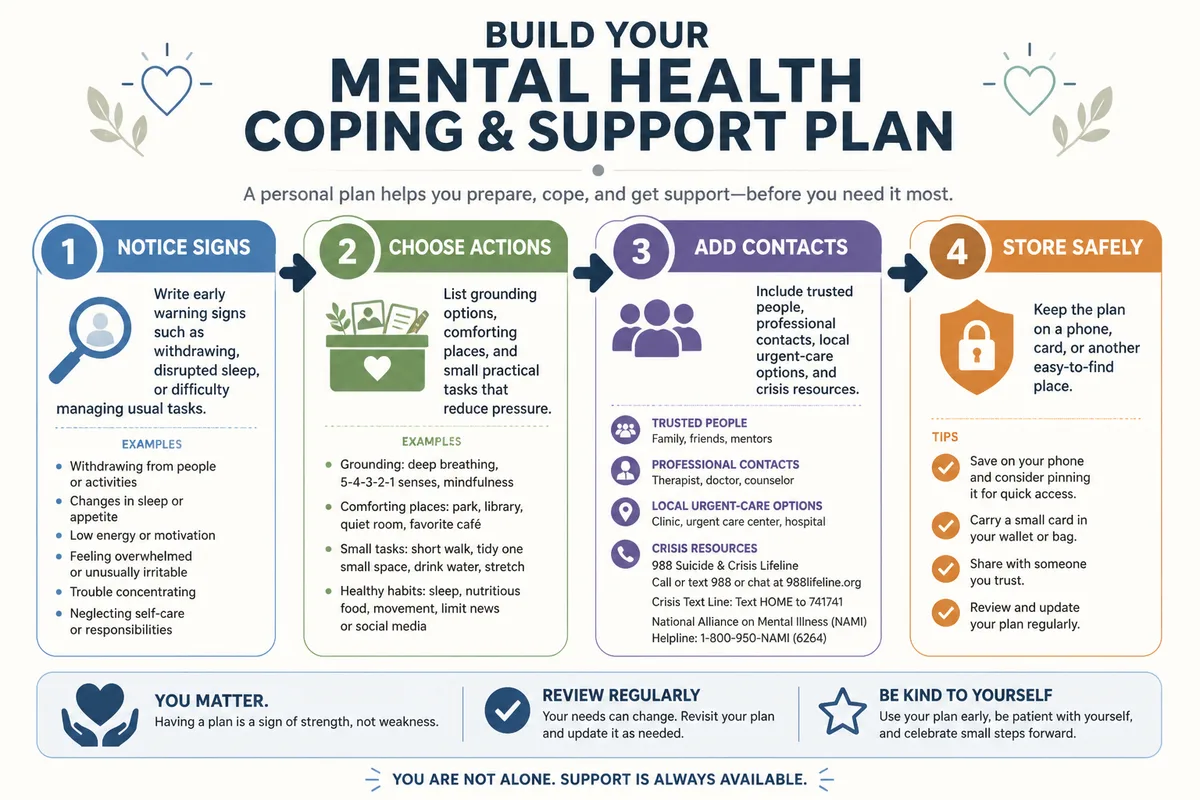
A short plan prepared before distress becomes intense can reduce decisions during a difficult moment. Keep it practical, easy to find, and based on actions and contacts that have felt safe or useful rather than on promises that you will never struggle again.
Include warning signs and helpful actions
How to make a plan: write down the changes that may show you are becoming more overwhelmed, then match each one with a low-effort response. Warning signs might include withdrawing from people, disrupted sleep, or feeling unable to manage usual tasks.
- Write two or three early signs that are noticeable to you.
- Choose grounding options, calming places, and practical tasks that reduce immediate pressure.
- Record what another person can do, such as listening, sitting with you, or helping with a call.
- Review the plan when you are relatively settled and update anything that no longer feels safe or useful.
Add people and services to contact
Include trusted contacts, a primary care clinician or therapist, local urgent mental health services, and verified crisis resources. Store the plan on your phone, on a card, or somewhere another trusted person can find it if you want them involved.
Reach out for emotional and professional support
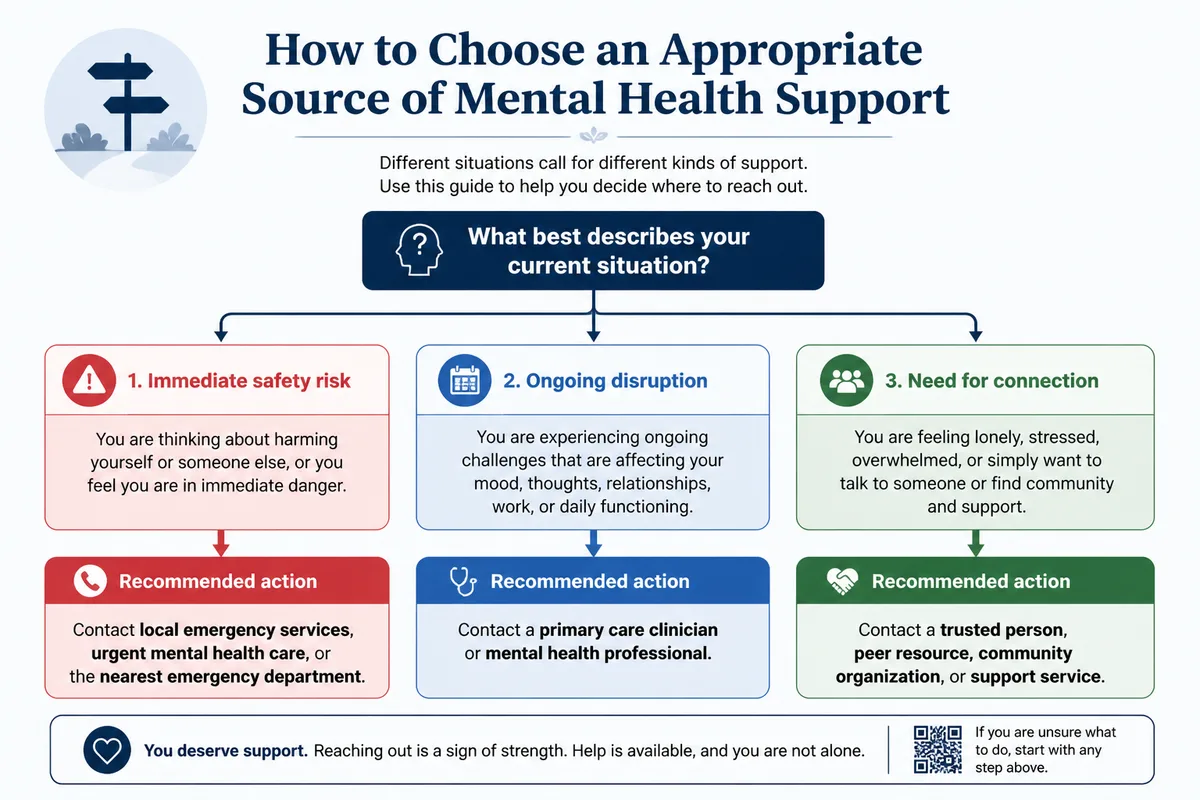
Asking for support before a crisis is a valid form of prevention, not an admission of failure. Depending on the situation, a trusted person, primary care clinician, therapist, psychologist, psychiatrist, counsellor, school or workplace service, community organization, or peer resource may be the most practical starting point.
How to tell someone you need support
You can use a direct message: “I am having a difficult time and could use some support. Could you check in with me or stay with me for a while?” A specific request often gives the other person a clearer way to help.
Ask for listening without fixing, help making an appointment, a lift to care, or a check-in later. If speaking feels too difficult, use text, email, or a written note instead.
How to find mental health care
A primary care clinician may help assess what is happening and discuss suitable referrals. Therapy, counselling, psychology, psychiatry, community mental health services, school services, workplace support, and peer organizations can offer different forms of care.
When comparing options, choose the most accessible service that matches the level of need. A primary care clinician is a useful first step for broad concerns; urgent services are the right choice when safety is at risk; a therapist or counsellor may suit ongoing emotional support; and community or peer services may help with cost, isolation, language, or access barriers.
Do not delay help because you lack a diagnosis. You can ask about lower-cost care, remote appointments, language-specific services, disability access, employer-supported care, or community programs where these exist.
How to prepare for a first appointment
Note how long the difficulties have lasted, how they affect daily life, current medicines, recent changes, sleep, appetite, substance use, and the questions you want answered. You do not need perfect words or a complete explanation to deserve support.
The best first option is the service that can respond safely to your current level of need. Do not use a routine appointment as a substitute for emergency care when you may not be able to stay safe.
Know when more support is needed
Persistent, worsening, or disruptive distress is enough reason to speak with a professional. The National Institute of Mental Health identifies severe or distressing symptoms lasting two weeks or more as a reason to seek professional help, while urgent safety concerns require help immediately rather than waiting for a duration threshold.
Signs it may be time to speak to a professional
Consider contacting a healthcare professional when distress continues, intensifies, or interferes with ordinary responsibilities. Changes that deserve attention can include ongoing low mood or anxiety, major changes in sleep or appetite, withdrawal, panic, hopelessness, difficulty concentrating, loss of interest, difficulty functioning, or increasing reliance on alcohol or other substances.
These signs do not prove a particular diagnosis. They indicate that additional assessment and support may be useful, even if you are unsure whether your experience is “serious enough.”
If the first source of help is not the right fit
One unhelpful appointment does not show that treatment or support cannot work. Ask for another appointment, a different clinician, a different type of service, or an explanation of other available options.
Changing providers is a practical adjustment, not a personal failure. If a service cannot meet an urgent safety need, contact an urgent or emergency service instead of waiting for that provider to respond.
Crisis support if you may not be able to stay safe
If you may harm yourself or someone else, or cannot stay safe, contact local emergency services, a verified local crisis line, or urgent mental health care immediately. Move away from immediate dangers when it is safe to do so, and involve another person rather than managing the crisis alone.
What to do right now
Do not stay alone if a safe, trusted person can be with you. Ask them to help contact urgent support or accompany you to emergency care.
In the United States, the 988 Suicide & Crisis Lifeline is available by call or text 24 hours a day, seven days a week, according to U.S. public-health guidance. SAMHSA’s National Helpline, 1-800-662-HELP (4357), provides free, confidential information and referrals 24 hours a day, 365 days a year in the United States; it is not a replacement for emergency services.
Frequently asked questions about struggling with mental health
Short-term coping can support you through a difficult moment, while ongoing or unsafe distress calls for human and professional help. The answers below are general guidance and cannot replace an individual assessment.
What should I do when I am struggling with my mental health?
Start by checking your immediate safety, then choose one manageable action such as drinking water, moving somewhere calmer, grounding yourself, or contacting someone you trust. If distress persists, disrupts daily life, worsens, or creates a safety concern, seek professional or urgent support.
How can I calm down when everything feels overwhelming?
Try reducing stimulation, noticing five things around you, feeling your feet on the floor, and breathing slowly without forcing a particular rhythm. Stop or switch methods if the exercise makes you feel worse, and seek urgent help if you cannot remain safe.
When should I talk to a mental health professional?
Speak with a professional when distress is persistent, severe, worsening, or interfering with sleep, eating, relationships, work, study, or basic tasks. NIMH guidance identifies severe or distressing symptoms lasting two weeks or more as a reason to seek help, but safety concerns require immediate support.
How can I tell someone I need support?
Use a short and specific request, such as “I am having a difficult time and could use some support.” You can ask them to listen, stay with you, help arrange an appointment, or check in later by phone or message.
What if I have thoughts of self-harm or suicide?
Contact local emergency services, a verified local crisis line, or urgent mental health care immediately, and try to stay with a safe, trusted person if possible. In the United States, call or text 988; call 911 for a life-threatening emergency.
Struggling is not a personal failure, and you do not have to carry the whole situation alone. Take one safe next step, then connect with a trusted person or qualified professional who can help you decide what comes next.
Sources useful for further support
- National Institute of Mental Health → general mental health care guidance and indicators for seeking professional help → use it to review self-care boundaries and when to seek care.
- Centers for Disease Control and Prevention → stress management, sleep, physical activity, and alcohol guidance → use it for general health information, not individualized treatment.
- SAMHSA National Helpline → U.S. treatment information and referral services → verify that the service fits your location and urgency.
- Local government health service or emergency-services website → country-specific crisis numbers and urgent-care routes → check the information for your current region before relying on it.