How to Organize Your Finances and Take Control of Your Money
To organize your finances, start by making your money visible: list your income, accounts, debts, bills, and everyday spending. This first step is not about judging past decisions or becoming wealthy overnight. It is about replacing uncertainty with a clear picture you can use.
A practical reset can be completed one manageable task at a time. By the end, you should have a usable spending plan, organized payment dates, a clearer debt priority, and a short routine for checking your money without turning personal finance into a full-time job.
Quick Summary
💡 Start with facts, not assumptions: use statements, bills, pay records, and account information instead of trying to reconstruct your finances from memory.
🧾 Build your budget from real spending: include essential costs, irregular expenses, debt minimums, savings priorities, and a modest amount of flexible spending.
🛡️ Deal with urgent risks first: unfamiliar transactions, overdue essential bills, utility shutoff notices, eviction notices, and unaffordable debt require prompt action.
🔁 Keep the system small enough to repeat: a weekly check-in and a monthly reset are more useful than an elaborate spreadsheet you stop using.
Start with a judgment-free financial reset
A financial reset means creating clarity and stability before trying to optimize every dollar. Begin with one visible task, such as collecting statements or listing upcoming bills, rather than attempting to fix your entire financial life in one sitting. Organization cannot solve insufficient income or unaffordable housing by itself, but it can show you where action is needed.
Many money problems become harder when they remain vague. A missed payment, duplicate subscription, unknown fee, or rising balance is easier to address once it has a name, amount, and due date. Your target is a complete money snapshot, a realistic spending plan, organized bills, and a review routine you can repeat.
Control starts with clarity, not perfection. If you suspect fraud, have an overdue essential bill, received an eviction or utility shutoff notice, or cannot meet required debt payments, move that issue to the front of your list. Contact the relevant bank, provider, creditor, housing organization, or qualified nonprofit adviser through an official channel.
Step 1: Create a complete picture of your money
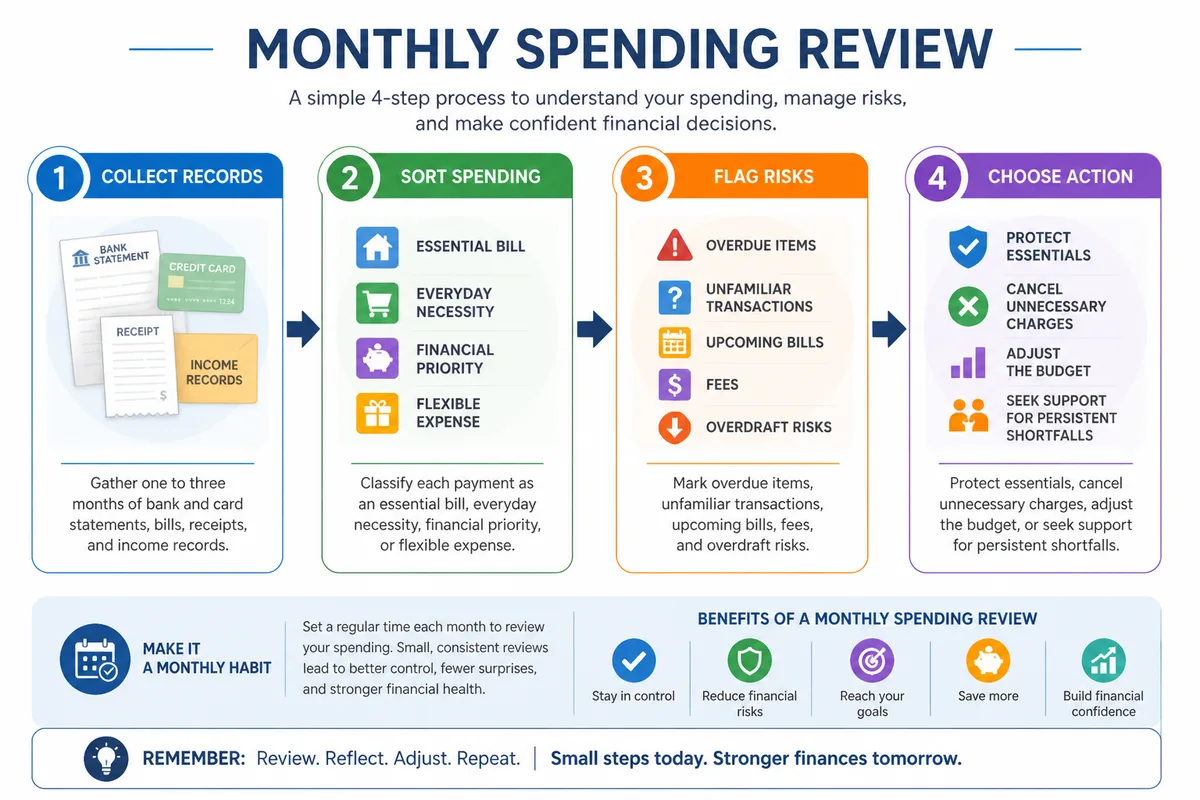
Before cutting expenses or choosing a budgeting method, gather the information that shows what is actually happening. Review bank and card statements, bills, loan records, pay information, insurance notices, and investment account statements. The goal is an accurate starting point, not a perfect financial archive.
Keep this information private. A tracker should not contain passwords, full login details, or unsecured account numbers. Use multifactor authentication where available, lock physical files away, and store digital documents in a protected location.
List every account, debt, and recurring payment
Create one inventory covering bank accounts, credit cards, loans, payment services, subscriptions, insurance, and investment accounts. For each item, record its purpose, current balance, interest rate when relevant, minimum payment, due date, fees, and payment status.
Mark unknown charges, duplicate services, overdue items, and accounts you no longer recognize. Those flags are follow-up tasks, not evidence that you have failed. A simple table can make the first review easier:
| Item | Information to record | Immediate check |
|---|---|---|
| Debt | Balance, interest rate, minimum payment, due date | Can the required payment be made on time? |
| Recurring bill | Provider, expected amount, payment method, renewal date | Is the service still needed? |
| Account | Purpose, current balance, access security | Are transactions familiar and authorized? |
| Investment or retirement account | Account type, balance, fees where shown | Is the information current and securely stored? |
Calculate the income you can safely plan around
List wages, benefits, freelance earnings, support payments, and other recurring income separately. Reliable income belongs in the core budget. Occasional or uncertain income should not be needed to pay essential bills.
For irregular income, use a conservative monthly estimate based on lower or typical earning months. Consumer.gov describes one method for non-monthly income: add the previous year’s income and divide it by 12 months. Treat that as a planning method, not a guarantee of future earnings.
Set up one secure home for financial documents
Create clear digital folders or physical files for bills, debt, insurance, tax records, and income documents. Use names such as “2026 electricity bill March” or “loan payment confirmation” so you can find evidence quickly.
Keep payment confirmations and written arrangements, especially when a provider or creditor has agreed to a new date or payment plan. Review account access security and enable multifactor authentication wherever it is offered.
For readers starting from zero, these beginner personal finance steps can provide another practical reference without requiring private account information.
Step 2: Track monthly spending and identify urgent gaps
Review the last one to three months of bank and card activity to see where money actually goes. Separate a temporary cash-flow problem from a recurring pattern, and do not begin by cutting essential needs before you understand the full picture.
Consumer.gov describes a useful rhythm: plan spending at the beginning of the month, track spending daily, and review the result at the end of the month. You can use a paper log, a protected spreadsheet, or another secure method, but the categories must remain understandable enough to maintain.
Sort spending into four practical groups
Use four groups that help you make decisions without creating an exhausting tracking task:
- Essential bills: housing, utilities, insurance, required debt payments, and other obligations that protect basic stability.
- Everyday necessities: food, transportation, medication, household supplies, and regular personal needs.
- Financial priorities: emergency savings, planned irregular costs, extra debt payments, and long-term goals.
- Flexible spending: entertainment, dining out, hobbies, gifts, and optional purchases.
Within each group, distinguish fixed costs from amounts that change each month. Include annual, seasonal, and irregular costs such as repairs, medical care, gifts, renewals, and school expenses. Leaving these out makes a budget look balanced until the bill arrives.
Find the problems that need attention first
Check upcoming due dates, missed minimum payments, overdraft risk, late fees, unfamiliar transactions, and essential bills that current income may not cover. A small subscription may be worth cancelling, but it is not automatically the main problem if housing or debt payments are already unaffordable.
If essential obligations exceed reliable income, the gap is the priority. Calculate the shortfall, protect housing and utilities as far as possible, and contact providers before a missed payment when you can.
Step 3: Build a starter budget that reflects real life
A budget is a plan for existing income, not a verdict on past choices. Build the first version from your actual spending, then revise it when new information appears. The best method is the one that gives you enough visibility to make decisions without becoming another source of stress.
Make room for irregular costs and modest flexible spending. A plan that assigns every dollar to essentials while ignoring predictable repairs, birthdays, or rest is likely to break. A hypothetical example illustrates the process: with $4,000 of monthly take-home income, $2,500 in essential bills and necessities, $500 in debt or savings priorities, and $300 in irregular-cost reserves, $700 remains for flexible spending or an additional priority.
Choose the simplest budgeting method you will repeat
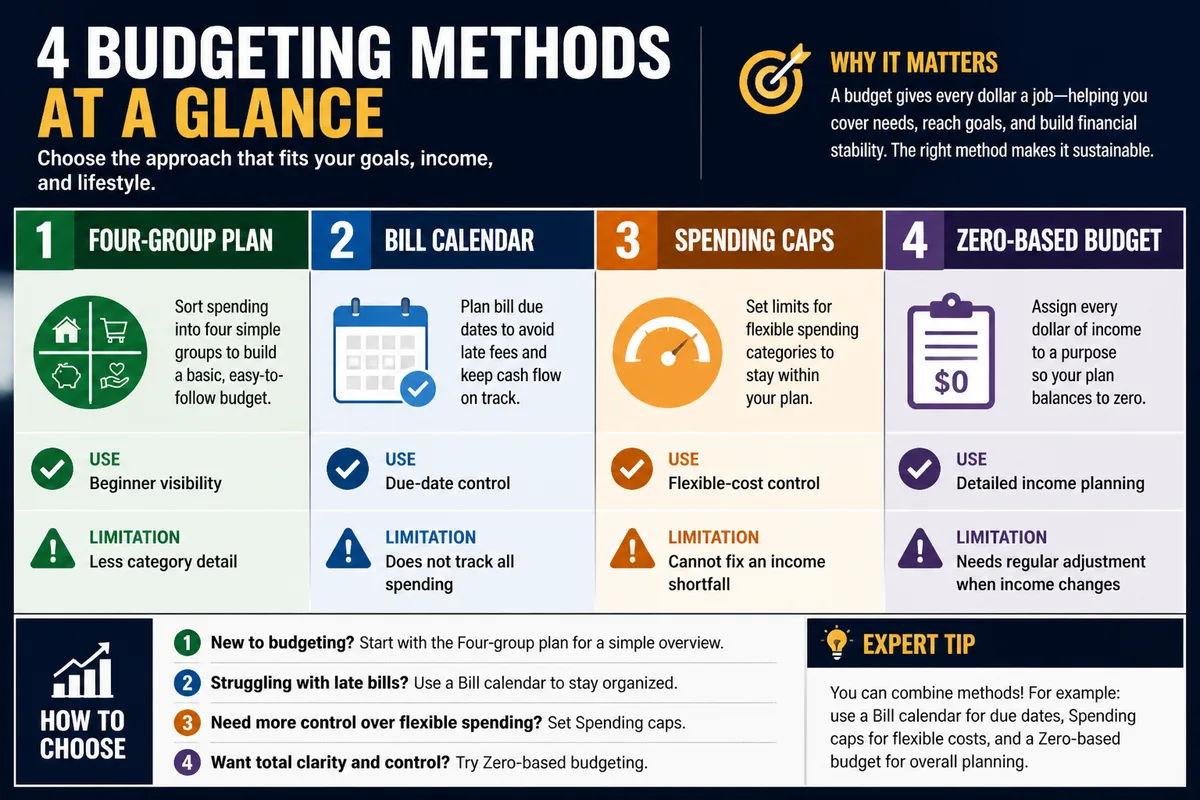
These methods solve different problems. None is a universal answer, and a method that feels too detailed during a stressful month may not be sustainable.
| Method | How it works | Useful when | Limit |
|---|---|---|---|
| Four-group plan | Sort income and spending into essentials, necessities, priorities, and flexible costs. | You need a clear beginner structure. | Less detail for people who need category-level control. |
| Bill calendar | List due dates, expected amounts, payment accounts, and confirmations. | Missed dates or cash-flow timing cause problems. | It does not replace full spending tracking. |
| Spending caps | Set a maximum for changing categories such as dining or entertainment. | Flexible spending is difficult to monitor. | A cap cannot fix an income shortfall. |
| Zero-based budget | Assign expected income to bills, spending, savings, debt, and other priorities. | Income is predictable and detailed planning feels manageable. | Frequent income changes require regular adjustments. |
For most beginners, a four-group spending plan paired with a bill calendar is the strongest starting point. Do not choose a complex system when a simple one already reveals the decisions you need to make.
Balance essentials, priorities, and flexibility
Fund housing, utilities, food, transportation, insurance, and required debt minimums before optional goals. Then assign realistic amounts to everyday needs, irregular expenses, and flexible spending.
If the numbers do not balance, show the shortfall instead of hiding it with new borrowing or an unrealistic spending limit. This is where organization reaches its limit: persistent income gaps may require changes to income, housing, fixed costs, creditor arrangements, or outside support.
Step 4: Organize bills, due dates, and payment accounts
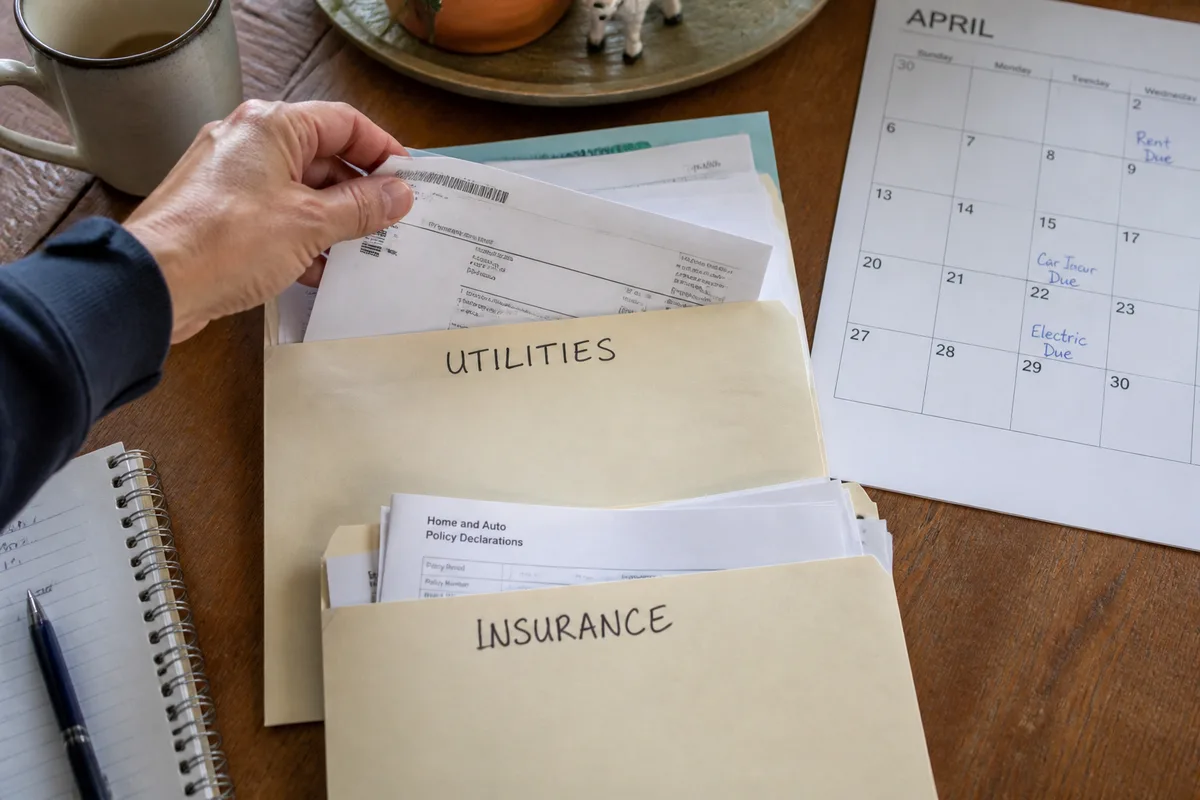
Turn scattered payment dates into a calendar you can check in minutes. Record the due date, expected amount, payment method, and confirmation status for every bill, then set reminders several days before payment is due.
Match major due dates to paydays where possible, but do not change accounts or payment dates unless the change solves a specific problem. More accounts do not automatically create more control.
Build a bill calendar you can check in minutes
Use one calendar or list with five fields: bill name, due date, expected amount, payment account, and confirmation status. Add reminders earlier for variable bills such as utilities, insurance renewals, or medical payments.
After a payment is scheduled, verify that it processed correctly. Keep the confirmation until the transaction appears in the relevant account.
Use accounts with a clear purpose
Identify where income arrives and which account pays essential bills. Keep enough money available before scheduled payments to reduce overdraft risk, especially when automatic payments are active.
Do not open additional accounts merely because a budgeting method suggests them. Add an account only when it makes bill payments, savings goals, or tracking materially easier.
Step 5: Prioritize debt and respond early when money is short
Protect essential living costs and required minimum payments before making extra debt payments. If a payment will be late, contact the provider or creditor early and keep a written record of the arrangement, date, and confirmation number.
Debt should not be labelled simply as “good” or “bad.” Its cost, purpose, affordability, and repayment risk matter more than a label. High-cost borrowing that threatens essential expenses deserves immediate attention.
Pay essential obligations in a practical order
Prioritize housing, utilities, food, transportation, insurance, and required debt minimums according to the risks in your household. Do not use payday loans or other high-cost borrowing to create the appearance of a balanced budget.
Early communication is more useful than silence. Ask the provider what official options exist, request the terms in writing, and avoid offers that promise instant debt relief without explaining fees, consequences, or eligibility.
Choose a focused debt repayment approach
The debt avalanche approach directs extra money toward the debt with the highest interest rate while maintaining minimum payments elsewhere. It generally focuses attention on the costliest balance first.
The debt snowball approach directs extra money toward the smallest balance first. It can create visible progress, but it may cost more interest than targeting a higher-rate balance.
Maintain minimum payments on other debts and choose one method you can follow. If cash flow is unstable, preserving a small buffer may be more practical than committing every available dollar to accelerated repayment.
Know when outside support is appropriate
Seek qualified or nonprofit guidance when accounts are in collections, legal notices arrive, insolvency is a concern, or available income cannot cover essential costs and debt. Contact creditors before a missed payment where possible.
Do not hide financial problems from a partner who is directly affected by shared bills or debt. A documented conversation and a joint list of urgent obligations are safer than allowing a missed payment to reveal the problem later.
Step 6: Automate money tasks without losing visibility
Automation reduces forgotten tasks; it does not replace monitoring. Start with predictable payments and modest transfers that the account can safely support, then pair each automatic action with alerts and a regular review.
Use automatic payments only when the amount is reliable and enough cash will be available. Variable bills still need reminders, and every scheduled payment should be checked after it processes.
Automate predictable bills carefully
Set low-balance, large-transaction, and upcoming-payment alerts where available. Keep a reminder for bills that change from month to month, and review automatic payments after an income or expense change.
Build a starter emergency fund and irregular-expense buffer
Start with a manageable transfer after payday or once per month. Direct early savings toward a small emergency cushion and known nonmonthly expenses rather than treating every future cost as unexpected.
There is no universally correct emergency-fund amount. Size the buffer according to essential expenses, income stability, dependants, insurance coverage, health risks, and how quickly you could replace lost income. The figures sometimes quoted online, such as three months of income or three to six months of expenses, are rules of thumb rather than requirements for every household.
Remove unnecessary financial friction
Cancel unused subscriptions, resolve duplicate charges, and keep reminders, bill dates, and financial documents in one secure system. Review every automated transfer or payment after a change in income, housing, household size, debt, or insurance.
Step 7: Keep your money management system running
A sustainable system relies on short reviews rather than occasional all-day catch-up sessions. Use those reviews to notice changes early, not to criticize yourself for imperfect spending.
Consumer.gov’s monthly rhythm is practical: plan at the beginning of the month, track spending during the month, and review the result at the end. Add a brief weekly check so unusual charges and upcoming bills do not wait until month-end.
Use a 15-minute weekly money check-in
Check balances, recent transactions, upcoming bills, unusual charges, scheduled payments, and savings transfers. Record unexpected costs while they are still easy to remember.
Complete a monthly reset
Compare planned amounts with actual spending and revise categories for the next month. Update irregular-expense estimates, debt balances, recurring payments, and income assumptions.
Useful progress can be small: avoiding a fee, catching an error, cancelling a duplicate charge, or paying one bill on time. These results show that the system is working before any large financial goal is complete.
Review the bigger system every few months
Reassess subscriptions, accounts, savings priorities, debt strategy, and document storage. Adapt the plan after changes in income or essential costs, and keep the system simple enough to use during stressful periods.
For a routine designed around a new paycheck, these first-paycheck money habits may help translate a general system into regular actions.
Your financial reset checklist for today
Complete the next useful action rather than trying to finish everything at once. A first session can focus on information and urgent risks; the budget and automation decisions can follow once the facts are visible.
-
Gather records
Collect recent bank and card statements, bills, debt notices, income records, insurance documents, and savings information in one secure location.
-
List accounts and obligations
Record balances, due dates, minimum payments, interest rates where relevant, recurring charges, and payment status.
-
Mark urgent risks
Flag unfamiliar transactions, overdue essential bills, possible overdrafts, missed minimum payments, utility warnings, eviction notices, and collection letters.
-
Track recent spending
Review one to three months of activity and sort payments into essential bills, everyday necessities, financial priorities, and flexible spending.
-
Draft the first budget
Use reliable income, actual spending, irregular costs, required debt payments, modest flexible spending, and a visible savings priority.
-
Create the bill calendar
Add due dates, expected amounts, payment accounts, reminders, and confirmation checks.
-
Schedule the next review
Put a 15-minute weekly check-in and a monthly reset on your calendar before you finish today’s session.
Start with the first unfinished item on this list. The objective is a working money management system, not a flawless document.
Frequently Asked Questions About Organizing Your Finances
These answers apply to general personal finance organization. They are educational, not individualized financial, tax, legal, or investment advice.
Where should I start if my finances are completely disorganized?
Start by listing accounts, income, bills, debts, and current balances. Then identify urgent essential payments, unfamiliar transactions, and any notice that requires immediate contact with a provider or creditor.
What is the easiest budgeting method for beginners?
Use the least complicated method that gives you enough visibility. A four-group spending plan paired with a bill calendar is often a practical starting structure, but it should be adjusted if your income or expenses change frequently.
How often should I check my finances?
Use a short weekly check-in for balances, transactions, and upcoming bills. Complete a more detailed monthly review to compare planned spending with actual spending and update your goals.
Should I pay off debt or save money first?
Protect essential expenses and required minimum payments first. Where possible, create a modest cash buffer, then choose a debt or savings priority based on interest costs, income stability, upcoming needs, and your ability to maintain the plan.
How can I manage money with irregular income?
Base essential spending on a conservative income estimate and plan for slower months. Keep reliable income separate from occasional earnings, and use stronger months to rebuild buffers or cover known irregular expenses.
What if my expenses are higher than my income?
Calculate the size of the gap and protect essential obligations first. Contact providers early, avoid high-cost borrowing, and seek qualified or nonprofit support if the shortfall continues or debt cannot be covered by available income.
Financial control comes from a clear, forgiving system that you revisit regularly. Complete one money task today, then schedule the next check-in before you finish.