The 30% Renovation Rule: How to Set a Realistic Home Improvement Budget
How much should you spend on a renovation? The 30% rule for renovations suggests keeping total improvement costs at or below 30% of your home’s current market value. It is a budgeting guardrail, not a legal requirement, building-code threshold, or guaranteed resale formula.
For example, a home valued at $400,000 produces a purely mathematical ceiling of $120,000. That figure still has to fit your income, debt, emergency savings, financing costs, project scope, local labor market, and intended length of ownership before it becomes a realistic remodeling budget.
What does the 30% renovation rule actually mean?
The 30% renovation rule is a broad whole-home guideline: multiply the property’s current market value by 0.30 to create an initial spending ceiling. Use that result to organize priorities and question an unusually large project, rather than treating it as permission to spend the full amount.
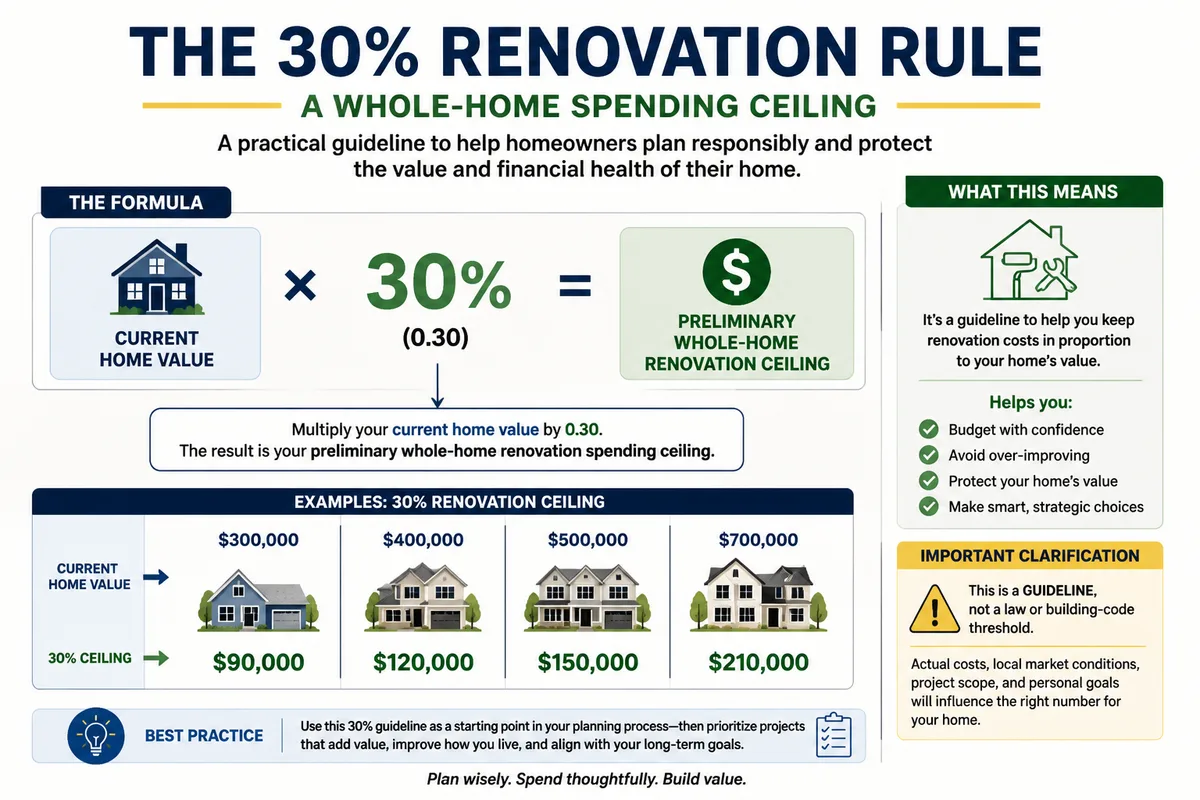
The rule has no universal legal status.
No national building code creates this percentage.
Its practical purpose is to flag possible overcapitalization, which occurs when the renovation cost becomes difficult to justify through the home’s use, condition, neighborhood, or likely resale market.
A popular claim says that staying below 30% guarantees a profitable renovation. That conclusion goes too far. A project can remain below the guideline and still lose money if the scope is inflated, the financing is expensive, or local buyers value different improvements.
How do you calculate a renovation budget with the 30% rule?
Start with a defensible current market value, multiply it by 0.30, and then test the result against your actual affordability and project requirements. The calculation is simple; choosing the right property value and defining the costs that belong inside the ceiling require more care.
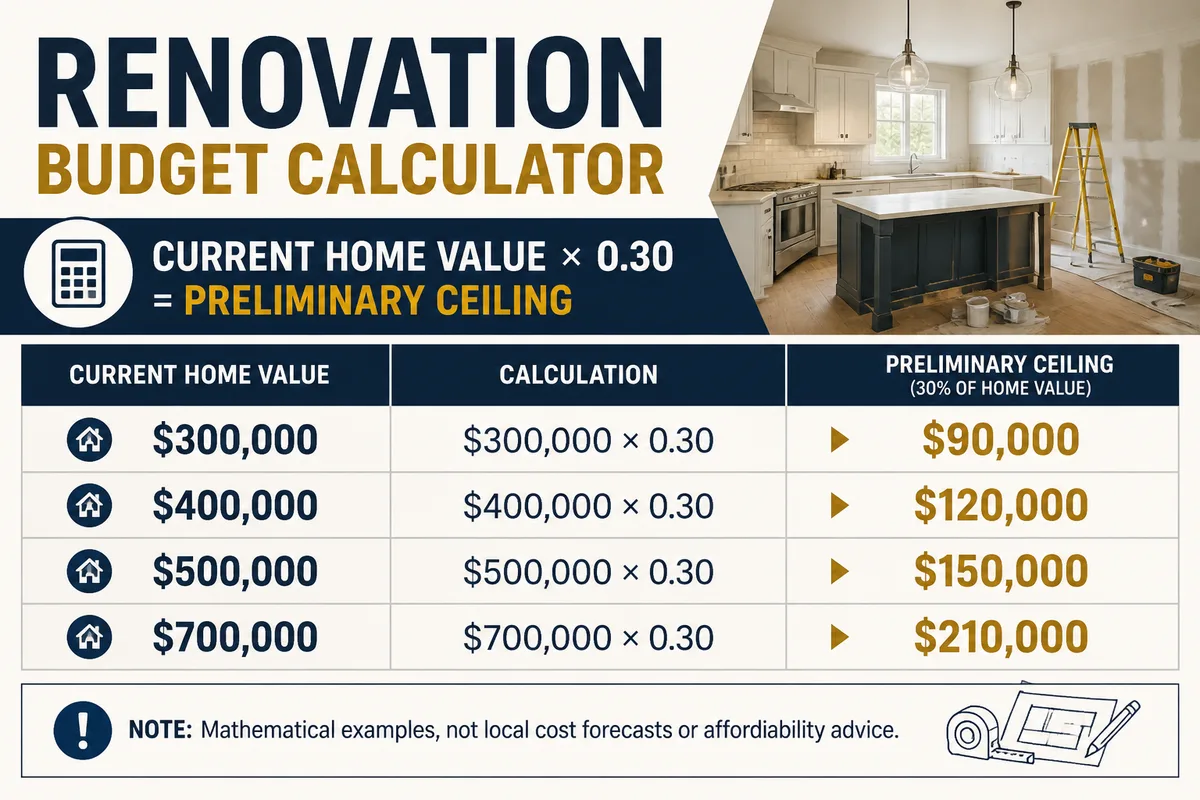
Budget ceiling = current home value × 0.30
That is the answer in one line.
Use current market value, not the original purchase price, an optimistic online estimate, or the amount still owed on the mortgage. A recent appraisal, a local real estate professional’s comparative analysis, or several relevant nearby sales can provide a stronger starting point than one automated estimate, especially when the property has unusual features.
Here are mathematical examples, not recommendations or local cost forecasts:
| Current home value | 30% calculation | Preliminary ceiling |
|---|---|---|
| $300,000 | $300,000 × 0.30 | $90,000 |
| $400,000 | $400,000 × 0.30 | $120,000 |
| $500,000 | $500,000 × 0.30 | $150,000 |
| $700,000 | $700,000 × 0.30 | $210,000 |
The arithmetic does not establish affordability. If your available cash is $35,000, your emergency savings are limited, or the monthly payment would strain the household budget, a $90,000 theoretical ceiling remains too high.
Which costs belong in the renovation budget?
A realistic home renovation budget includes the complete cost of delivering the finished work, not just visible materials. Labor, design, demolition, permits, inspections, delivery, waste removal, taxes, temporary accommodation, financing charges, and a clearly separated contingency reserve can all affect the final amount.
Materials are only one line item.
Labor often changes the project total substantially.
Ask each contractor estimate to identify the scope, quantities, labor, materials, allowances, taxes, permit responsibilities, cleanup, warranty terms, and exclusions so that two bids can be compared on the same basis rather than judged by their headline totals alone.
- Pre-construction: surveys, design, engineering, planning, and permit applications.
- Site work: demolition, protection, disposal, delivery, temporary utilities, and cleanup.
- Construction: labor, materials, fixtures, equipment, subcontractors, and inspections.
- Living costs: storage, temporary housing, meals, or additional travel when rooms become unusable.
- Contingency: a reserved amount for documented unknowns, kept separate from discretionary upgrades.
There is no single contingency percentage that suits every property. A simple, well-documented interior refresh has fewer unknowns than an older house with concealed water damage, outdated wiring, movement, mold, asbestos, or uncertain plumbing connections, so the reserve should reflect the risks identified during investigation.
How should you apply the rule to kitchens, bathrooms, and whole-home work?
The 30% renovation rule generally describes total project spending across the home, not an automatic allowance for every individual room. A kitchen or bathroom needs its own scope, measurements, quotes, and priorities; transferring the full 30% figure to one room can produce an unrealistic budget immediately.
Room budgets require narrower thinking.
A kitchen renovation may combine cabinets, appliances, worktops, plumbing, lighting, flooring, ventilation, and structural changes, while a bathroom may involve waterproofing, drainage, ventilation, fixtures, tile, and accessibility work.
| Scope | What the percentage means | Useful budgeting question |
|---|---|---|
| Whole-home project | A broad 30% planning ceiling | Can the complete program be justified and financed? |
| Kitchen project | A room-specific cost plan | Which layout, equipment, and finish choices drive the total? |
| Bathroom project | A room-specific cost plan | Are waterproofing, ventilation, and plumbing included? |
| Contingency reserve | A separate risk allowance | Which unknown conditions justify holding this money back? |
Keep essential repairs separate from optional upgrades.
Fixing an active leak takes priority.
When the available budget is limited, address water ingress, unsafe electrical work, structural defects, heating or cooling failure, and code-related problems before replacing sound finishes for cosmetic reasons.
For larger decisions, compare the renovation with moving, delaying, or completing only essential repairs. Renovating makes more sense when the location works, the existing structure is suitable, and the improvements solve problems you expect to live with for several years; moving deserves attention when the project requires major reconfiguration and still leaves the home mismatched with your needs.
When can spending more than 30% be reasonable?
Exceeding the guideline can make sense when the work protects safety, replaces failed systems, preserves a significant property, or supports long-term occupancy in a location you strongly value. The larger the departure from 30%, the stronger the documentation should be for scope, financing, property value, and personal affordability.
Safety work comes first.
Do not postpone a dangerous electrical installation, structural instability, gas issue, serious moisture problem, asbestos concern, or hazardous mold condition merely to preserve a percentage target. These situations call for qualified assessment and, where relevant, licensed or otherwise properly qualified professionals.
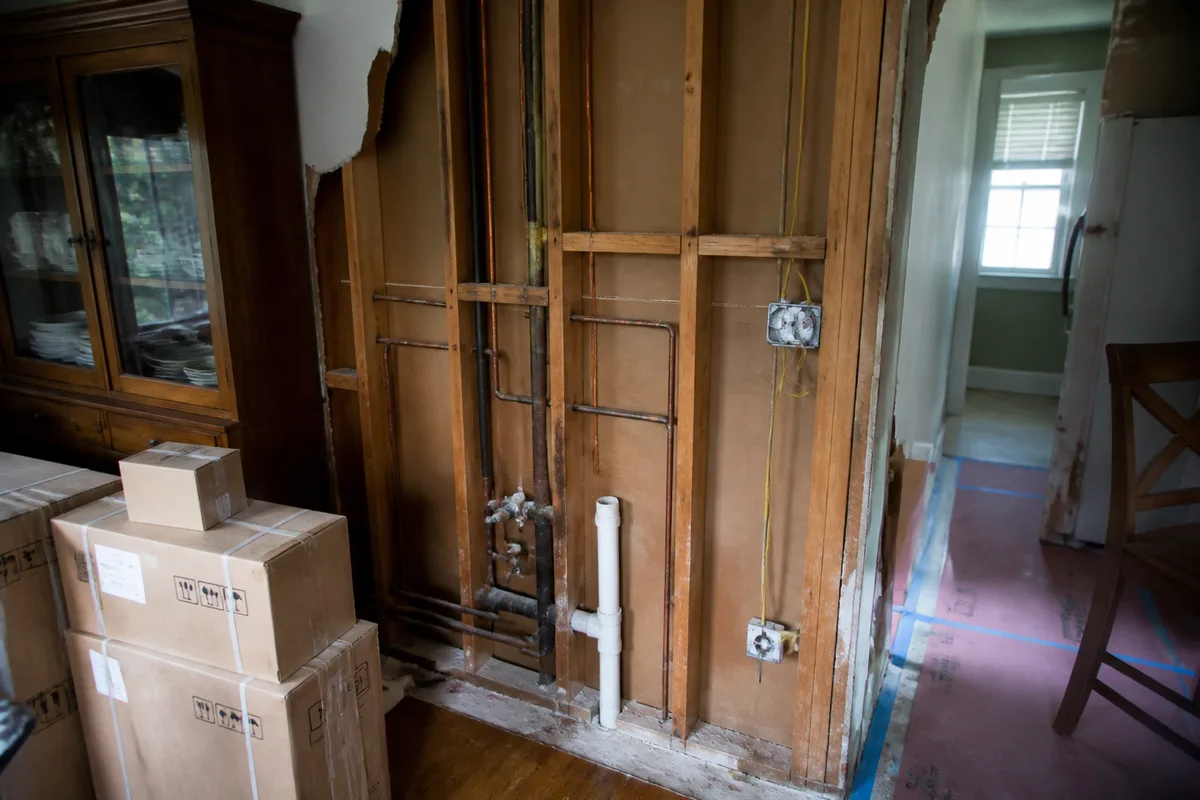
Older, historic, and poorly maintained properties bring hidden-condition risk. Opening walls can reveal damaged framing, obsolete wiring, leaking supply lines, inadequate ventilation, or previous unpermitted alterations that change both the work sequence and the cost.
High-end customization creates another exception. Imported finishes, bespoke cabinetry, complex technology, extensive layout changes, and premium equipment may suit a long-term owner, yet they can be difficult to recover at resale if nearby homes offer a more modest standard.
Spend above the guideline only with a written reason.
Verify the local market.
- Use comparable homes to assess whether the planned finish level fits the area.
- Separate mandatory repairs from lifestyle preferences.
- Confirm the financing payment under a conservative household budget.
- Obtain professional assessments for structural, electrical, gas, plumbing, asbestos, mold, or code-related concerns.
- Record which costs would remain valuable if you sold earlier than planned.
What are the most common renovation budgeting mistakes?
Most budget failures begin before construction starts: an incomplete scope, an unreliable home-value assumption, or a quote that excludes inconvenient work. The 30% rule cannot correct missing information, so the strongest protection is to make every major assumption visible before signing a contract.
Small omissions become expensive.
Watch for these specific traps:
- Using the purchase price as current value. A past transaction may no longer represent the property’s market position. Use recent evidence and record the valuation date.
- Comparing headline quotes only. One estimate may include demolition, permits, waste removal, and finish installation while another excludes them. Request an itemized comparison.
- Calling upgrades an emergency. A new layout or premium fixture can be desirable without being urgent. Place it in a separate option list until essential work is funded.
- Spending the contingency early. If the reserve pays for early design changes, later discoveries may require debt or rushed compromises.
- Ignoring professional and regulatory work. Structural calculations, permits, inspections, hazardous-material surveys, and specialist repairs can change the schedule and total cost.
DIY work needs a real value.
Include purchased materials, tool rental, disposal, your time, correction work, and any required inspection in the home renovation cost estimate; otherwise, the apparent saving can conceal a delayed project or a poor-quality result that costs more to fix.
How can you keep a renovation within budget?
Control comes from a written scope, itemized estimates, staged decisions, and cost tracking from the first design fee to the final invoice. If the numbers stop working, reduce scope or phase the work; do not quietly remove safety tasks or rely on an unprotected contingency fund.
Write the scope before choosing finishes.
Specify room dimensions, materials, quantities, installation standards, exclusions, completion requirements, and who obtains permits. A change-order process should record the requested change, its price, its schedule effect, and approval before the work proceeds.
- Define the outcome. List the rooms, defects, functional goals, preferred finishes, and work that remains outside the project.
- Confirm the property condition. Investigate structure, moisture, wiring, plumbing, ventilation, hazardous materials, and likely permit requirements.
- Set the initial ceiling. Multiply the current market value by 0.30, then lower the working budget if affordability or savings cannot support the result.
- Build the cost breakdown. Add design, labor, materials, permits, taxes, delivery, demolition, temporary living expenses, and contingency.
- Collect comparable estimates. Give contractors the same written scope and ask them to identify allowances, exclusions, assumptions, and lead times.
- Approve a phase plan. Fund essential repairs first, protect the building envelope and systems, then schedule optional upgrades only when the remaining budget is clear.
- Track committed and paid costs. Update a spreadsheet weekly and treat approved changes as part of the total immediately.
Track commitments, not only payments.
Unused allowances can be misleading.
A renovation budget calculator should show at least the approved contract value, signed changes, deposits, unpaid invoices, purchased materials, contingency balance, and projected final total so that a comfortable bank balance does not hide future obligations.
How should renovation return on investment influence the decision?
Renovation return on investment can inform a choice, yet it cannot guarantee that a homeowner will recover the spending. Results vary with location, timing, workmanship, buyer preferences, project quality, sale costs, financing, and the difference between a broad market average and one specific property.
Resale value is only one test.
A renovation may improve comfort, accessibility, energy performance, safety, storage, or daily function without producing a matching sale price. Those benefits matter when you plan to remain in the home, although they should still be weighed against the money tied up in the project.
Published cost-versus-value reports can offer context when their edition, region, project definition, and methodology are checked. Do not transfer a percentage from a national or regional report directly to your home without confirming that the project scope and market are comparable.
Use local evidence before making a resale claim.
Ask a qualified local property professional for comparable sales analysis, and keep financial projections separate from personal preference. A projected gain is an estimate, not a guaranteed outcome.
Which sources should you check before approving the budget?
Use different sources for different facts: valuation evidence for the property’s market value, local authorities for permits and code requirements, qualified specialists for defects, and itemized contractors’ estimates for project pricing. No single source can establish the correct renovation budget for every property and household.
Start with primary information.
Check your local building department for permit requirements, the relevant state or local licensing authority for regulated trades, and official consumer guidance from the Consumer Financial Protection Bureau before taking on renovation debt.
- Property value: recent comparable sales, a qualified appraisal, or a documented local market analysis.
- Permits and code: your city or county building department.
- Hazards: appropriately qualified specialists for asbestos, mold, structural movement, gas, or electrical risks.
- Costs: multiple itemized estimates based on the same written scope.
- Financing: official lender disclosures showing interest, fees, payment, term, and consequences of borrowing.
Verify dates and assumptions.
Before committing, recalculate the home improvement budget with the latest quotes, confirmed permit information, current financing terms, and a contingency reserve that reflects the property’s known risks rather than a copied percentage.