How to Promote Your Business Locally for Free and Reach More Nearby Customers
How can you promote your business locally for free? Start with a complete Google Business Profile, consistent business listings, clear local SEO, genuine customer reviews, and direct referrals before adding social media and community activity.
These methods require time and regular attention rather than an advertising budget, and the results depend on your location, offer, competition, and consistency. The practical priority is simple: make your business easy to find, easy to trust, and easy to contact.
Which free local promotion steps should you take first?
Begin with the channels that capture existing local demand: Google Business Profile, accurate listings, service-area information, genuine reviews, and a clear contact path. Then add community posts, social content, referrals, and partnerships that create repeated exposure around the places and problems your customers already recognize.
Start with visibility.
Complete these actions in order:
- Claim and complete your Google Business Profile.
- Check your business name, address, phone number, and hours everywhere.
- Add clear service and location information to your website.
- Ask satisfied customers for honest reviews without offering prohibited incentives.
- Publish useful local content on the platforms your customers already use.
- Contact complementary local businesses about referrals or joint activities.
A shop, tradesperson, consultant, or local professional can use the same sequence, although the best examples and customer contact points will differ by business type. A plumber may emphasize emergency service areas, while a café may focus on opening hours, photos, local events, and repeat visits.
How do you use Google Business Profile to promote a business on Google Maps?
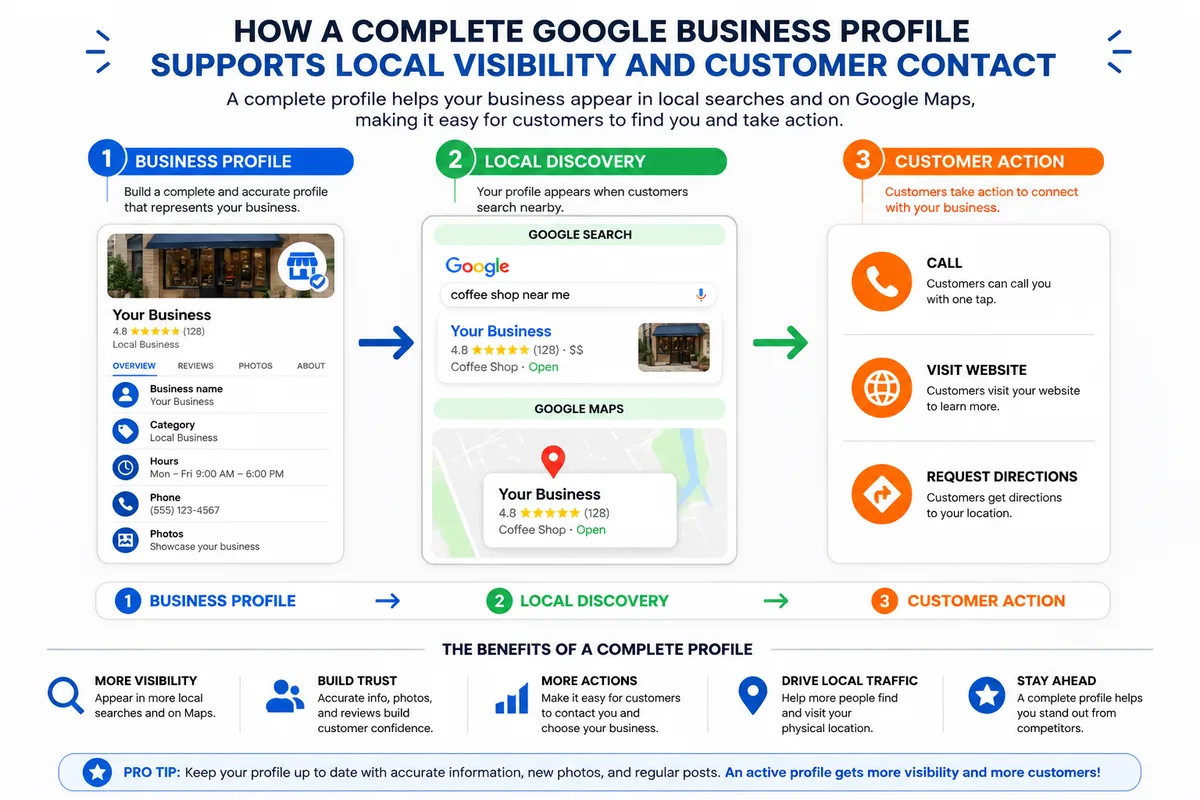
Google Business Profile is a free tool for controlling how an eligible business appears in Google Search and Google Maps. A complete profile should make the business identity, location or service area, contact details, opening hours, photos, category, and customer feedback clear to nearby searchers.
Step 1: Claim and verify the profile
Search for your business name in Google Business Profile and follow the current verification process shown by Google. The available verification method depends on the business and account, so use the instructions inside the official Google Business Profile interface.
Use the real business identity.
Do not create duplicate profiles for the same location or use a misleading address simply to appear in another area. Service-area businesses should describe where they actually work and follow Google’s current eligibility guidance for address display.
Step 2: Complete every important field
Use one consistent business name, the correct primary category, a working phone number, accurate hours, relevant services, and recent photos that represent the real business. A profile with missing details creates friction because customers must search elsewhere for basic answers.
Hours deserve special attention.
Update holiday hours and temporary closures when relevant, then check whether the displayed phone number and website still work; a technically complete profile can still lose inquiries when the contact route fails.
Step 3: Publish useful updates
Share genuinely useful updates such as a new service, a seasonal schedule, a local event, a practical answer, or a clear explanation of how customers can prepare for a visit. Avoid turning every post into a sales message, because local relevance matters more than posting volume.
How can local SEO and directories improve local online visibility?
Local SEO works when your website and listings clearly explain what you do, where you operate, and how people can contact you. Combine service-specific pages, natural location wording, accurate directories, and an easy mobile contact experience instead of repeating the same city name unnaturally.
Create useful service and location pages
Build one strong page for each important service rather than making nearly identical pages for every nearby town. A page for residential plumbing in Austin, for example, should explain the service, the areas genuinely covered, the response process, and the correct contact method.
Specific pages answer specific searches.
Include customer questions, service limits, photos of real work where appropriate, and practical information such as appointment expectations or access requirements; this gives visitors a reason to stay and contact you.
Keep listings accurate
Submit your business to relevant free directories, industry associations, chambers of commerce, and local organizations when the listing is genuinely useful to customers. Keep the business name, address, and phone number consistent across profiles so people and search systems receive fewer conflicting signals.
Quality beats quantity.
Ten accurate listings in relevant places are more useful than dozens of neglected profiles that contain old hours, broken websites, or inconsistent business names.
Make the website easy to trust
Show the services offered, service area, contact details, opening hours, customer policies, and clear next steps without forcing visitors through a complicated menu. Add a visible phone number or inquiry form, especially for mobile users who may be ready to act immediately.
How should you build reviews, referrals, and word-of-mouth?
Ask real customers for honest reviews shortly after a completed service, successful appointment, or positive interaction. Reviews support trust, while referrals turn satisfied customers into a local acquisition channel; neither tactic guarantees new business, and both require a genuine customer experience first.
Ask at the right moment.
Request genuine reviews
Send a short message with the correct review link and explain that honest feedback helps people understand the service. Do not write reviews for customers, pressure them toward a specific rating, or offer incentives that breach platform rules or local regulations.
Make the request easy.
A useful message might say: “Thank you for choosing us. If you have a moment, please share honest feedback about your experience on our business profile.” Keep the wording simple and avoid asking several times.
Respond professionally
Thank customers for positive feedback and address negative comments calmly, without revealing private information or arguing in public. If a complaint needs investigation, invite the customer to use a private contact route while keeping the public response brief and respectful.
Build a simple referral process
Tell satisfied customers exactly who you help and how they can introduce someone, such as forwarding a booking link or sharing a service page. A vague request for “more referrals” creates work for the customer, while a specific description makes the recommendation easier.
How can social media and community channels reach nearby customers?
Choose social platforms according to customer behavior, not popularity alone. Facebook, Instagram, LinkedIn, WhatsApp, neighborhood networks, and local discussion groups can support free local marketing when posts answer real questions, show relevant activity, or help residents find a suitable nearby service.
Publish useful local content
Share location-tagged updates, customer stories with permission, seasonal advice, behind-the-scenes information, staff introductions, local offers, and answers to recurring questions. A bicycle repair shop might explain how to prepare a bike for a commute, while a fitness professional could publish a safe local walking route checklist.
Useful beats promotional.
Keep the local connection specific, because a generic motivational post rarely gives nearby customers a reason to remember your business or start a conversation.
Participate without spamming
Read the rules of local groups before posting, answer questions where your expertise genuinely helps, and disclose your business connection when recommending your own service. Repeated promotional comments, unsolicited direct messages, and copied posts can damage trust and may lead to moderation or removal.
Use neighborhood platforms carefully
Nextdoor states that businesses can claim a professional page and create free business posts, with audience settings that can include a radius or selected neighborhoods; features and eligibility should be checked in the current Nextdoor business documentation.
Use a professional page connected to the correct business, then select the current content or post option shown by the platform. Treat platform claims about audience size or recommendation influence as promotional statements unless an independently verifiable methodology is available.
Which local promotion channels are free, low-cost, or paid?
Free local business promotion usually means no media fee, while low-cost tactics may require printing, transport, event materials, or software upgrades. Paid advertising buys additional reach; it can be useful for speed, yet it is not required to establish the basic local visibility system described here.

| Channel | Typical cost category | Best use | Main limitation |
|---|---|---|---|
| Google Business Profile | Free | Capture local search and Maps intent | Requires accurate information and ongoing updates |
| Website and local SEO | Free if self-managed | Explain services, locations, and contact options | Needs useful content and technical maintenance |
| Reviews and referrals | Free | Build trust through real customer experiences | Cannot be manufactured safely or guaranteed |
| Community activity | Free or low-cost | Develop local familiarity and relationships | Requires time and respectful participation |
| Printed flyers and events | Low-cost | Reach people in a defined neighborhood | Printing, distribution, or venue costs may apply |
| Search or social advertising | Paid | Accelerate reach for a specific offer | Requires budget and careful conversion tracking |
Choose free channels first.
For a business with no advertising budget, Google visibility, accurate listings, reviews, referrals, and direct community participation deserve priority over buying impressions; paid promotion becomes a separate decision when the business needs faster reach and can measure the resulting inquiries.
How do you create local partnerships and offline promotion?
Complementary businesses can exchange relevant referrals, organize joint activities, promote each other’s services, or support a local event. Offline tactics such as business cards, flyers, noticeboards, workshops, and community events work best when they appear in places where the intended customers already spend time.
Find complementary partners
List businesses that serve the same audience without selling the same core service. A wedding photographer could approach florists and venues, while a home organizer might connect with movers, estate professionals, and cleaning companies.
Choose relevance over reach.
Suggest one clear collaboration, such as a shared checklist, a joint workshop, a local offer with transparent terms, or a referral handoff that respects the customer’s choice.
Run a useful local activity
Workshops and free webinars can demonstrate expertise and answer practical questions, provided the subject is genuinely useful and the registration process respects permission. Local events, professional meetups, and trade shows can also strengthen recognition when participation matches the business audience.
Use offline materials responsibly
Place flyers or cards only where permission exists, include a clear service description, and use a simple tracking method such as a dedicated phrase or contact form. Do not cover public property, interrupt private premises, or distribute misleading offers.
How can email and retention marketing bring customers back?
Email is useful after a customer has clearly agreed to receive messages and understands what those messages contain. A small permission-based list can support reminders, seasonal advice, appointment follow-ups, useful local information, and repeat visits without requiring paid advertising.
Permission comes first.
Collect only the information needed, explain the frequency and purpose of messages, and provide a straightforward unsubscribe route; privacy obligations differ by jurisdiction, so confirm the rules that apply to your business before sending campaigns.
Segment messages by customer need when the list is large enough to justify it. A local repair business might separate maintenance reminders from first-time customer guidance, while a retailer could distinguish product updates from event invitations.
What should your free 30-day local promotion plan look like?
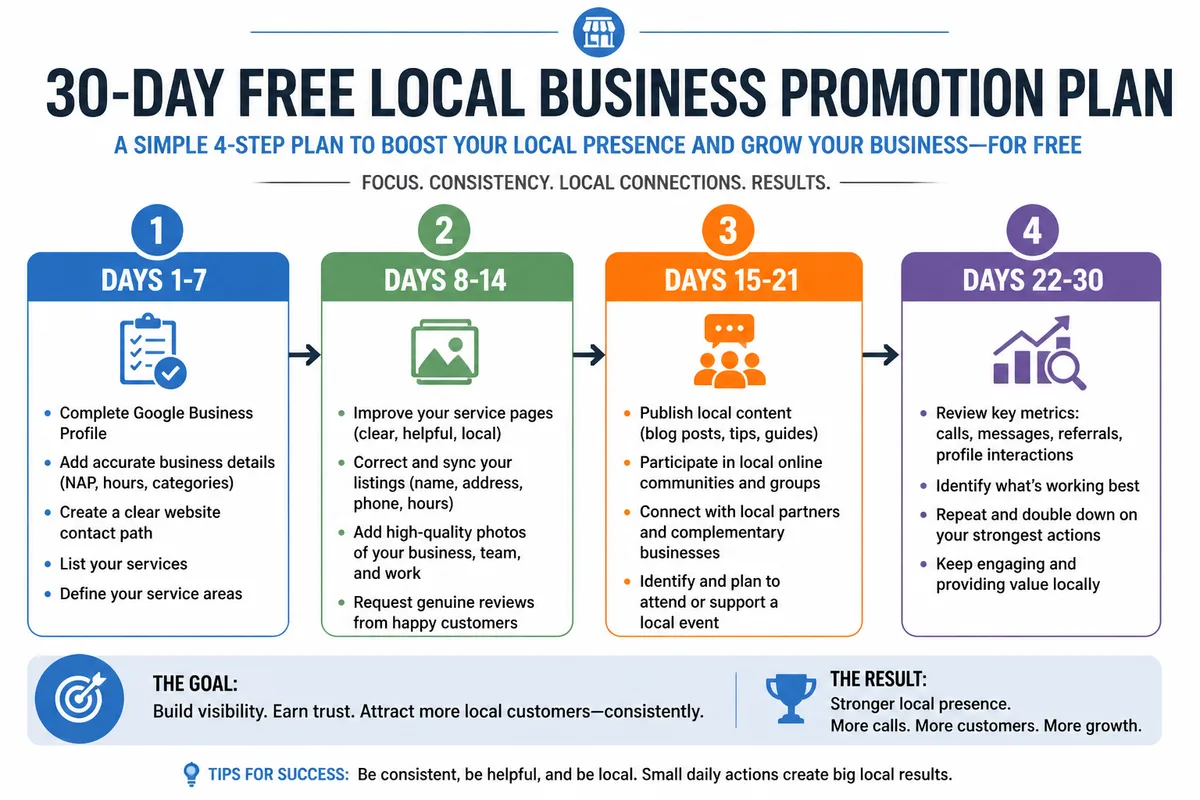
A 30-day plan turns scattered free marketing ideas into repeatable work. Complete the essential visibility assets first, then add trust signals, community activity, and measurement; this sequence prevents a business from publishing social content while its phone number, hours, or service information remain unclear.
Step 1: Establish the foundation
During days 1 to 7, claim the Google Business Profile, correct the main business details, check the website contact path, and list the services and areas genuinely covered.
Record the starting point.
Note the current number of reviews, profile questions, calls, form inquiries, and direction requests available in your business tools, while recognizing that platform reporting labels and availability can change.
Step 2: Build trust and discoverability
During days 8 to 14, add appropriate photos, improve service pages, correct relevant directory listings, and send a polite review request to recent satisfied customers. Prepare a short response style for both positive and negative feedback.
Fix weak contact paths immediately.
Step 3: Reach the local community
During days 15 to 21, publish useful local posts, answer relevant community questions, contact two complementary businesses, and identify one event, workshop, or local group that fits your audience.
Be visible without being intrusive.
Step 4: Measure and improve
During days 22 to 30, review which activities generated calls, messages, visits, referrals, or meaningful conversations, then keep the strongest two or three actions in the next month’s routine.
Consistency beats random bursts.
How do you measure whether free promotion is working?
Track actions that connect visibility with business activity: calls, contact forms, booking requests, direction requests, profile interactions, review volume, referral mentions, and event registrations. Compare channels using the same period and record what changed, because one isolated increase cannot explain which activity caused it.
Use a simple tracking sheet
- Date and activity published.
- Channel used.
- Offer, service, or question addressed.
- Calls, messages, forms, bookings, or referrals received.
- Customer wording that reveals how they found you.
- Next action to repeat, change, or stop.
Ask every new inquiry one neutral question: “How did you hear about us?” Record the answer without leading the customer toward Google, social media, or a referral, then compare patterns over several review periods.
Do not chase vanity numbers.
A large follower count can matter less than a small number of relevant local inquiries, while a useful profile update may support a customer who never publicly interacts with it.
What mistakes weaken free local business promotion?
Most failures come from inconsistent information, weak follow-through, or tactics that create attention without trust. Avoid the following traps, because each one either wastes limited time, creates platform risk, or makes it harder to identify which activity actually produces customer contact.
Using several conflicting business identities
Different names, addresses, phone numbers, or opening hours across listings confuse customers and weaken confidence. Choose the accurate version, update the important directories, and remove duplicate profiles where the platform provides a legitimate process.
Asking for only positive reviews
Directing customers to praise rather than share honest feedback can violate platform rules and distort expectations. Ask for genuine reviews from real customers, then respond professionally to the feedback received.
Posting everywhere without a customer reason
Opening accounts on every network creates maintenance work without guaranteeing local reach. Select the platforms used by your audience and publish material tied to a local question, service, event, or customer need.
Using location keywords unnaturally
Repeating a town name in every sentence makes pages harder to read and provides little additional information. Name the service area where it matters, then use specific service details, local constraints, and clear contact information to demonstrate relevance.
Treating free as effortless
Free promotion still costs time, attention, photography, writing, customer service, and follow-up. Plan a sustainable weekly workload, because an abandoned profile or unanswered review can undermine the credibility created by earlier activity.
Which sources should you check before publishing a local promotion plan?
Platform interfaces, eligibility rules, directory policies, and privacy requirements can change, so confirm current instructions before making a recommendation or creating an account. Use official documentation for platform behavior and local authorities for legal, business, data-protection, or advertising requirements.
Check the source before acting.
- Google Business Profile Help: profile eligibility, verification, business information, reviews, and Maps features.
- Google Search Central: search guidance, structured data documentation, and website visibility principles.
- Nextdoor Business documentation: professional pages, business posts, audience settings, and current availability.
- Local government or chamber resources: permits, event rules, signage requirements, and local business opportunities.
- Applicable privacy authority: permission-based email, contact data, and unsubscribe requirements.
For a small business, free local marketing works best as a routine: keep the profile accurate, make the website useful, ask for honest feedback, participate in the community, and measure real inquiries rather than chasing promises of instant visibility.