Planning a Trip With Friends: How to Agree on Money, Dates and Activities
Planning a trip with friends works best when the group agrees on the destination, travel style, budget, duration, interests, accommodation, meals, transport and decision-making process before anyone pays a deposit.
A shared planning document, clear responsibilities and optional activities turn different preferences into a workable plan, while written payment and cancellation rules prevent awkward conversations later.
Start with the same expectations
Before comparing destinations, agree on what the trip should feel like: restful, active, social, cultural or spontaneous. A short conversation about budget, comfort, walking, nightlife, food, accessibility and free time prevents one person from planning a luxury city break while another expects a low-cost beach weekend.
Keep the first decision simple.
Define the purpose and travel style
Ask each participant to answer the same questions in writing. Written answers reveal differences that casual group chat messages often hide, especially when enthusiastic suggestions make an expensive or demanding itinerary appear more popular than it really is.
- What is the main purpose: relaxation, sightseeing, nightlife, nature or shared time?
- What spending range feels comfortable?
- How many hours of activity feel realistic each day?
- Which comforts are essential?
- Which activities are optional?
- Are there mobility, sensory, medical, dietary or childcare needs?
Ask everyone to identify one non-negotiable and one flexible preference. This gives the group a practical starting point instead of forcing every decision into a vague compromise where nobody knows what matters most.
Set group decision rules
Agree in advance which choices require everyone’s approval and which choices can be delegated. Destination, dates, accommodation cost and shared transport usually affect the whole group; a museum visit or restaurant choice can often remain optional.
Use one decision method consistently:
- Consensus: use it for major commitments that affect every traveller.
- Voting: use it when several realistic options remain and the group is large.
- Delegation: assign one person to research or book a defined item within agreed limits.
- Negotiation: trade priorities, such as a cheaper hotel in exchange for one paid activity.
Negotiation is usually the strongest tool for genuine disagreements because it allows the group to adjust cost, timing or comfort instead of treating every decision as a winner-takes-all vote.
How should friends agree on a group travel budget?
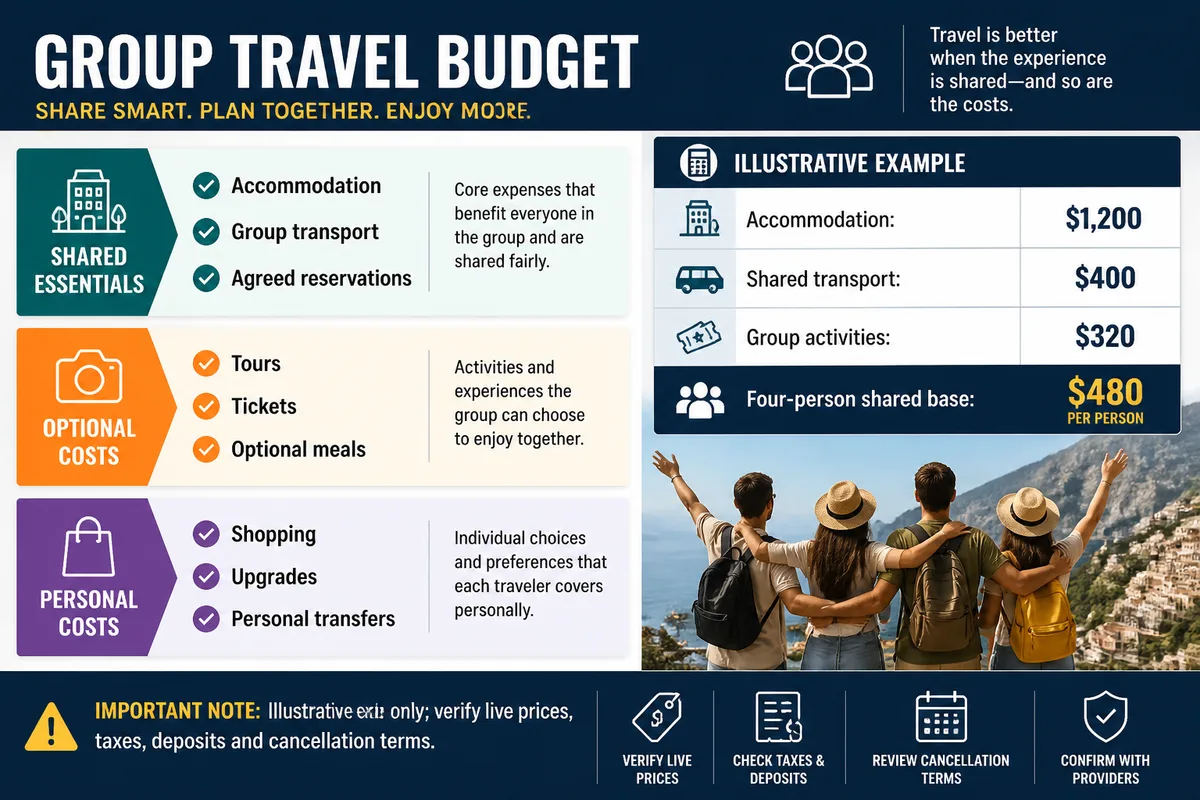
Set a spending range before choosing flights, rooms or activities, then separate shared expenses from personal choices. The fairest split usually reflects actual use: a shared transfer is divided among users, while a private room upgrade stays with the person requesting it.
Money needs clear rules.
Establish a realistic spending range
Create three figures for each traveller: a preferred total, a maximum comfortable total and a payment deadline. Include transport, accommodation, meals, activities, local travel, booking fees, insurance and a contingency amount without presenting an invented price as a current market standard.
Use this simple worksheet:
- Shared essentials: accommodation, group transport and agreed reservations.
- Shared optional items: tours, tickets or meals that everyone explicitly accepts.
- Personal costs: shopping, upgrades, alcohol, private transfers and optional activities.
- Contingency: an agreed reserve for disruptions or unexpected practical costs.
For example, a hypothetical four-person group might estimate a shared accommodation total of $1,200, shared transport of $400 and group activities of $320; the shared base would equal $1,920, or $480 per person before personal spending.
That example is illustrative only. Confirm live prices, taxes, deposits, exchange rates and cancellation terms directly with each provider before treating the estimate as a booking budget.
Make the cost split fair
Choose the split before the first payment. Equal division suits identical rooms and shared services, while itemised division is more appropriate when travellers have different rooms, transport needs, meal choices or activity participation.
| Expense | Fair allocation | Record before booking |
|---|---|---|
| Shared accommodation | Equal split or room-based split | Room type, occupants and total price |
| Optional activity | Only participating travellers | Participants and cancellation deadline |
| Group meal | Equal split or itemised bill | Dietary needs and payment method |
| Private upgrade | Person requesting the upgrade | Extra amount and approval |
Set payment and cancellation rules
Write down who pays the provider, when reimbursements are due and what happens if someone cancels. A person who advances money for the group should receive confirmation of the amount owed, the deadline and the booking conditions in the shared document.
Track expenses as they happen.
Expense-sharing tools such as Splitwise can record contributors and calculate balances, while a spreadsheet remains useful for deposits, booking references and cancellation dates.
Never pressure a friend into borrowing money or hiding an unaffordable cost. If the original plan exceeds someone’s limit, reduce the shared commitment, offer an optional part of the trip or create a separate arrangement before booking.
How do you choose dates and a destination without endless debate?
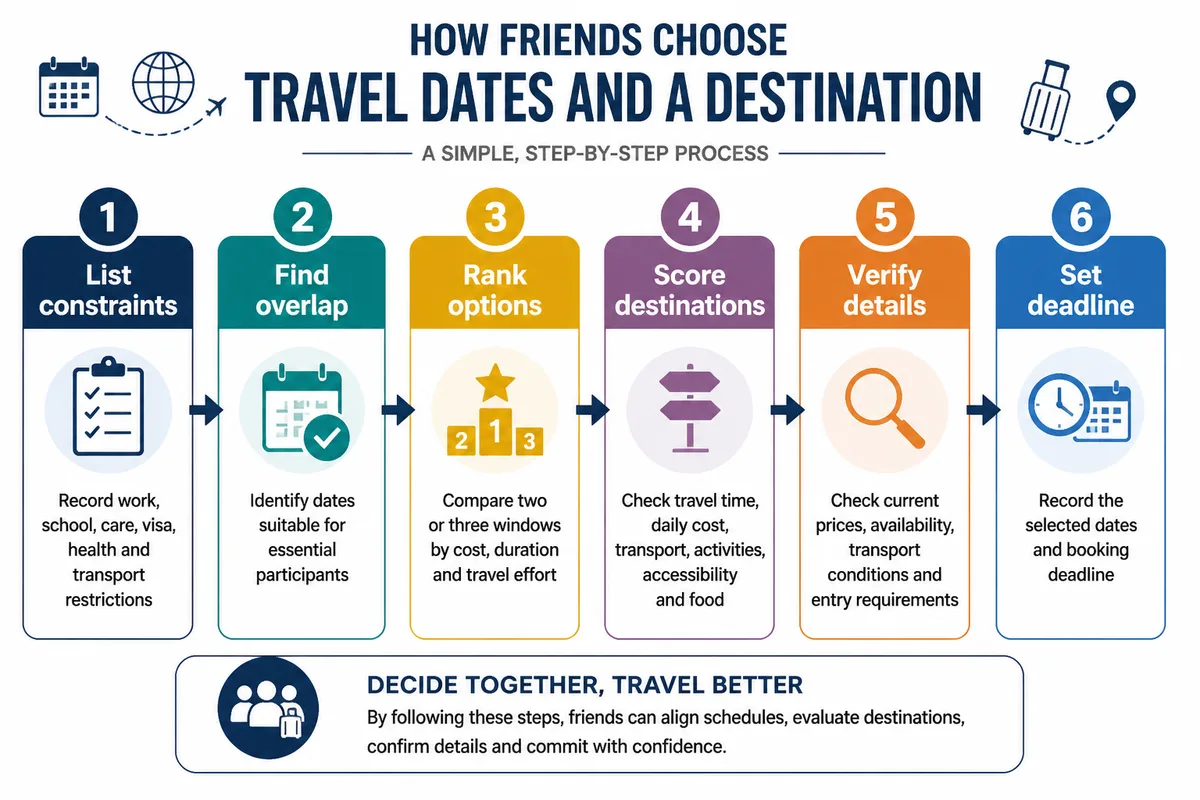
Collect availability first, then compare destinations against the group’s budget, duration, transport options, travel pace and accessibility needs. A destination becomes workable when it satisfies the non-negotiable criteria and leaves enough time for the group to enjoy the place without rushing between bookings.
Start with dates.
Collect availability efficiently
Ask everyone to submit unavailable dates and preferred travel windows by a fixed deadline. A shared calendar or simple poll works well when each person uses the same format, including departure location and whether arrival or departure days are flexible.
- List constraints: record work, school, care, visa, health and transport restrictions.
- Find overlap: identify dates that suit the essential participants.
- Rank options: compare the strongest two or three windows by cost, duration and travel effort.
- Set a decision deadline: close the poll and record the selected dates in the shared document.
Do not ask the group to debate every possible weekend.
Choose the destination with practical criteria
Score each destination against the same criteria: total travel time, accommodation availability, expected daily cost, transport simplicity, activity fit, accessibility, food options and cancellation flexibility. The scoring method matters less than applying it openly to the same shortlist.
Use a five-column comparison:
- What the destination offers the group.
- What it makes difficult.
- Which traveller benefits most.
- Which compromise it requires.
- What must be verified before payment.
For current prices, availability, transport conditions and entry requirements, check the official destination, carrier and government websites immediately before booking because these details change over time.
Match duration to the group’s energy
A dense itinerary can exhaust people before the shared activities begin, especially when the group combines different fitness levels, arrival times or mobility needs. Treat suggested durations as planning prompts, then count transfer time, arrival recovery and realistic daily movement.
Choose fewer bases when the group values ease.
For a multi-city plan, count accommodation changes and long transfers as activities in their own right; a route with several stops may look attractive on paper while leaving little time for the places listed.
How do you build an itinerary everyone can enjoy?
Build each day around one main shared activity, practical travel time and open space for rest or separate plans. This structure gives the group a clear friends trip itinerary without turning every hour into a mandatory appointment that punishes late risers, tired travellers or different interests.
Leave room to breathe.
Balance group activities and free time
Mark activities as essential, preferred or optional. Everyone attends essential plans, preferred plans require a quick group check, and optional plans remain opt-in so people can rest, explore independently or manage a personal need without creating conflict.
A useful daily template includes:
- One fixed anchor, such as a booked attraction or shared meal.
- One flexible block for nearby options.
- Travel time with a realistic buffer.
- A meal arrangement that includes dietary requirements.
- Free time with no explanation required.
Time buffers allow the group to adjust the itinerary when energy, weather, delays or mood change; they also stop one late connection from disrupting every reservation that follows.
Plan meals, transport and accessibility together
Accommodation, meals and transport affect one another. A cheaper room far from public transport may increase daily travel costs, while a central location may reduce transfers but limit room size or quiet space.
Check these details before confirming:
- Bed arrangements, bathrooms, stairs, lifts and accessible entrances.
- Kitchen access and the number of meals planned at home.
- Dietary restrictions, allergies and suitable restaurant options.
- Last transport connections and backup routes.
- Walking distances between accommodation, stations and activities.
Book restaurants with limited capacity well ahead of the meal date after confirming the final participant list, especially when the group needs specific dietary accommodation or accessible seating.
How should the group organise responsibilities?
Assign ownership for each task instead of making everyone responsible for everything. One person may research accommodation, another may track payments, and another may check transport, while major commitments still require the approval rule agreed by the group.
Ownership prevents forgotten tasks.
Build one shared planning document
Use a shared spreadsheet, document or planning application with editing access for the relevant travellers. The goal is a single reliable record containing decisions, links, amounts and deadlines rather than scattered information across private messages.
Create these sections:
- Decisions: destination, dates, group members and agreed travel style.
- Budget: estimated totals, deposits, contributors and balances.
- Bookings: confirmation numbers, addresses, check-in times and cancellation terms.
- Itinerary: essential plans, optional activities and travel buffers.
- Responsibilities: owner, deadline, status and backup person.
- Safety and documents: emergency contacts and each traveller’s document responsibilities.
Keep the final version easy to read on a phone. A complicated planning tool that nobody updates creates less certainty than a plain document with current information.
Assign tasks with deadlines
Use named ownership for research, booking, payments, restaurant reservations, accessibility checks and transport confirmation. Add a second person to critical bookings so the group can still access information if the primary organiser becomes unavailable.
Record the result immediately.
Which group-trip planning model suits your friends?
Self-planning gives the group the greatest control, while delegated or outsourced formats reduce coordination work. Choose the model according to group size, flexibility, decision speed and budget tolerance, rather than assuming that one organiser or one platform suits every friendship group.
There is no universal format.
| Planning model | Best suited to | Main advantage | Main drawback |
|---|---|---|---|
| One lead planner | Small groups with a trusted organiser | Fast decisions and consistent itinerary | High workload for one person |
| Shared planning | Friends who want equal involvement | Distributed research and responsibility | Slower decisions without deadlines |
| Opt-in activities | Groups with different interests or energy | Flexible participation and spending | Fewer moments with the entire group |
| Travel agent or tour operator | Groups seeking outsourced logistics | Less direct coordination work | Reduced flexibility and possible additional cost |
| Smaller trip | Friends struggling to align schedules | Simpler communication and booking | Some friends may remain outside the plan |
For a large group with conflicting schedules, opt-in planning is the strongest choice. For a small group with similar expectations, shared planning usually creates better visibility without adding unnecessary layers.
How can you handle group travel disagreements?
Handle disagreements by separating fixed constraints from preferences, then offer a concrete trade-off. A friend who cannot exceed a budget needs a different solution from a friend who simply prefers another restaurant, and treating both concerns as equal vetoes stalls the entire trip.
Address friction early.
Use a clear disagreement script
Ask each person to state the concern, the limit and the acceptable alternatives. For example: “My maximum for accommodation is $X. I can accept a smaller room, a less central location or a shorter stay.” The group can then respond to options instead of personalities.
Apply these rules:
- Pause a booking when a participant has not understood the total cost.
- Separate shared obligations from optional upgrades.
- Give the person affected by a constraint a clear voice.
- Set a decision deadline after presenting two or three workable alternatives.
- Allow someone to skip an optional activity without criticism.
Challenge the common myth
“If everyone is really excited, the details will sort themselves out.” That belief fails when deposits, different budgets, sleep preferences or accessibility requirements appear after booking, because enthusiasm cannot rewrite a cancellation policy.
Write the difficult details down.
Negotiation preserves more options than avoidance. A silent disagreement usually reappears as a missed payment, a resentful compromise or a last-minute cancellation, when changing the plan costs more time and money.
Final group trip checklist
Complete the operational checks before departure, then keep essential information available offline. The final review should confirm who is travelling, what has been paid, which reservations can be cancelled and what the group will do if transport, weather, health or accommodation creates a disruption.
Check every deadline.
Two to four weeks before departure
- Confirm the final traveller list and room allocation.
- Recheck booking names, dates, addresses and cancellation terms.
- Collect outstanding shared payments.
- Verify current transport conditions and local travel requirements through official sources.
- Confirm dietary, accessibility and medical arrangements with relevant providers.
- Save confirmations, contact details and directions offline.
- Assign responsibility for arrival, navigation, meals and emergency communication.
During the trip
- Update shared expenses on the day they occur.
- Confirm the next day’s essential activity and meeting point.
- Keep optional plans genuinely optional.
- Leave room for rest and separate activities.
- Tell the group promptly when a delay or cost changes.
The practical test is simple: every traveller should know the next essential commitment, the amount they owe and the person responsible for each unresolved task.
Planning a trip with friends becomes manageable when decisions are visible, costs are explicit and participation remains flexible. Agree on the financial limits first, record the dates and responsibilities, then build an itinerary that gives the group shared experiences without demanding identical preferences.