Can You Sleep in a Train Car?
Yes, you can sleep in a train car when the service provides a sleeping car, berth, private room or sleeper cabin. A normal passenger seat may let you rest, but it does not automatically convert into a bed, so the accommodation type matters from the moment you book.
There is also a second meaning: some railway carriages are permanently parked and converted into holiday accommodation. That gives you the atmosphere of a train without travelling overnight. The practical details—bed size, privacy, bathroom access, heating and occupancy—vary widely between operators and properties.
| 🚆 | Moving sleeper train: a train equipped with beds or sleeping compartments for an overnight journey. |
| 🪑 | Standard seat: suitable for resting, but not necessarily designed or sold as a bed. |
| 🛏️ | Room options: berths, roomettes, bedrooms, family rooms and suites can provide different levels of privacy. |
| 🚿 | Facilities: toilets, showers, bedding, meals and attendant services depend on the operator and train. |
| 🏚️ | Stationary carriage stay: a converted railway vehicle used as a hotel or holiday rental rather than a moving train. |
| 🔎 | Booking check: confirm the exact route, bed layout, facilities, occupancy and current fare before paying. |
Can You Sleep on a Moving Train?
Yes, but you need a designated sleeping accommodation for a proper bed. Sleeper trains may offer private rooms, shared berths or couchettes, while ordinary carriages normally provide seats rather than beds. The safest assumption is simple: if the booking does not name a sleeper compartment or bed, expect a seat.
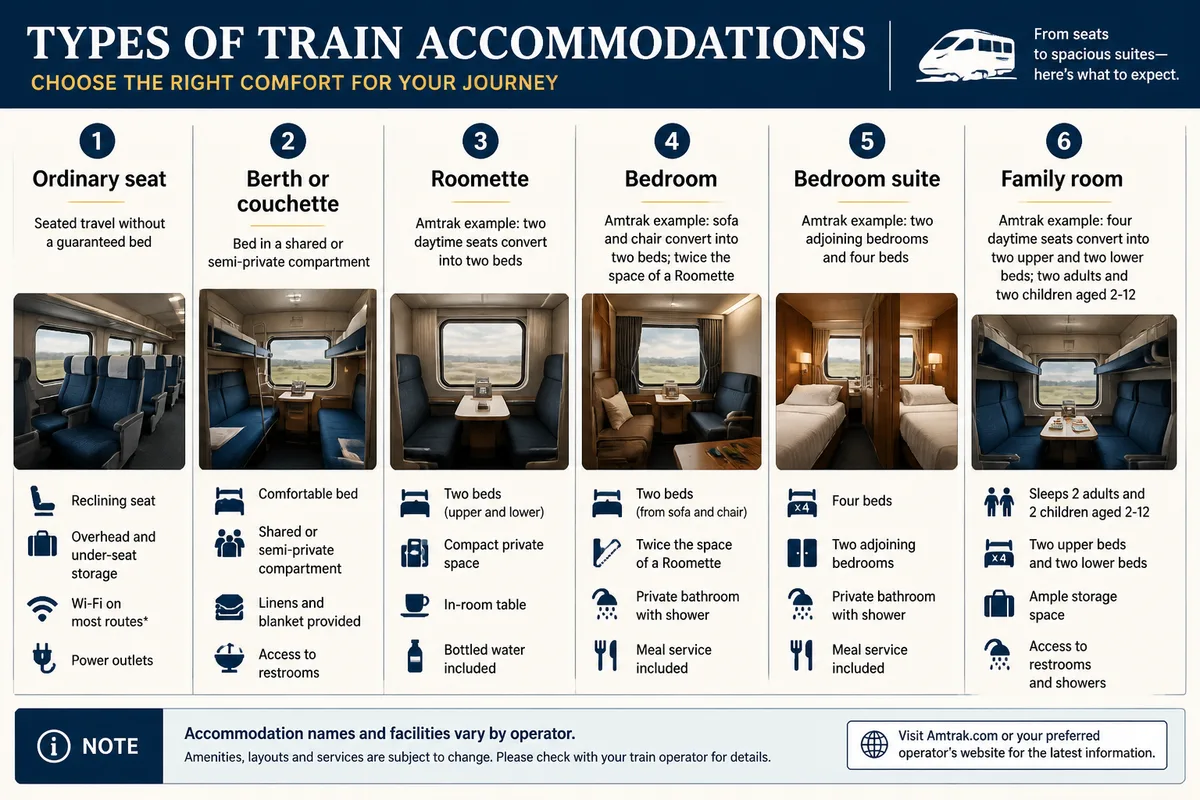
A regular seat is not the same as a sleeping berth. A seat might recline and may be comfortable enough for a short rest, but it does not guarantee a flat sleeping surface, bedding or private space. On a long-distance overnight service, look specifically for terms such as “sleeping car,” “roomette,” “bedroom,” “berth,” “couchette” or “sleeper cabin.”
Amtrak provides a useful example of how the distinction works. Its official sleeping-car information states that Roomettes feature two comfortable seats by day transformed to upper and lower beds by night. Bedrooms provide twice the space as a Roomette and feature a sofa and separate chair by day transformed into upper and lower beds by night. These are examples from Amtrak, not universal definitions for every railway.
Amtrak also identifies two main sleeping-car types: The primary difference: a Superliner features two levels of private rooms per car and a Viewliner features a single level of accommodations. The train type affects the layout, so the same room name should not be treated as proof that every operator provides the same facilities.
What Types of Train Sleeping Accommodation Are Available?
Railway sleeping accommodation can mean anything from a shared bed compartment to a private room. A berth or couchette usually prioritises efficient overnight travel, while a roomette or bedroom adds privacy. Family rooms and suites are designed for particular group sizes, but the exact configuration must always be checked with the operator.
| Accommodation | Typical arrangement | Best suited to | Check before booking |
|---|---|---|---|
| Berth or couchette | Bed in a shared or semi-private compartment | Travellers focused on overnight transport | Privacy, bedding and compartment occupancy |
| Roomette | Compact private room; Amtrak example: Roomettes feature two comfortable seats by day transformed to upper and lower beds by night. | Solo travellers or couples | Bed dimensions, toilet access and room facilities |
| Bedroom | Larger private room; Amtrak example: Bedrooms provide twice the space as a Roomette and feature a sofa and separate chair by day transformed into upper and lower beds by night. | Travellers wanting more personal space | Bathroom layout, shower access and route availability |
| Bedroom suite | Two adjoining bedrooms; Amtrak example: Bedrooms Suites combine two adjoining Bedrooms—featuring two sofas and two separate chairs by day transformed into four beds by night. | Families or small groups | Whether the adjoining rooms are sold together |
| Family room | Amtrak example: For customers traveling with children in First Class, Family Rooms span the width of the car with ample space for two adults and two children (ages 2-12). Each room features seating for four by day transformed into two upper and two lower beds by night, plus two big picture windows, newly upgraded bedding, pillows, towels and linens. | Two adults and two children aged 2–12 | Age rules, luggage space and sleeping privacy |
| Ordinary seat | Seated travel without a guaranteed bed | Shorter journeys or flexible budgets | Recline, overnight duration and personal comfort |
For a solo traveller, a private compact room may be enough; for a family, the number and position of beds matter more than the room label. For customers traveling with children in First Class, Family Rooms span the width of the car with ample space for two adults and two children (ages 2-12). Each room features seating for four by day transformed into two upper and two lower beds by night, plus two big picture windows, newly upgraded bedding, pillows, towels and linens.
- Choose a berth or couchette when the priority is having a bed at a lower level of privacy.
- Choose a roomette when you want a compact private space for one or two travellers.
- Choose a bedroom when extra space and a more substantial daytime seating area matter.
- Choose a family room or suite only after confirming the stated age limits and bed arrangement.
Do not choose a room based only on photographs. The listing should state the number of beds, whether they are fixed or converted from seats, and whether the bathroom is inside the room or elsewhere in the carriage.
What Is It Like to Sleep Inside a Train Car?
Sleeping on a train combines movement, railway noise and a compact interior with the convenience of travelling while you rest. A private room can feel enclosed and calm, while a shared berth gives less personal space. Heating, ventilation, mattress quality, lighting and access to toilets can make a noticeable difference overnight.
The bed may be fixed, folded from a seat or arranged as an upper and lower berth. Bedding can be included, supplied on request or left for the guest to confirm, depending on the operator. Do not assume that a sleeper ticket includes meals, a shower, lounge access or a private bathroom; those features belong to the specific service and fare.
Privacy is another practical dividing line. Curtains or a closing door can make it easier to sleep, change clothes and store belongings, whereas an open berth or ordinary seat leaves you more exposed to corridor movement and other passengers. Families should also check whether children sleep on upper bunks and whether access involves narrow steps.
Noise is part of the experience rather than a defect that every service can eliminate. Track joints, station stops, announcements and carriage movement may interrupt sleep. If you are sensitive to sound, a private room farther from busy communal areas may be preferable, but the operator may not guarantee a specific position in the train.
How Can You Check Whether a Sleeper Train Is Suitable?
Start with the exact train and travel date, then verify the bed layout and included facilities on the operator’s official booking page. A route may use different carriages on different departures, and room names do not guarantee identical layouts across countries or railway companies.
- Confirm that the train actually carries sleeping accommodation. Do not confuse an overnight departure with a sleeper service.
- Read the capacity description. Check the number of adults, children and beds allowed in the room.
- Identify the bed arrangement. Look for fixed beds, converted seats, upper bunks or shared couchettes.
- Check privacy and access. Look for a closing door, curtains, narrow steps and the location of toilets.
- Verify practical facilities. Confirm bedding, heating, cooling, electrical outlets, showers, meals and attendant services.
- Check the current fare and availability. Prices and inventory are linked to the operator, route, date, room type and booking conditions.
- Ask the operator about specific needs. Contact the railway before booking if accessibility, child safety or medical equipment affects the choice.
Book the accommodation category that matches your actual sleeping need. If you require a flat bed and private space, do not book an ordinary seat hoping the carriage will be quiet enough. In this case, a standard seated ticket is the wrong product.
Availability is not a permanent feature of a route. Services can change, sleeper cars may run only on selected departures, and the same operator can use different equipment across its network. Verify the live booking result rather than relying on an old review, an archived fare or a photograph from another journey.
Before comparing destinations, it can help to review railway carriage holiday options by overnight format, comfort level and budget. That comparison concerns stationary holiday accommodation, so it should not be confused with a ticket for a moving sleeper train.
What Is a Stationary Railway Carriage Holiday?
A stationary railway carriage holiday is an overnight stay inside a converted train vehicle that remains parked in one location. It offers the shape, fittings and atmosphere of a carriage without the motion, route timetable or onboard service of a sleeper train. Beds, kitchens, bathrooms and heating depend entirely on the individual property.
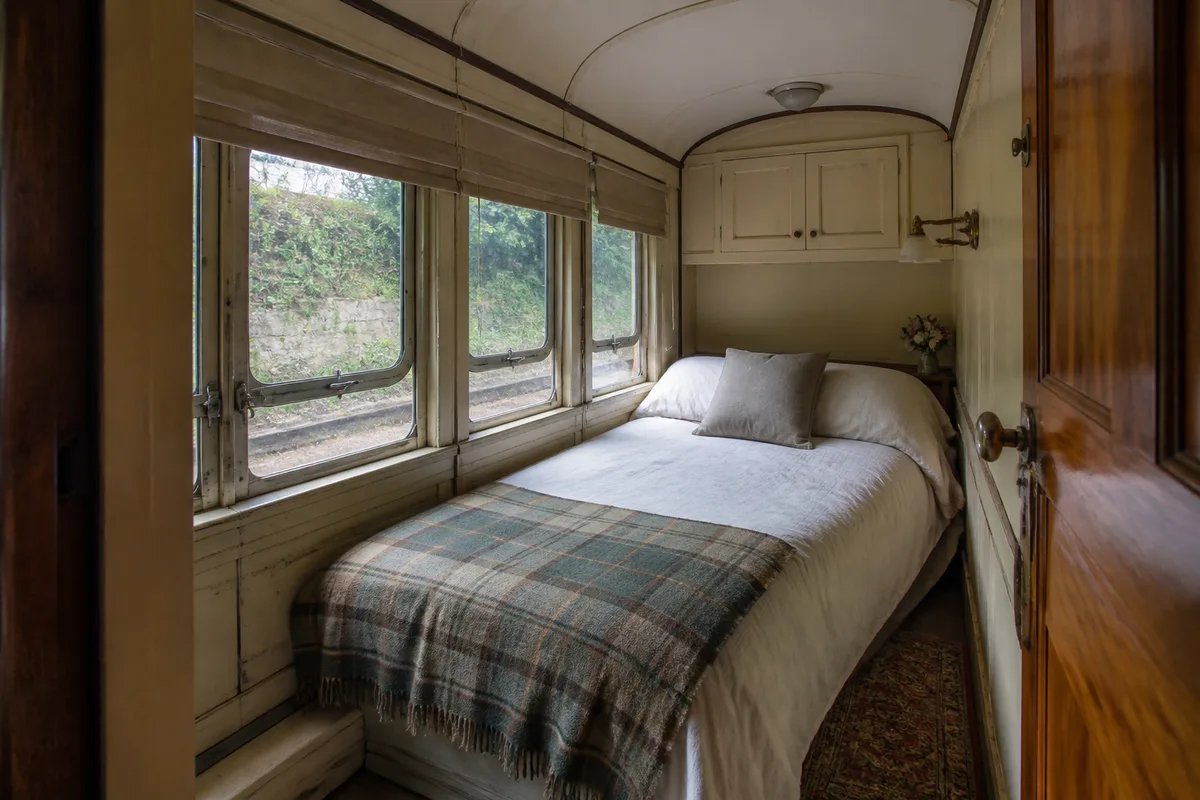
The fixed setting changes the comfort equation. You avoid track movement and station announcements, but you may still have a narrow interior, compact storage and unusual access arrangements. Read the property description for the exact bed count, bathroom position, kitchen equipment, heating system and maximum occupancy.
Couples often look for a carriage with one private double bedroom, while families may need bunk beds, separate sleeping zones and enough floor space for luggage. Railway enthusiasts may place more value on original fittings and nearby heritage attractions than on having the same space as a conventional cottage.
For location ideas, browse railway carriage holidays across the UK and compare the actual accommodation details rather than choosing solely from the exterior. A carriage in Norfolk, Hampshire or Devon can offer a very different setting, access arrangement and local transport situation.
Dedicated enthusiasts may also want to compare railway carriage stays for enthusiasts, especially when original railway features are part of the reason for booking. Confirm current opening dates, facilities and availability directly with the property before making travel arrangements.
Which Sleeping Option Fits Your Trip?
Choose a moving sleeper train when the overnight journey itself is part of the plan and you need to cover distance while sleeping. Choose a stationary carriage when the accommodation is the destination. The clearest decision comes from separating transport needs, sleeping comfort, privacy and the type of experience you actually want.
| Your priority | More suitable option | Reason |
|---|---|---|
| Travel while sleeping | Moving sleeper train | You combine overnight accommodation with transport. |
| Historic accommodation without motion | Stationary railway carriage | You stay in one place and explore the surrounding area. |
| Maximum privacy on a rail journey | Private bedroom or sleeper cabin | A closing room generally provides more separation than a seat or shared berth. |
| Family sleeping capacity | Family room or suitable carriage rental | The stated bed count and occupancy rules determine whether everyone fits. |
| Lowest complexity | Clearly described fixed holiday carriage | You can inspect the listed room, facilities and local access before arrival. |
For a first overnight rail journey, select a clearly labelled sleeping accommodation rather than testing whether a standard seat will be tolerable. For a themed break, a stationary carriage gives you the railway setting without requiring a sleeper route or overnight ticket.
The belief that “any train car can become a bed at night” is false. Dedicated sleeping cars are built and sold for overnight accommodation; an ordinary passenger car may remain a seated carriage throughout the journey.
Can You Sleep in a Train Car? FAQs
Can you sleep in a regular train seat?
You may be able to rest in a regular seat, but it is not a guaranteed bed and normally does not include bedding or a private sleeping space.
Do all overnight trains have sleeping cars?
No. An overnight departure may use ordinary seated carriages, so confirm that the specific train and date offer a sleeper compartment, berth or couchette.
What should you check before booking a sleeper train?
Check the exact bed layout, occupancy, privacy, bedding, bathroom access, accessibility arrangements, fare and cancellation conditions on the operator’s current booking page.
Is a stationary railway carriage the same as a sleeper train?
No. A stationary carriage is holiday accommodation that remains in one location, whereas a sleeper train travels between stations during the night.
Current route information, fares, room inventory and facilities should be checked with the relevant operator or property. Those details can change by date and service, while the basic distinction remains stable: a sleeper accommodation is designed for sleeping, and a standard seat is not a guaranteed bed.