How Rail Travel and Cycling Shaped Memorable Tour de France Stages
The Tour de France grew in a France increasingly connected by rail, while the bicycle transformed travel, sport and national identity. Railways helped make distant regions reachable and logistically manageable, yet the memorable stages were created by racing through those landscapes on bicycles.
That relationship explains why the event became more than a long road race. Newspapers, bicycle manufacturers, urban transport networks and improved access to provincial towns gave the Tour an audience and a national setting, while the Pyrenees and Alps supplied the difficult terrain that turned routes into sporting legends.
A France Connected by Rail and Ready for a National Race
The first Tour de France appeared in 1903, when railway expansion had already made travel between major French cities more practical and visible. Railways did not create the race alone, but they helped organizers, journalists, sponsors and spectators imagine a competition extending across a large national territory rather than staying within one local sporting circuit.
And the bicycle was already familiar beyond the racing community. It offered workers, tourists and middle-class enthusiasts a relatively affordable form of personal mobility, while manufacturers promoted long-distance riding as a modern activity. Cycling clubs helped establish shared rules, touring habits and local rivalries that newspapers could turn into national stories.
The 1903 Tour and the idea of crossing France
The inaugural Tour began and ended in Paris, with stages connecting cities including Lyon, Marseille, Toulouse, Bordeaux and Nantes. Those places were not selected at random: they were important urban centers with established transport links, newspaper markets and sporting audiences.
The route was exceptionally demanding by modern standards. Riders faced very long stages, primitive road surfaces, heavy bicycles and limited mechanical support. The race regulations and equipment belonged to another era, so present-day terminology can mislead: early “stages” were not managed with the same road closures, team vehicles or safety systems used today.
Yet the basic narrative was already powerful. A rider left one city, crossed a large section of France and arrived in another place where the result could be reported, discussed and reprinted. Railways helped information and people move through the country, while the bicycle supplied the physical drama between those points.
Railways, cities and the geography of stage starts and finishes
Railway stations gave towns a practical connection to the wider event, even when the racing road itself followed a different alignment. A stage finish near an accessible city could support accommodation, supplies, press work and public attendance more easily than an isolated location.
However, railway geography should be treated as an enabling background rather than a master plan. The Tour also followed roads, commercial interests, regional identity and the editorial ambitions of its organizers. A railway could make a destination easier to reach without determining every bend ridden by the competitors.
How the Bicycle Turned Transport Corridors into Sporting Landscapes
The bicycle changed a journey between cities into a test of personal endurance. A train could carry people toward a region quickly, yet riders experienced the road at ground level, confronting gradients, weather, surfaces and fatigue in a way that made valleys and passes memorable to the public.
But bicycles also carried cultural meaning. They represented independence, physical competence and movement through the countryside without a timetable. That symbolism helped French cycling culture grow around clubs, touring publications, manufacturers and local competitions, creating an audience ready to follow a national race.
The bicycle as mobility, technology and cultural symbol
Early racing bicycles were lighter and more specialized than ordinary utility bicycles, although they remained basic compared with modern machines. Riders dealt with narrow tires, limited gearing, rudimentary brakes and repair problems that could become decisive during a long stage.
Technology therefore shaped the route’s meaning. A steep road was not merely scenic; it exposed the limits of gearing, balance and muscular endurance. A rough descent demanded control from a machine with far less stopping power than a contemporary racing bicycle.
And the bicycle kept the rider visibly connected to the landscape. Spectators could see effort without the barrier of an engine or enclosed carriage. That visibility helped transform difficult roads into shared memories, particularly when newspapers described riders arriving exhausted after crossing terrain that many readers knew only through travel or maps.
From practical routes to iconic race terrain
Ordinary roads became sporting landmarks when repeated stories attached names, climbs and towns to decisive moments. The route acquired a memory layer: a pass could represent a breakthrough, a collapse, an attack or simply the first time the race entered a demanding region.
This is why iconic Tour de France routes are remembered as sequences of human encounters with terrain, not as lines on a railway map. Infrastructure helped people reach the event, while cycling made the landscape emotionally legible.
The same process continues whenever a race returns to a mountain road or a historic finish. Geography provides the physical constraint, but competition supplies the meaning. A climb becomes famous because riders, teams, journalists and spectators repeatedly give it a place in the story.
When Did Mountain Routes Create the Tour’s Most Memorable Stages?
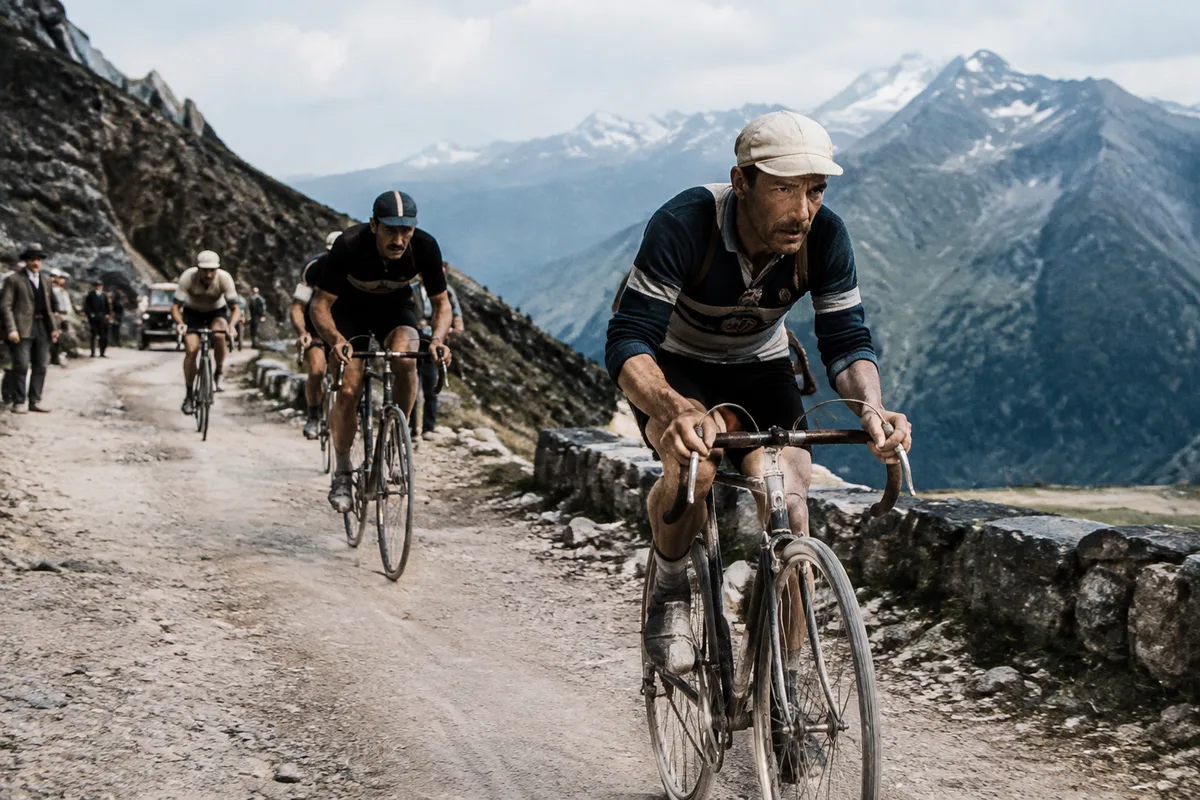
The Pyrenees entered the Tour de France in 1910, and the Alps followed in 1911. These additions changed the event by making high mountain terrain a central part of route design, forcing riders to manage gradients and isolation while giving newspapers a dramatic setting for rivalry.
The Pyrenees in 1910
The first Pyrenees Tour stage took place in 1910, introducing major mountain roads to the race and marking a decisive shift in sporting ambition. The mountain range offered longer climbs, harsher gradients and more remote conditions than the largely urban and lowland geography associated with the earliest editions.
The 1910 route included the Peyresourde, Aspin, Tourmalet and Aubisque passes. Their inclusion was a bold choice because early bicycles, roads and support systems were poorly adapted to sustained high-altitude racing.
Yet the difficulty created the very drama organizers wanted. Riders could no longer rely only on speed over relatively open roads; climbing ability, pacing and mechanical resilience became central. The Tour’s geography now offered moments in which a competitor could gain or lose significant time through physical effort alone.
For readers today, the key point is not that every modern mountain tradition already existed in 1910. It did not. The first Pyrenees stage established a new possibility: a Tour route could use mountain passes as the main setting for sporting judgment, rather than treating them as obstacles to avoid.
The Alps in 1911
The Alps entered the Tour in 1911, extending the mountain experiment into another major French range. The addition made high-mountain routes a recurring part of the event’s identity and reinforced the idea that the race could explore the country through its most difficult natural corridors.
The Galibier became an especially important name in the history of mountain stages. Its presence gave the Tour a setting associated with altitude, exposure and exceptional physical demand, although the road, equipment and safety conditions of the period were very different from those of modern racing.
Or the significance of the Alps should not be reduced to a single climb. The broader change was structural: organizers could now build stages around mountain chains, linking passes and valleys to create a narrative of accumulated fatigue rather than one isolated test.
Why mountain stages outlast ordinary stages in memory
Mountain stages compress several kinds of drama into one route. They make differences in strength visible, slow the race enough for tactics to emerge and place riders in landscapes that are easy for audiences to recognize and name.
Flat stages can be tactically complex. Mountain stages often make the consequences more legible to casual viewers because the road itself explains why the group fragments.
For a wider collection of decisive moments, the history of memorable Tour de France stages shows how individual routes become part of the event’s long cultural memory. The important connection is not simply difficulty; it is the meeting of a recognizable place, a consequential contest and a story that can be retold.
Did Rail Transfers Define Early Tour Logistics?
Railways supported the Tour’s wider organization, but riders did not routinely complete the entire competition by train between every stage. Trains could help move officials, journalists, equipment and spectators, while the race itself remained a road contest whose stages were ridden by bicycle.
Yet early Tours were not uninterrupted bicycle journeys from Paris and back. The route included starts and finishes in cities, organizational movements and practical arrangements that depended on the transport network available at the time. Describing the event as a simple continuous ride across France hides the logistical work behind the spectacle.
Did riders travel between stages by train?
Some early race formats involved transfers or arrangements that should be studied edition by edition rather than summarized as one universal practice. The available evidence does not justify claiming that riders routinely took trains after every stage, nor does it support the opposite idea that every person and piece of equipment moved only by bicycle.
In this case, do not describe the Tour as a train-supported stage tour with riders casually skipping the road. That interpretation removes the physical achievement that made the race newsworthy.
Instead, separate three movements: the competitive route ridden by the cyclists, the logistical movement of the organization and the travel undertaken by spectators or journalists. They could overlap geographically without being the same journey.
The hidden infrastructure behind a visible sporting event
Large sporting events require more than athletes and roads. They need accommodation, food, communications, timing, mechanical assistance, reporting and a way to connect distant communities with the event.
Railways helped with that background system because they linked cities and supported regular movement across long distances. Newspapers could distribute reports through established urban networks, while manufacturers and sponsors could present cycling as part of a modern national culture.
And the railway’s influence was often indirect. A station might make a city suitable for a start or finish, but the race route still had to satisfy road conditions, regional interests and the organizers’ sporting intentions. This is why railway influence on cycling should be understood as a framework rather than a single cause.
How Railway Geography Became Tour de France Heritage
The lasting relationship between trains and the Tour rests on contrast: railways made France more accessible as a national space, while bicycles made that space difficult to cross at human speed. The most memorable stages appeared when transport, media, landscape, equipment and athletic effort reinforced one another.
That heritage remains visible in cycling tourism. Visitors seek mountain passes, historic roads and towns associated with major stages, often using the same transport infrastructure that makes regional travel possible today. The sporting route becomes a cultural itinerary.
A legacy visible in cycling tourism and modern race design
Modern route designers still use geography to create narrative. A stage can begin in a transport-connected city, cross a rural region and finish on a climb whose name carries historical weight. The arrangement is practical, symbolic and televisual at the same time.
However, modern races operate under safety standards, traffic controls, support systems and equipment rules that early organizers did not possess. Comparing the eras requires care. The historical importance of early mountain stages does not justify romanticizing dangerous roads or treating hardship as a measure of sporting purity.
French cycling culture also extends beyond the professional race. Recreational riders follow famous climbs, local clubs organize rides and tourism bodies use cycling routes to connect landscapes with history. The Tour helped make certain roads famous, yet the continued meaning of those roads depends on people using them long after the peloton has passed.
What the Tour’s origins really show
What to Remember
- The Tour began in 1903 within a France already connected by expanding rail networks and urban transport.
- Railways supported access, organization and publicity without determining every racing road.
- The Pyrenees entered the Tour in 1910, followed by the Alps in 1911.
- Mountain stages became memorable because terrain made physical differences and tactical choices visible.
- Early Tour logistics included more than uninterrupted bicycle travel, so each edition must be interpreted in its own context.
Frequently Asked Questions About Rail Travel, Cycling and the Tour de France
Which newspaper created the Tour de France in 1903?
The Tour de France was created by the sports newspaper L’Auto, whose editor Henri Desgrange organized the first edition. The race helped L’Auto attract readers and strengthen its position in the French sporting press.
Who won the first Tour de France?
Maurice Garin won the inaugural Tour de France in 1903. He finished the six-stage race ahead of Lucien Pothier and completed the course in 94 hours, 33 minutes and 14 seconds.
How long was the first Tour de France?
The 1903 Tour covered about 2,428 kilometres across six stages. Its stages were much longer than those typically used in modern racing, adding to the physical demands created by poor roads and limited mechanical support.