Car Advice Reviews: Common Complaints, Real Benefits, and How to Read Them
Car Advice Reviews: Common Complaints, Real Benefits, and How to Read Them
Car advice reviews are most useful when they help you separate repeatable evidence from one-off opinions. The best reviews show recurring patterns in reliability, ownership costs, comfort, and technology, while also pointing out practical benefits such as faster shortlisting and better buying confidence. They matter because they can save you from a weak choice before money changes hands.
The smart way to use car advice reviews is to treat them as a filter, not as a final verdict. You will get the best results by comparing expert testing with owner feedback, checking whether complaints are recent and repeated, and then cross-checking the strongest claims with a test drive, recall lookup, or inspection.
Quick summary
🔎 Car advice reviews are valuable when they show patterns, not just opinions.
💰 The main benefit is faster shortlisting, with fewer bad options to test drive.
⚠️ The biggest risk is bias, especially when reviews are generic, outdated, or promotional.
✅ Public signals for CarAdvise are mixed, so its claims should be checked against user feedback and recent app-store data.
What do car advice reviews actually help you decide?
Car advice reviews help you decide whether a model deserves a closer look, not whether it is perfect. A useful review turns vague impressions into practical signals about reliability, maintenance, safety, comfort, technology, and total ownership cost. That is what makes car advice reviews more valuable than a simple star rating.
In real shopping, the biggest value comes from removing weak options early. A buyer looking at three compact SUVs can use car advice reviews to spot which one has the cleaner reliability history, which one costs more to service, and which one is likely to feel frustrating after six months of daily driving.
- Shortlist faster: remove cars that repeatedly disappoint owners in the same area.
- Compare trims more intelligently: one trim can have better tech but worse ownership costs.
- Catch hidden trade-offs: a low purchase price can mask higher service, insurance, or depreciation costs.
- Focus your test drive: review patterns tell you what to verify in person.
How do you judge whether a review is trustworthy?
A trustworthy review explains its method, its context, and its limits. The most reliable car advice reviews separate tested facts from personal preference, show the model year and trim, and make clear whether the writer is an expert tester, an owner, or a commercial publisher with affiliate incentives.
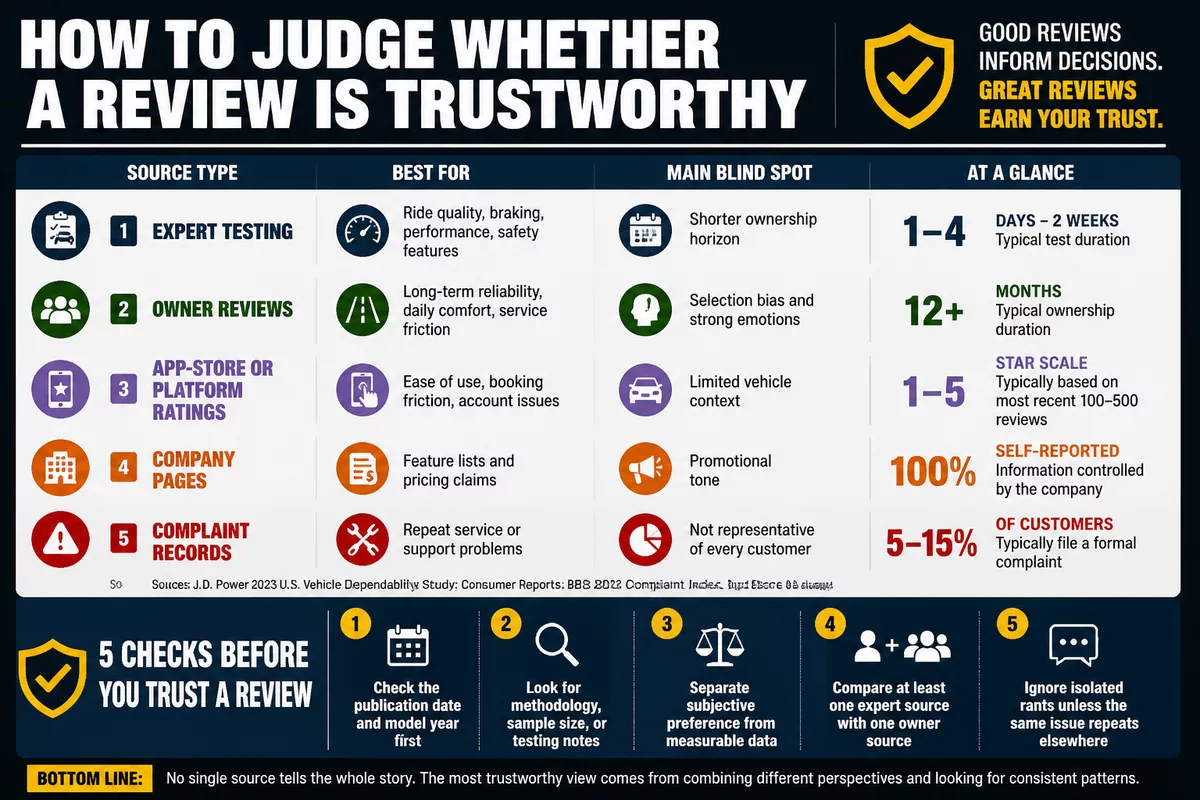
The easiest way to judge trust is to compare source types, because each one is good at something different. Expert car reviews are better for structured testing, while owner feedback is better at exposing long-term frustrations. The strongest buying advice comes from using both, then checking whether the complaints repeat across recent model years.
| Source type | Best for | Main blind spot |
|---|---|---|
| Expert testing | Ride quality, braking, performance, safety features | Shorter ownership horizon |
| Owner reviews | Long-term reliability, daily comfort, service friction | Selection bias and strong emotions |
| App-store or platform ratings | Ease of use, booking friction, account issues | Limited vehicle context |
| Company pages | Feature lists and pricing claims | Promotional tone |
| Complaint records | Repeat service or support problems | Not representative of every customer |
- Check the publication date and model year first.
- Look for methodology, sample size, or testing notes.
- Separate subjective preference from measurable data.
- Compare at least one expert source with one owner source.
- Ignore isolated rants unless the same issue repeats elsewhere.
A review earns trust when it shows its work instead of asking you to trust the conclusion on its own.
Which complaints deserve the most attention?
The complaints that matter most are the ones that affect safety, reliability, cost, or daily usability. A single annoyed comment about styling is less important than repeated reports of electrical faults, expensive repairs, weak brakes, or software glitches that affect the screen, camera, or navigation system.
In car advice reviews, the strongest warning signs usually appear when the same complaint shows up across the same model, the same engine, or the same trim level. That pattern is more useful than a lone negative review, because it suggests a real ownership problem rather than personal preference.
- Repeated reliability problems: especially engine, transmission, battery, or electrical issues.
- High maintenance or repair costs: these directly affect the total cost of ownership.
- Safety-related complaints: brake, steering, tire, airbag, or visibility issues deserve priority.
- Technology glitches: infotainment, phone pairing, backup camera, and software bugs can become daily annoyances.
- Poor dealer or service support: slow diagnosis and weak communication can make small issues much worse.
A single complaint matters less than the same complaint repeating across recent reviews, the same trim, and the same ownership pattern.
What real benefits can car advice reviews provide?
The real benefit of car advice reviews is better decision quality. Good reviews help you avoid overpaying for features you will not use, reveal hidden running costs, and show where a car feels easy or annoying to live with after the first month. That saves both time and money.
Reviews also help with comparison shopping. Two cars can look similar on paper, yet one may have better safety equipment, lower depreciation, simpler maintenance intervals, or a less frustrating infotainment system. Car advice reviews make those trade-offs easier to see before you commit.
Illustrative example: if one car looks cheaper at purchase but needs an extra service visit every year, the ownership difference can be larger than the sticker-price gap over time. That is why readers should look beyond the listing price and ask what the car costs to keep on the road.
- Time saved: you can drop weak options before booking visits.
- Cost visibility: reviews often reveal maintenance, fuel, insurance, and depreciation pain points.
- Better fit: comfort, cargo space, and driving position become clearer.
- Fewer surprises: repeated complaints warn you about common ownership frustrations.
How should you read CarAdvise reviews specifically?
CarAdvise is a maintenance and repair app from CarAdvise LLC, and its reviews should be read like any other commercial service: carefully, with an eye on both the promised benefits and the public complaints. The company says the platform lets users compare prices, schedule services, approve repairs, and keep service history in one place.
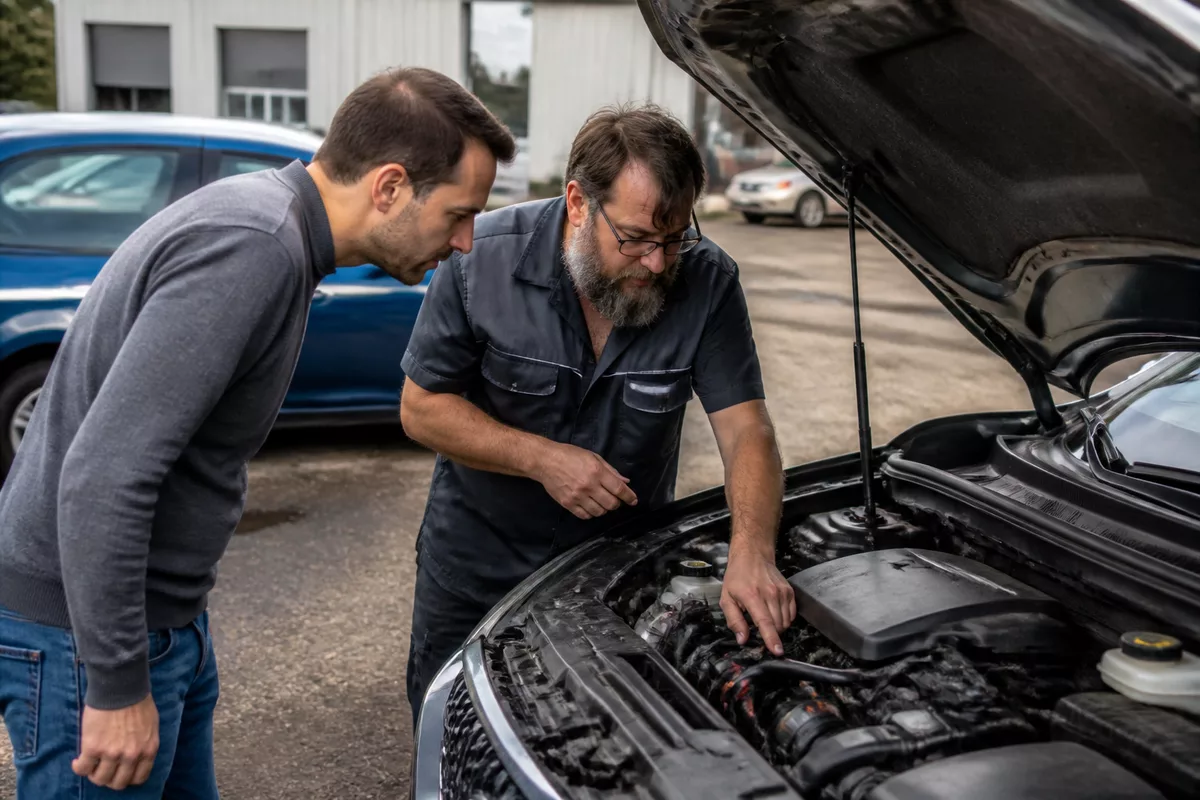
Public signals are mixed, which is exactly why car advice reviews need context. The App Store listing shows a 2.6/5 rating from 158 ratings, while Google Play shows 100,000+ downloads and a last update date of 13 May 2026. The company also claims a network of more than 25,000 shops, more than 35 national brands, and a 12-month or 12,000-mile warranty on transactions.
Those claims can be useful, but they do not replace user experience. A service that promises price comparison and convenience should still be checked for booking friction, approval delays, pricing clarity, and support quality. If you are reading CarAdvise reviews, focus on whether the complaints are about the app itself, the repair process, or the shops in the network.
- Check whether the review is about the app, the garage, or the repair estimate.
- Compare App Store and Google Play feedback instead of relying on one platform.
- Look for repeated comments about pricing, communication, and approval flow.
- Separate company claims from verified customer experience.
- Use the reviews to decide whether the app is worth testing, not whether it is perfect.
The useful question is not whether CarAdvise sounds convenient; the useful question is whether the same pain points repeat across recent users.
What sources should you cross-check before buying?
The safest approach is to cross-check reviews with sources that answer different questions. Expert reviews tell you how a car performs, owner feedback tells you how it behaves over time, and official sources tell you whether there are open recalls, warranty limits, or maintenance rules that change the real cost of ownership.
Used car advice works best when reviews are paired with records. A service history, recall check, and pre-purchase inspection can confirm whether the glowing review or the scary complaint reflects the actual car in front of you. That is how you turn reading into a better decision.
- Official recall databases: verify safety issues and whether fixes were completed.
- Manufacturer warranty and maintenance guides: check coverage, intervals, and exclusions.
- Owner forums and review platforms: look for repeated issues with the same trim or engine.
- Expert car review sites: compare testing methods, long-term testing, and update dates.
- Insurance or depreciation data: use them to judge true ownership cost, not only the sticker price.
If the car is used, a pre-purchase inspection is usually worth more than a dozen vague five-star reviews. If the car is new, the most useful question is whether the criticism is tied to a specific model year or a recent software update.
Key takeaways
- 🔎 Repeated, recent complaints matter more than isolated rants.
- 💰 Strong reviews help you estimate the full ownership cost, not just the purchase price.
- 🧭 Trust reviews that show method, context, and model-year detail.
- 📱 CarAdvise looks feature-rich, but public ratings and company claims need careful cross-checking.
- ✅ A test drive, recall check, and inspection still close the loop.
FAQ
Are car advice reviews worth trusting?
Yes, but only as one input. Car advice reviews are most useful when they are recent, specific, and backed by evidence such as testing notes or repeated owner feedback. Treat them as a guide to what deserves your attention, not as a final decision.
What complaints should I take most seriously?
Focus on reliability problems, costly repairs, safety concerns, and repeated technology failures. Complaints about style or personal preference matter less unless they affect comfort, visibility, or how easy the car is to live with every day.
Should I read expert reviews or owner reviews first?
Start with expert reviews if you want structure and comparison, then use owner reviews to see what happens after real mileage and long-term use. The two types answer different questions, and the best buying decisions use both.
Is CarAdvise worth a closer look?
CarAdvise may be useful if you want price comparison, booking in one place, and service history tracking. The public ratings are mixed, though, so it is smart to read complaints carefully and verify whether the friction is about pricing, the app, or the repair process.
How many sources should I compare before buying?
At least three: one expert source, one owner source, and one official source such as a recall database or warranty guide. More sources help when the reviews disagree, especially for used cars and models with mixed reliability histories.