How to Start a Vegetable Garden: A Beginner’s Step-by-Step Guide
How to Start a Vegetable Garden: A Beginner’s Step-by-Step Guide
To start a vegetable garden, choose a level site with at least six hours of direct sunlight, accessible water, and good drainage. Begin with a manageable bed or a few containers, prepare the soil, select vegetables suited to your climate, then plant according to the seed packet or nursery label. Regular watering, weeding, pest checks, and harvesting complete the basic routine.
This guide explains how to start a vegetable garden without overbuilding, wasting money, or choosing crops that do not suit your space. You will learn how to compare garden formats, read local planting information, prepare soil safely, and follow a simple first-season schedule.
Quick Summary
🌱 Start small: one bed or several containers are easier to maintain than a large first-year plot. A starter area of 50 to 75 square feet is one institutional example, not a universal rule.
☀️ Choose the site carefully: most vegetable gardens need at least six hours of direct sun, convenient water access, and soil that drains well.
🧪 Prepare before planting: test uncertain soil, use mature compost, and avoid untreated manure around edible crops.
📅 Follow local timing: frost dates, growing zones, crop type, and seed-packet instructions determine when to plant.
Start Small: Define Your Garden Goals, Space, and Budget
A productive first garden is a growing area designed around your available time, space, cooking habits, and maintenance capacity. The goal may be fresh produce, practical learning, family activity, or reduced grocery purchases, but each goal leads to a slightly different crop list and layout.
Garden size should match the routine you can realistically sustain. A small bed or a few containers provide useful feedback without creating a large watering, weeding, and harvesting workload. The University of Maryland Extension gives 50 to 75 square feet as one possible starting range for a new garden, while smaller spaces can work well for beginners with limited time.
Crop success depends on climate, sunlight, soil, weather, pests, and care. A carefully planned small backyard vegetable garden can outperform a larger plot that becomes difficult to maintain halfway through the season.
Choose a Manageable First-Year Garden
Begin with vegetables your household is likely to eat. Growing unfamiliar crops simply because they appear easy can leave you with wasted seed, unused produce, and no clear lesson for the next season.
A practical first-year plan should contain fewer crops than your available space could technically hold. Choose a small selection that includes quick crops for early feedback, one or two longer-season plants, and herbs or greens that can be harvested regularly.
- Seeds or healthy seedlings suited to your local season.
- Mature compost or an appropriate soil amendment.
- Containers or bed materials, if needed.
- Plant labels and a waterproof marker.
- A hand trowel, garden gloves, and a watering can or hose attachment.
- Simple support materials for plants that climb or become top-heavy.
Keep the first budget focused on soil quality, reliable watering, and suitable plants rather than decorative structures. Expand after you know how much time your first garden requires each week.
Choose the Best Backyard Location and Garden Format
The best backyard garden location combines direct sunlight, good drainage, easy access, and nearby water. Most fruiting vegetables need roughly six to eight hours of direct sun, while some leafy greens can tolerate partial shade. A level or gently sloped site is safer and easier to prepare than a low area where water remains after rain.
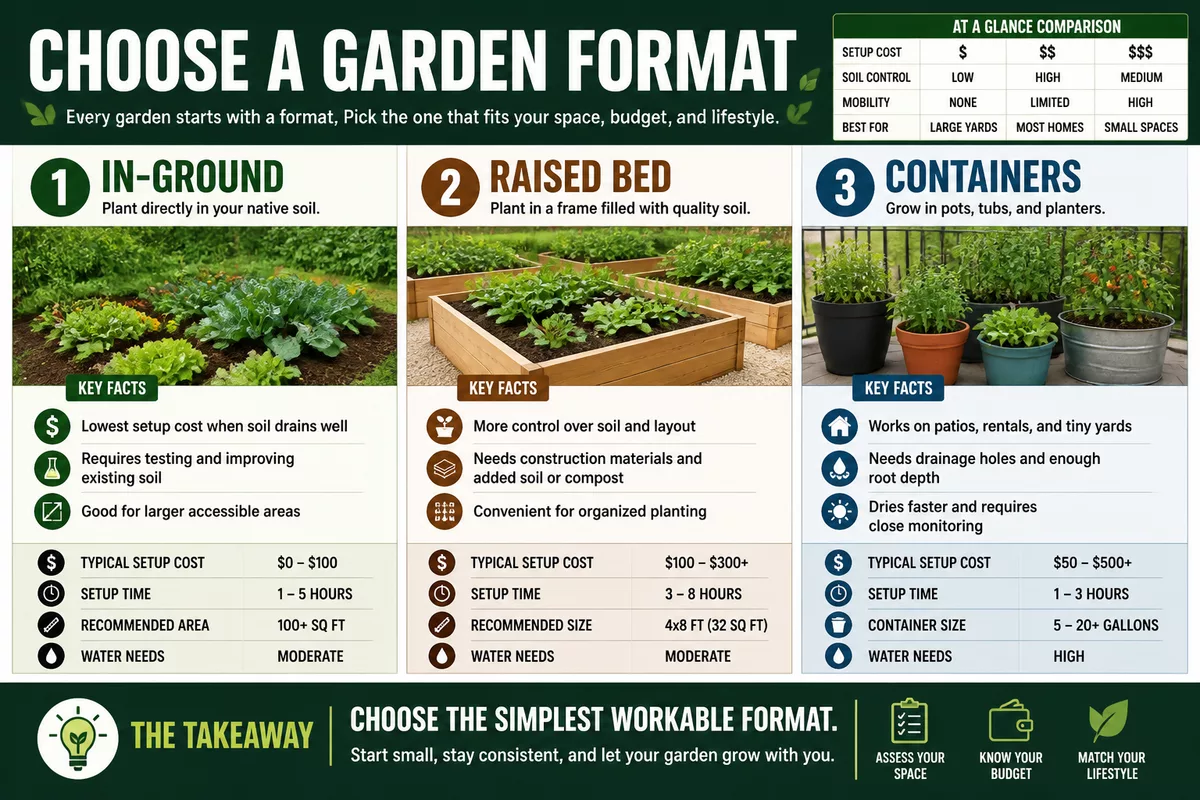
Inspect the proposed area at different times of day before building anything. Persistent shade from a house, fence, or tree can change the crop choices, while large tree roots may compete for water and nutrients.
In-Ground Beds, Raised Beds, or Containers?
In-ground gardening is often the lowest-cost option when existing soil drains well and is not contaminated. The format uses the space already available, but soil testing and improvement may be necessary before planting edible crops.
Raised beds make it easier to control soil quality, bed dimensions, and planting layout. They also require materials for the frame and enough suitable soil or compost to fill the growing area. Avoid building a raised bed before confirming that its location receives sufficient sunlight.
Containers are practical for patios, renters, balconies where permitted, and very small backyards. Containers need drainage holes, adequate depth for the chosen crop, and a clean growing mix. The limited soil volume warms and dries faster than ground soil, so container plants need more frequent observation.
Readers working with a very small outdoor area can also use ideas from these small-space garden ideas to combine edible plants with limited patio or yard space.
Check Sunlight and Drainage Before You Build
Mark the possible garden area and observe the light during the morning, midday, and afternoon. Record shade caused by buildings, fences, trees, or seasonal changes rather than relying on a single quick visit.
Test drainage after rain or by observing how quickly water disappears from the surface. Avoid places with standing water, persistent flooding, or compacted soil that remains saturated. Keep paths wide enough to water, weed, harvest, and reach every plant without stepping into the growing soil.
Prepare Healthy Soil Before Planting
Healthy garden soil is a growing medium that supports roots with suitable structure, air, water movement, and nutrients. A soil test can reveal pH and nutrient levels, while local extension services or reputable laboratories can explain which test is appropriate for the area.
Unknown urban or previously used land deserves extra caution. The University of Maryland Extension advises testing soil safety, including lead levels, before planting food crops; the same guidance identifies less than 400 parts per million of lead as a reference point in its soil-safety discussion. Interpretation can depend on the site and local recommendations, so verify the result with the testing laboratory or local extension service.
“Test uncertain soil before planting edible crops, especially where the garden site has an unknown history.”
Mature compost is fully decomposed organic matter that can improve soil structure and fertility. Compost may help moisture retention, drainage, and root growth, but it should not replace a soil test when the soil has an unknown history or a known nutrient problem.
Do not use fresh or untreated manure around edible crops. Fresh materials can create sanitation, nutrient, and plant-health problems. Use clean, properly finished compost or a soil mix intended for the crop and growing container.
“Add amendments for a reason: soil test results and crop needs are more reliable than an automatic fertilizer routine.”
Improve Soil With Compost and Organic Matter
Clear existing weeds and loosen compacted soil without repeatedly turning or disturbing it more than necessary. Create a level, well-drained planting surface before sowing. For bare ground, University of Maryland Extension guidance describes incorporating at least two inches of compost as one preparation approach, but the amount should be adapted to the existing soil and the selected growing format.
When converting grass into a bed, cardboard or newspaper covered with a two- to four-inch compost layer is another approach described by the same extension guidance. Check that the material is suitable for garden use and avoid glossy or heavily printed paper.
Raised beds and containers should use clean, appropriate soil mixes. Avoid filling containers with dense native soil that may compact and drain poorly.
Choose Easy Vegetables and Build a Climate-Aware Planting Schedule
The easiest vegetables to grow are not identical in every region. Crop choice must match local temperature, frost dates, sunlight, available space, and household preferences. Cool-season crops grow best during milder conditions, while warm-season crops need warmer soil and protection from frost.
A last spring frost is the approximate final date when freezing conditions are expected in spring. A first fall frost is the approximate date when freezing conditions may return in autumn. These dates help define planting windows, but they are estimates rather than guarantees. Use local extension calendars, seed packets, growing-zone information, and regional nursery guidance instead of copying dates from another climate.
| Crop group | Beginner options | Timing guidance | Planning note |
|---|---|---|---|
| Cool-season crops | Radishes, lettuce, spinach, peas, kale, carrots | Use local spring and fall guidance | Useful for cooler periods and partial-shade conditions, depending on the crop |
| Warm-season crops | Tomatoes, cucumbers, zucchini, peppers, basil | Plant after local frost risk has passed | Usually need warmer soil and strong sunlight |
| Compact or container crops | Herbs, green onions, lettuce, bush beans | Follow the plant label and local calendar | Choose varieties suited to the available container depth and width |
Beginner-Friendly Crops to Consider
Radishes, lettuce, spinach, green onions, herbs, and bush beans are approachable choices in many regions. Tomatoes, cucumbers, zucchini, peppers, and basil may suit warm conditions after frost risk has passed. Peas, kale, broccoli, carrots, and other leafy greens can work in cooler periods where local conditions support them.
Use quick crops to gain early experience, but remember that maturity time varies by variety and climate. Longer-season crops such as tomatoes or peppers may occupy space for months and need more consistent support and monitoring.
Growing what you eat is one of the simplest ways to make a small garden worthwhile. A household that regularly cooks salads may prefer lettuce, herbs, radishes, and green onions, while a household that uses summer vegetables may prioritize beans, tomatoes, cucumbers, or zucchini.
Read Seed Packets and Nursery Labels
Seed packets and plant labels usually provide the crop’s planting depth, spacing, thinning instructions, days to maturity, and preferred season. Days to maturity are an estimate tied to the variety and growing conditions, not a guaranteed harvest date.
Thinning means removing extra seedlings so the remaining plants have enough room, light, air, and root space. Direct-sown crops such as radishes, carrots, beans, peas, and many lettuce varieties can often be planted directly outdoors when conditions are suitable. Other crops may be started indoors and transplanted later.
Succession sowing means planting a quick crop again after an earlier planting is harvested or established. Local weather and remaining growing time determine whether succession planting is practical.
Plan the Layout and Plant Seeds or Transplants Correctly
Good garden layout places tall crops where they cast the least shade on shorter plants. In many beds, taller plants are positioned toward the north or west, but the correct arrangement depends on the path of the sun, nearby structures, and the garden’s orientation.
Group crops with similar water and sunlight needs to simplify care. Follow the recommended spacing rather than packing plants tightly into a small bed; overcrowding can reduce airflow and increase competition for water and nutrients.
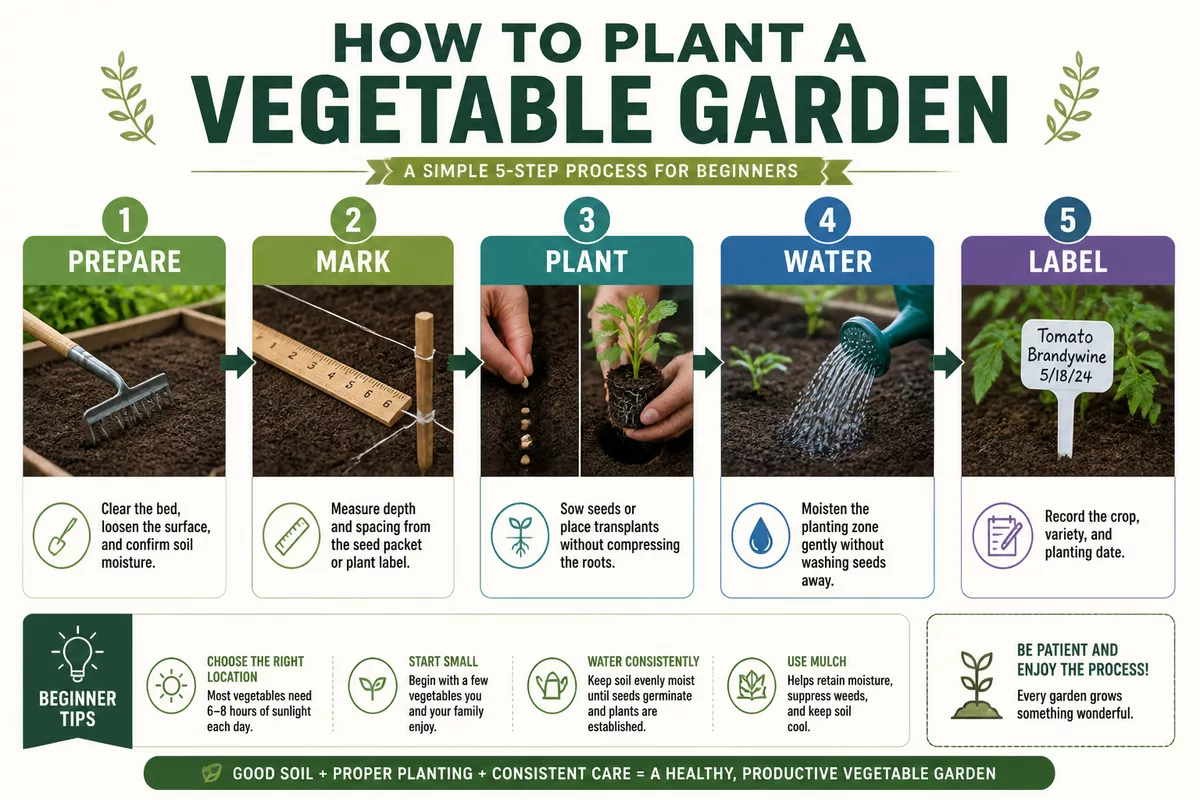
Direct-Sow Seeds Outdoors
Prepare a fine, level seedbed and follow the packet’s depth and spacing instructions. Water shallowly and gently while seeds germinate, keeping the surface evenly moist without creating puddles. Germination speed depends on crop, soil temperature, moisture, and weather.
Radishes, beans, carrots, peas, lettuce, and some herbs are commonly direct-sown when local conditions are suitable. Thin seedlings at the stage recommended on the packet. Removing extras may feel wasteful, but crowded seedlings compete for light and root space.
Transplant Young Plants Safely
Seeds usually cost less and offer more variety, while nursery seedlings provide convenience and can shorten the time between planting and visible growth. The right choice depends on crop, season, available space, and your willingness to manage early seedlings.
Hardening off means gradually acclimating indoor-grown seedlings to outdoor light, wind, and temperature before transplanting. Move plants outdoors for increasing periods in a protected location, following local weather conditions and the plant’s guidance.
Water seedlings as needed, handle the root ball carefully, and transplant during a cooler part of the day when practical. Set each plant at the depth recommended by its label rather than applying one depth to every crop.
Maintain the Garden With a Simple Weekly Routine
Vegetable garden maintenance is a recurring check rather than a single task. Inspect soil moisture before watering, adapt frequency to weather and soil type, remove young weeds, examine leaves and stems, and harvest ready produce.
Water near the soil line and favor thorough watering of the root zone over frequent shallow sprinkling. Mature plants may need deeper and less frequent watering than newly planted seeds, while containers generally dry faster because they hold less soil.
Mulch is a protective layer placed on the soil surface to conserve moisture and suppress weeds. Keep mulch slightly away from plant stems to reduce the risk of rot and pest problems.
A Low-Effort Care Checklist
- Check soil moisture before adding water.
- Water the root zone instead of repeatedly wetting the foliage.
- Pull small weeds before they establish deep roots.
- Inspect the upper and lower surfaces of leaves.
- Support tomatoes, cucumbers, or other plants that need structure.
- Harvest ready crops and record observations for the next planting.
Fertilizer should respond to soil conditions and crop needs. Excess nitrogen can produce abundant leafy growth without strong fruit production, so avoid adding fertilizer automatically when the plants show a problem.
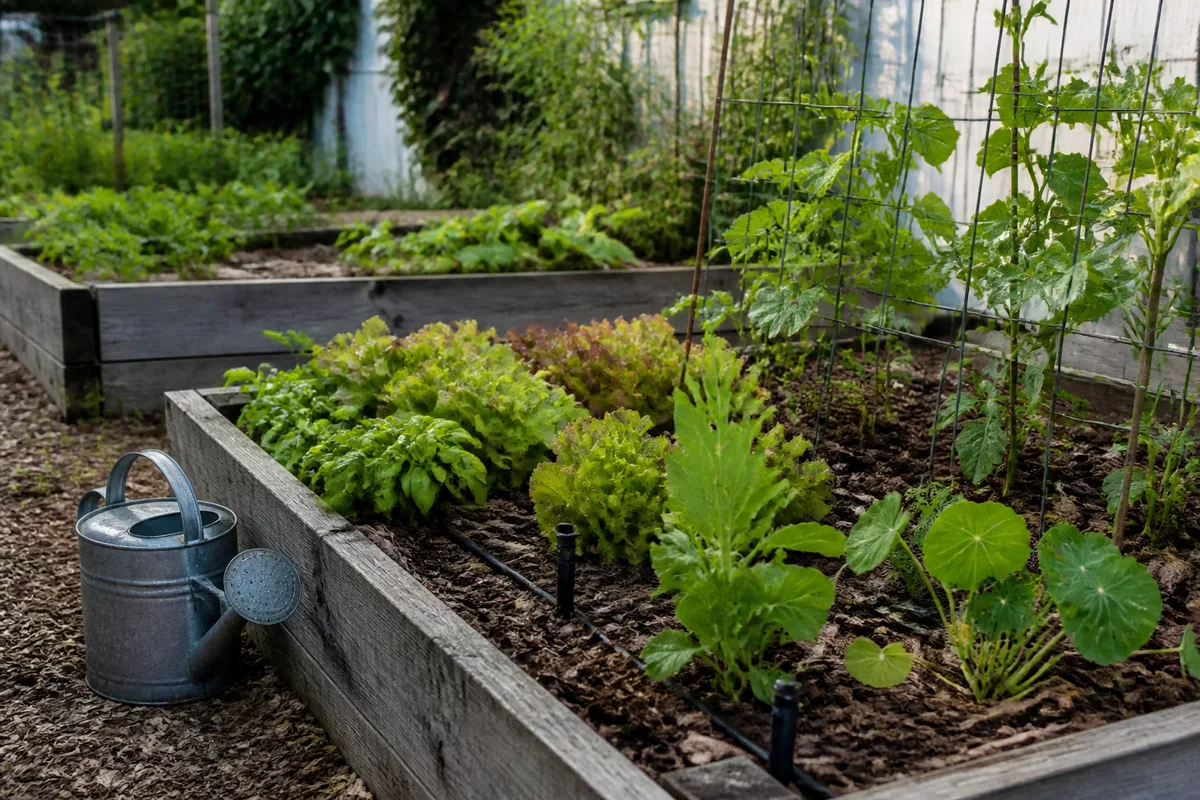
Troubleshoot Common Vegetable Garden Problems Safely
Vegetable garden symptoms rarely identify one cause by themselves. Yellow leaves, wilting, holes, and poor growth may result from water stress, unsuitable light, root damage, pests, disease, temperature, soil conditions, or overcrowding.
Use a simple diagnostic order: inspect water and drainage first, then sunlight, roots, pests, soil, temperature, and spacing. Prevention and low-risk physical measures should come before any pesticide application.
Pests and Feeding Damage
Inspect both sides of leaves for insects, eggs, holes, webbing, or sticky residue. Aphids, slugs, and snails can damage vegetable crops, but treatment should follow identification rather than guesswork.
Hand removal, physical barriers, row covers, and targeted low-risk measures may help when appropriate. Protect beneficial insects and pollinators, and follow the product label and local regulations if a treatment is necessary near edible crops.
Disease, Wilting, and Yellow Leaves
Improve airflow with suitable spacing and avoid wetting foliage late in the day. Check drainage and root health before increasing watering, because extra water can worsen a problem caused by saturated soil.
Clean tools after removing affected material, dispose of severely diseased plant matter responsibly, and avoid moving contaminated soil between beds. Crop rotation can reduce repeated pressure from some problems when the available space makes rotation possible.
Harvest at the Right Stage and Plan Next Season
Harvest vegetables when they reach the size, color, firmness, or flavor described for the variety. Regular harvesting can encourage continued production for many crops and reduces the chance that produce becomes overmature.
Lettuce is commonly harvested as leaves or a head before it becomes too mature, beans are picked while pods remain tender, and cucumbers and zucchini are usually harvested before they become oversized. Tomatoes are picked according to the variety’s mature color and intended use, while carrots and herbs require crop-specific judgment.
Harvest gently and review the season while the details are still fresh. Record which crops grew well, which required too much time, where shade or pests caused problems, and what your household actually used.
A Compact Starter Garden Plan
A flexible first garden could combine leafy greens, one quick crop, herbs, bush beans, and one warm-season crop where the climate permits. The exact crop list and timing must be adapted to local frost dates, growing zone, sunlight, container size, and available space.
A small bed or several containers can be expanded later if the weekly routine remains manageable. Quick crops may be succession-sown when enough growing time remains, while long-season crops should not crowd out plants that the household uses more often.
Final Beginner Gardening Checklist
- Choose a sunny, accessible site with good drainage.
- Select an in-ground bed, raised bed, or container setup that matches your space.
- Test uncertain soil and improve it with mature compost when appropriate.
- Select vegetables suited to the local season and household preferences.
- Follow seed-packet or nursery-label instructions for depth, spacing, and thinning.
- Water consistently, mulch carefully, remove weeds, and inspect plants.
- Harvest regularly and record what worked for the next season.
Starting a vegetable garden is less about getting every detail perfect than choosing a suitable site, planting a few climate-appropriate crops, and learning from each harvest. A manageable first garden gives you practical information that no generic planting calendar can provide.
Key Points
- 🌱 Start with a small garden that fits your available time and space.
- ☀️ Confirm sunlight, drainage, and water access before building.
- 🧪 Test uncertain soil and use mature compost instead of automatic fertilizer.
- 📅 Match crops and planting dates to local frost information and growing conditions.
- 💧 Check moisture, weed early, monitor pests, and harvest regularly.
Frequently Asked Questions
How much space do I need to start a vegetable garden?
You can start with one small bed or several containers. The University of Maryland Extension identifies 50 to 75 square feet as one possible starter range, but a smaller area may be more suitable when time, sunlight, or budget is limited.
What is the easiest vegetable to grow for a beginner?
Radishes, lettuce, herbs, green onions, bush beans, and some leafy greens are often approachable choices when local conditions suit them. The easiest crop for your garden is one that matches the season, sunlight, available space, and foods your household actually eats.
How often should I water a backyard vegetable garden?
Check soil moisture before watering instead of following one fixed weekly amount. Frequency depends on weather, soil type, plant size, crop needs, and container size; water the root zone thoroughly and adjust when conditions change.
Can vegetables grow in partial shade?
Some leafy greens and herbs can tolerate partial shade, while fruiting crops such as tomatoes, peppers, cucumbers, and zucchini generally need stronger direct light. Observe the site throughout the day and choose crops according to the amount of sunlight available.
Should I start vegetables from seeds or seedlings?
Seeds usually offer lower cost and more variety, while nursery seedlings are convenient for beginners and can simplify early growth. Use direct sowing or transplanting according to the crop, local timing, and instructions on the packet or plant label.
How do I keep weeds out of a vegetable garden?
Remove young weeds regularly, keep the soil covered with suitable mulch, and avoid allowing weeds to produce seeds. Hand pulling, shallow cultivation, and a clean planting surface are safer starting methods than applying an unidentified chemical treatment near edible crops.
When should I plant vegetables in my backyard?
Planting dates depend on your local last spring frost, first fall frost, growing zone, crop type, and current weather. Use local extension calendars, seed packets, and regional nursery guidance rather than copying dates from a different climate.
What does hardening off mean?
Hardening off is the gradual process of acclimating indoor-grown seedlings to outdoor light, wind, and temperature. The process reduces transplant stress before young plants move permanently into the garden.
Sources
The University of Maryland Extension vegetable garden guidance provides institutional information on starter garden size, sunlight, soil testing, compost, planting, and basic care. Local extension services, reputable soil laboratories, seed packets, plant labels, and regional frost calendars should be used for climate-specific decisions.