How Technology Works Scientifically: A Plain-English Explanation
How technology works becomes easier to understand when you stop treating it as a mysterious force. Technology applies scientific knowledge through tools, machines, software, and systems that transform inputs into useful outputs.
A bicycle, smartphone, search engine, thermostat, and artificial intelligence system operate in different ways, yet each follows a designed process involving energy, information, materials, instructions, or human decisions. The results also depend on maintenance, user behavior, rules, and the environment around the technology.
What does technology mean in simple terms?
Technology works by applying knowledge through designed tools, machines, software, or systems that transform inputs into useful outputs. A physical tool may redirect force, while a digital device processes data and a communication network moves information between locations.
Technology solves a practical problem.
A hammer receives a force from your hand and transfers it through a hard head into a nail. A refrigerator moves heat away from its interior. A word processor receives keystrokes, changes stored data, and displays letters on a screen.
The word technology therefore covers more than computers and phones. It includes materials, mechanical devices, electrical circuits, agricultural methods, medical equipment, transport systems, communication networks, and organized procedures designed to achieve repeatable results.
That repeatability matters. A tool becomes useful when people can apply it under defined conditions and obtain a reasonably predictable result, even though every real system has limits, errors, and maintenance requirements.
How are science, engineering, and technology connected?
Science seeks reliable knowledge about the natural world, engineering uses that knowledge to design workable solutions, and technology is the resulting tool, process, or system in practical use. The three areas overlap, although they answer different questions and use different measures of success.
Science asks why.
Physics can describe electricity, force, light, and heat. Chemistry explains how materials react. Biology helps explain living systems and supports technologies such as diagnostic instruments or fermentation processes.
Engineering turns these explanations into constraints and choices: which material can withstand pressure, how much energy a circuit needs, how accurately a sensor must measure temperature, or how a structure should distribute weight.
Technology appears when the design enters use, whether that means a bridge carrying traffic, a battery powering a device, or software organizing information according to instructions created by people.
Engineers also balance competing objectives, because improving one characteristic can reduce another; a lighter battery, for example, might store less energy, cost more, or require materials that create different environmental concerns.
How does technology work in general?
Most technologies can be understood through four connected parts: an input enters the system, a process transforms it, an output delivers a result, and feedback helps the system or its user adjust what happens next.
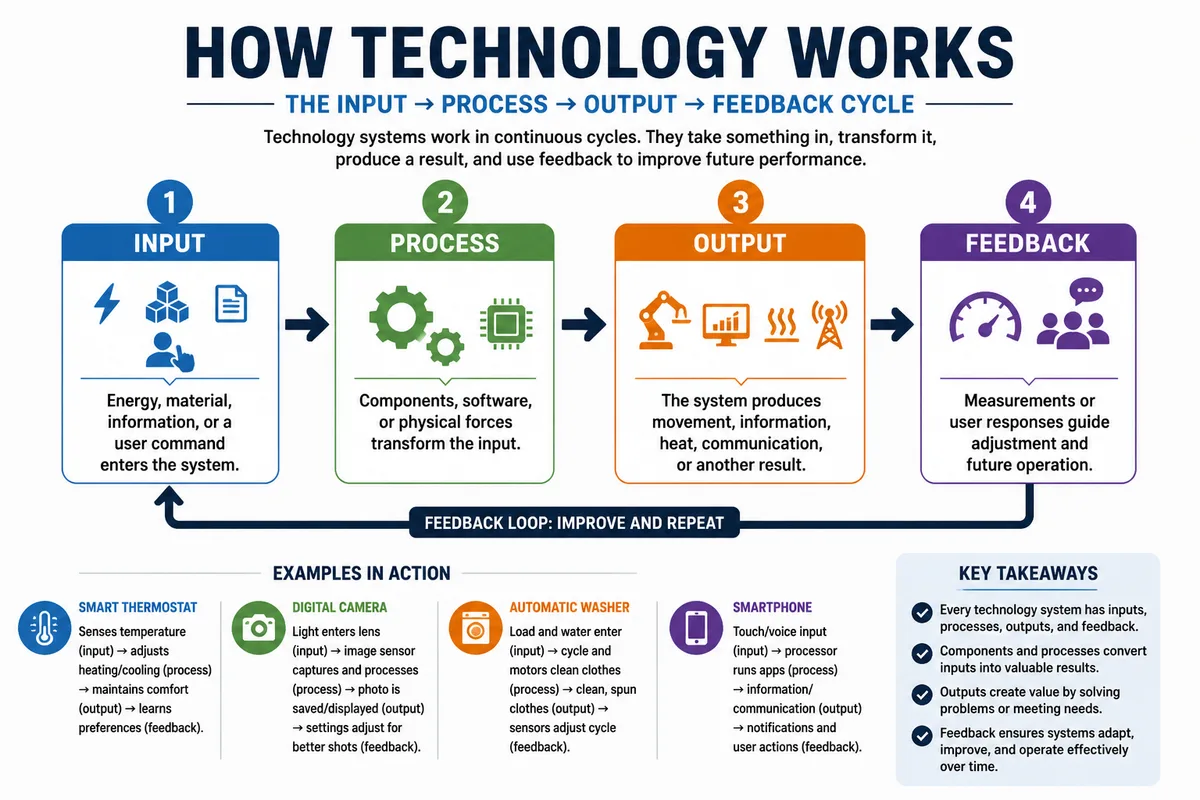
The pattern is simple.
Consider a thermostat. The input is a temperature measurement. The process compares that measurement with a chosen setting. The output is a signal that starts or stops heating, while feedback arrives through a new temperature reading.
Inputs can take several forms. They may be electrical energy, fuel, sunlight, raw materials, sensor readings, written commands, sound, or pressure from a person.
Processing also has several meanings. A machine may cut or heat material; a circuit may control current; software may calculate a result; or an organization may apply a procedure to information.
Outputs can be physical or digital. A motor produces movement, a lamp produces light, a printer produces a page, and a search engine produces ranked information on a screen.
Feedback closes the loop, which is why many useful systems measure their own performance instead of acting once and stopping, allowing them to compensate for changing conditions while remaining dependent on the quality of their sensors, instructions, and human settings.
What role does electricity play in modern technology?
Electricity supplies energy and carries signals through many modern technologies, from household appliances to computers and communication equipment. A power source creates a potential difference, components guide the resulting current, and circuits convert electrical energy into light, movement, heat, or information.
Electricity needs a path.
A battery, power supply, or generator provides electrical energy. Conductive materials provide routes for current, while switches, resistors, capacitors, motors, and other components control how the system behaves.
Electronic circuits can also represent information through changing voltage or current states. Transistors act as controllable switches, and large groups of transistors form circuits capable of performing logical operations and calculations.
Digital devices use electricity extensively, though electricity alone does not explain the whole device. Software instructions, storage components, communication protocols, sensors, physical materials, and human-designed interfaces determine how electrical changes become useful actions.
Some technologies operate without electricity. A lever, paper map, hand saw, sail, ceramic pot, and mechanical clock can perform useful work through force, motion, heat, or material properties.
How do computers understand information?
Computers represent information as patterns that electronic circuits can distinguish, process, store, and transmit. In digital systems, a bit has two possible states commonly written as 0 and 1, while groups of bits encode numbers, text, images, sound, and instructions.
Binary is a representation.
A computer does not experience a photograph as a human viewer does. It handles numerical data arranged according to agreed formats, and software interprets those numbers as pixels, colors, sounds, characters, or commands.
The processor follows instructions stored in memory. It performs operations such as adding values, comparing conditions, moving data, and choosing what instruction comes next.
Memory holds data needed immediately. Storage keeps files and programs when the device is turned off, although the exact technologies differ between devices and product designs.
Software gives the hardware organized instructions. Hardware supplies the physical circuits, surfaces, sensors, screens, and storage required to carry out those instructions.
Binary explains a major foundation of digital technology, yet it does not describe every layer by itself, because a working computer also requires electrical engineering, operating systems, applications, data formats, networks, security controls, and people who define the goals.
How do hardware, software, and the internet work together?
Hardware is the physical equipment, software is the organized set of instructions, and a network is the connection that allows devices to exchange data. Together, these layers let a user request an action, let a computer process it, and receive a response from local or remote systems.
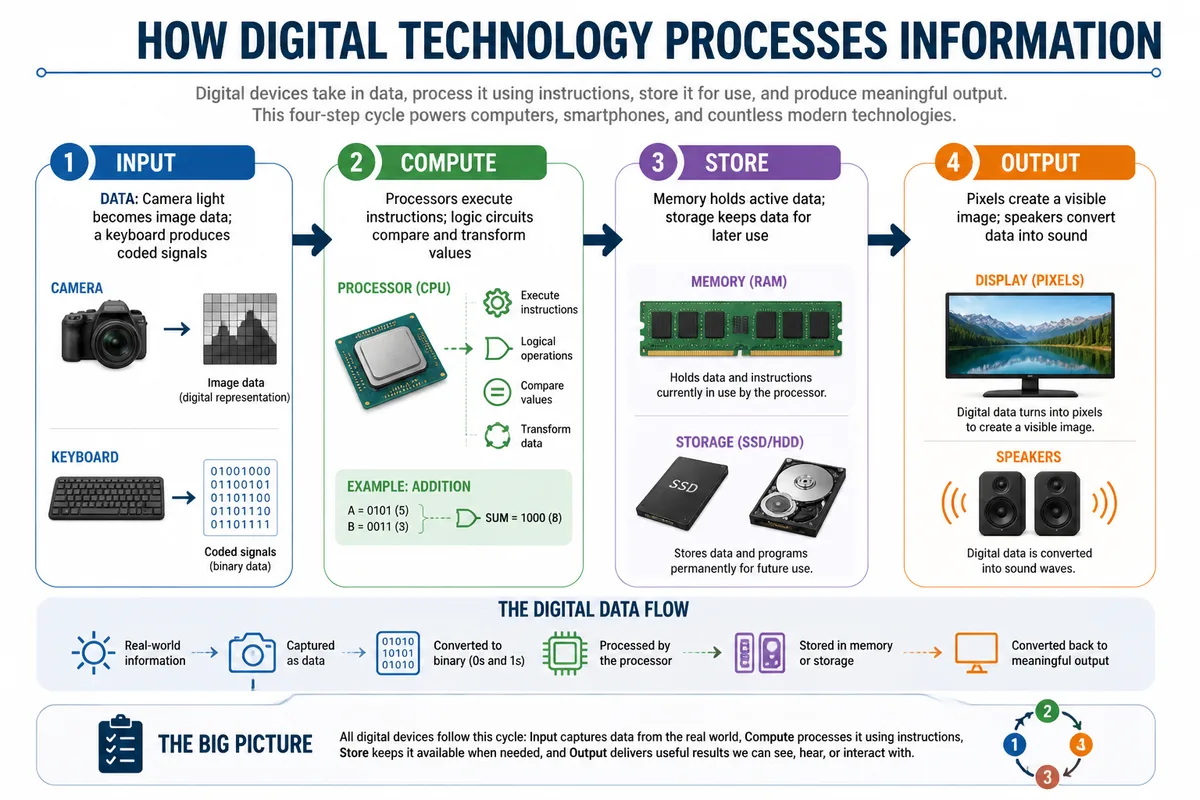
Hardware occupies space.
A phone contains processors, memory, storage, cameras, radios, a battery, sensors, and a display. Software tells these parts when to capture light, save a file, open an application, or send information.
The internet links many independent networks. When you request a web page, your device prepares data, network equipment forwards packets toward a destination, a server processes the request, and a response travels back to your device.
Names such as website addresses help people identify destinations, while routing systems use numerical network addresses and forwarding rules to move packets between systems. The route can change when equipment is busy, unavailable, misconfigured, or disconnected.
A connection can fail for several concrete reasons:
- Local failure: the device, cable, radio, or home network has a problem.
- Routing failure: an intermediate network cannot forward the data correctly.
- Server failure: the destination system is unavailable or overloaded.
- Protocol or security failure: systems reject data that does not meet their rules.
Cloud computing extends this arrangement by allowing software, storage, or processing to run on remote systems accessed through a network, which is convenient while making availability, account access, privacy, and data-location questions more important.
How do sensors, automation, and artificial intelligence work?
Sensors measure conditions such as light, motion, pressure, sound, location, or temperature; a control system interprets those measurements and selects an action. Automation follows predefined rules, while artificial intelligence systems use models built from data to produce classifications, predictions, generated content, or recommendations.

Sensors collect signals.
An automatic door may detect movement, apply a programmed condition, and activate a motor. A car safety system can combine measurements from several sensors before deciding whether to warn the driver or intervene.
Artificial intelligence fits within this broader pattern. Data enters a model, mathematical operations transform that data, and the system produces an output such as a label, probability, text response, or image.
Artificial intelligence does not guarantee human-like understanding. A model can identify statistical patterns and produce useful results while still missing context, repeating errors in its data, or generating an answer that sounds convincing without being correct.
Use automation for repeatable rules.
Use artificial intelligence cautiously when the output affects people, money, safety, privacy, or access to services, because human review, representative data, testing, monitoring, and clear accountability remain necessary parts of the larger system.
For readers choosing a first practical direction, technology skills for beginners can provide a more focused starting point than trying to master every technical field at once.
How do people and society shape technology?
Technical design creates possibilities and limits, while people, institutions, culture, laws, budgets, and habits influence how a technology is adopted and used. The same underlying system can produce different outcomes when its users have different goals, safeguards, resources, or social expectations.
Design affects behavior.
A device can make one action easy and another difficult through its interface, settings, physical layout, or default choices. Organizations then add policies, training, access controls, maintenance schedules, and incentives that shape what happens in practice.
Technology can support communication, work, access to information, transportation, scientific research, or medical practice, yet those benefits require suitable infrastructure and responsible use rather than appearing automatically whenever a device exists.
Risks also emerge at several layers. Weak security can expose information, poor design can encourage mistakes, unclear data practices can reduce privacy, and automated systems can reproduce limitations present in their training data or operating rules.
The belief that technology automatically improves life is incomplete. A faster communication tool may save time while increasing exposure to unwanted messages, and a connected service may improve access while creating new requirements for accounts, devices, or reliable internet service.
Technology shapes choices, and choices shape technology.
How technology improves, and where it falls short
Technology improves through testing, measurement, redesign, and feedback rather than through novelty alone. Engineers compare a system with defined requirements, identify failures, change materials or instructions, and test again, while users and regulators can reveal problems that laboratory testing missed.
Testing exposes weaknesses.
Designers may measure speed, accuracy, energy use, durability, cost, accessibility, or safety. Improving one measure can create a trade-off elsewhere, such as higher complexity, greater energy demand, harder maintenance, or increased purchase and operating costs.
Common failures often come from small misunderstandings:
- Confusing a tool with its result: a device can enable an outcome without guaranteeing it.
- Treating digital data as meaning itself: encoded values require formats and interpretation.
- Assuming automation removes responsibility: people still define rules, targets, permissions, and responses.
- Ignoring maintenance: worn parts, outdated software, depleted batteries, and damaged connections change performance.
- Trusting confident software output: a clear interface can hide incomplete data or incorrect processing.
Do not choose a complex digital system for a simple task when a reliable physical method already meets the need. Choose the simpler option here.
For a connected system, check who controls the data, how access is protected, what happens when the connection fails, and whether a person can review or reverse important decisions before relying on it.
How does a smartphone send a photo?
A smartphone sends a photo by converting light into sensor measurements, processing those measurements into an image file, storing the file, dividing its data for network transmission, and reconstructing it on the recipient’s device for display.
The process starts with light.
- Capture the scene: the camera lens directs light toward an image sensor, which records measurable values related to the light reaching different locations.
- Build the image: the phone’s software processes sensor data, applies an image format, and creates a file containing numerical information for pixels and related metadata.
- Store the file: the operating system writes the image to local storage or prepares it for an application that can access the file.
- Prepare transmission: the application and network software divide the data into packets and attach information needed for delivery and reassembly.
- Route the data: wireless equipment and interconnected networks forward packets toward the recipient’s device or a remote service.
- Display the result: the receiving device rebuilds the file, decodes its image data, and sends display instructions to the screen.
Each step has a distinct failure point. A dirty lens affects capture, insufficient storage blocks saving, a weak connection interrupts transfer, and an unsupported format can prevent display even when the original photo remains intact.
The user sees one action.
The system performs many coordinated operations involving optics, electronics, software, storage, network protocols, and human choices about permissions and recipients, which shows why everyday technology feels simple at the surface while containing several technical layers underneath.
That is how technology works scientifically: measurable inputs pass through designed transformations, and the final result depends on the complete system rather than one component alone.