The 3,000 Dollar Car Repair Rule: Should You Fix Your Vehicle or Replace It?
The 3,000 Dollar Car Repair Rule: Should You Fix Your Vehicle or Replace It?
The 3,000 car repair rule is a rough decision point, not an automatic replacement order. When a repair estimate reaches about $3,000, compare the repair with the vehicle’s condition, safety, remaining service life, warranty coverage, recent repair history, and the true cost of obtaining a dependable replacement.
A $3,000 repair can be sensible for a reliable, paid-off vehicle with a strong maintenance record, while the same bill may be a warning sign on a car facing repeated major failures. This guide explains how to assess the estimate, calculate twelve-month ownership costs, verify the diagnosis, and decide without relying on market value alone.
Quick Summary
🔧 The 3,000 car repair rule is a budgeting guideline, not a legal standard, manufacturer recommendation, or universal financial formula.
💰 Compare the repair with the total cost of replacement, including taxes, registration, financing, insurance, inspection, and likely immediate maintenance.
🛡️ Safety-related work involving brakes, tires, steering, suspension, or structural integrity should be assessed by a qualified professional and not postponed because of resale value.
📋 A written diagnosis, itemized estimate, second opinion, service history, and twelve-month cost projection provide a stronger basis than the $3,000 figure alone.
What Is the 3,000 Dollar Car Repair Rule?
The 3,000 dollar car repair rule is a budgeting guideline that uses an approximately $3,000 repair estimate as a prompt to review whether keeping the vehicle still makes financial sense. The rule does not say that every car needing $3,000 of work should be sold or traded.
The $3,000 amount is not a manufacturer recommendation, legal threshold, or verified industry formula. Repair prices vary according to the vehicle, location, labor rate, parts selection, diagnostic complexity, and repair facility. Vehicle age and mileage matter, but reliability history and structural condition often matter more than a single dollar limit.
A $3,000 repair should start a structured comparison, not end the decision.
Why a Fixed Dollar Threshold Cannot Decide for You
A repair can exceed a vehicle’s market value and still cost less than replacing the vehicle with another dependable one. A paid-off car with documented maintenance may require one expensive repair but remain less costly over the next year than a replacement vehicle with financing, insurance changes, and unknown defects.
Market value, trade-in value, and replacement cost are separate figures. A trade-in offer may tell you what a buyer or dealer is willing to pay, but it does not tell you how much money you need to obtain safe and dependable transportation.
The phrase “3,000 dollar car repair rule” is also sometimes confused with a $3,000 car-buying or down-payment guideline. Those are different budgeting ideas. The repair-focused rule asks whether to keep a vehicle after a major estimate; a buying rule concerns the money available to purchase or finance another vehicle.
Why Can the 3,000 Dollar Car Repair Rule Be Misleading?
The 3,000 dollar car repair rule can be misleading when owners compare a repair bill with trade-in value instead of with the full cost of replacement. A replacement vehicle usually requires more than its advertised purchase price, and a used vehicle can bring deferred maintenance or defects that are not visible during a quick inspection.
Replacement costs may include sales tax, registration, financing interest, insurance changes, inspection fees, dealer or documentation charges, and immediate maintenance. The exact items depend on the jurisdiction, lender, seller, vehicle, and contract, so the final amount must be checked locally before making a decision.
Repair Cost Versus Vehicle Value
Private-party value, trade-in value, and practical replacement cost answer different questions. A vehicle with a low private-party value may still provide affordable transportation if the repair restores a reliable system and the body, frame, interior, and remaining mechanical components are sound.
A repair-to-value ratio can be useful as a warning signal, but it should not operate as a standalone decision rule. The ratio ignores how much it would cost to replace the vehicle and how much risk comes with the next vehicle.
Replacement Cost Is More Than the Purchase Price
A replacement calculation should include the purchase price, taxes, registration, financing, insurance, inspection, and likely immediate maintenance. A used replacement may also need tires, brakes, fluids, a battery, or other service soon after purchase.
For example, an illustrative $14,000 replacement financed over several years could create a monthly payment, interest expense, and insurance changes that do not exist on a paid-off vehicle. The example is not a market quote or personal recommendation; actual costs depend on credit, lender terms, location, vehicle, down payment, and insurance profile.
| Cost category | Keep the current vehicle | Replace the vehicle | What to verify |
|---|---|---|---|
| Immediate expense | Written repair estimate | Purchase price and acquisition fees | Itemized documents, taxes, and registration |
| Next 12 months | Maintenance and likely repairs | Immediate service and possible defects | Service records and inspection findings |
| Monthly ownership | Repair reserve, fuel, insurance, and registration | Payment, interest, insurance, fuel, and registration | Actual lender and insurance terms |
| Risk | Known problem and known history | Unknown condition and prior ownership | Inspection, title, accident, and maintenance history |
What Five Questions Should You Ask Before Approving a Major Car Repair?
Before approving a major car repair, ask what failed, how urgent the problem is, what the complete cost includes, and what other repairs may be approaching. A written diagnosis and itemized estimate help separate a confirmed safety issue from optional work or a recommendation that needs further evidence.
Safety-critical repairs deserve a safety decision first and a resale-value decision second.
What Exactly Failed and How Urgent Is It?
Ask the repair facility to identify the failed component, diagnostic evidence, labor, parts, taxes, warranty terms, and possible additional findings. A vague estimate that only lists a large total does not give you enough information to compare facilities or understand the decision.
Brakes, tires, steering, suspension, and other safety systems require particular caution. Do not delay necessary safety work because the vehicle has a low resale value. A qualified professional inspection is appropriate when the diagnosis is complex, expensive, or unclear.
What Other Repairs Are Likely Within 12 Months?
Review tires, brakes, battery, cooling components, suspension, belts, fluids, and known model-specific service needs. A single major failure on an otherwise maintained car is different from repeated breakdowns affecting the engine, transmission, electrical system, and cooling system.
Service records can reveal whether the vehicle has received mileage-based maintenance or whether several systems are reaching the end of their useful service at the same time. Recent repair spending should be recorded, but past spending alone does not justify approving a new repair; the question is what future transportation the next dollar will buy.
Does a Warranty or Service Contract Apply?
Check the factory warranty, remaining powertrain coverage, emissions coverage, recall status, and any service contract before authorizing work. Coverage depends on the vehicle, time, mileage, component, exclusions, deductible, maintenance records, and contract language.
Ask the administrator or manufacturer for a written coverage decision. A warranty may reduce the repair cost, but it does not automatically make an unsafe or unreliable vehicle worth keeping.
How Do You Compare Repairing and Replacing Your Car?
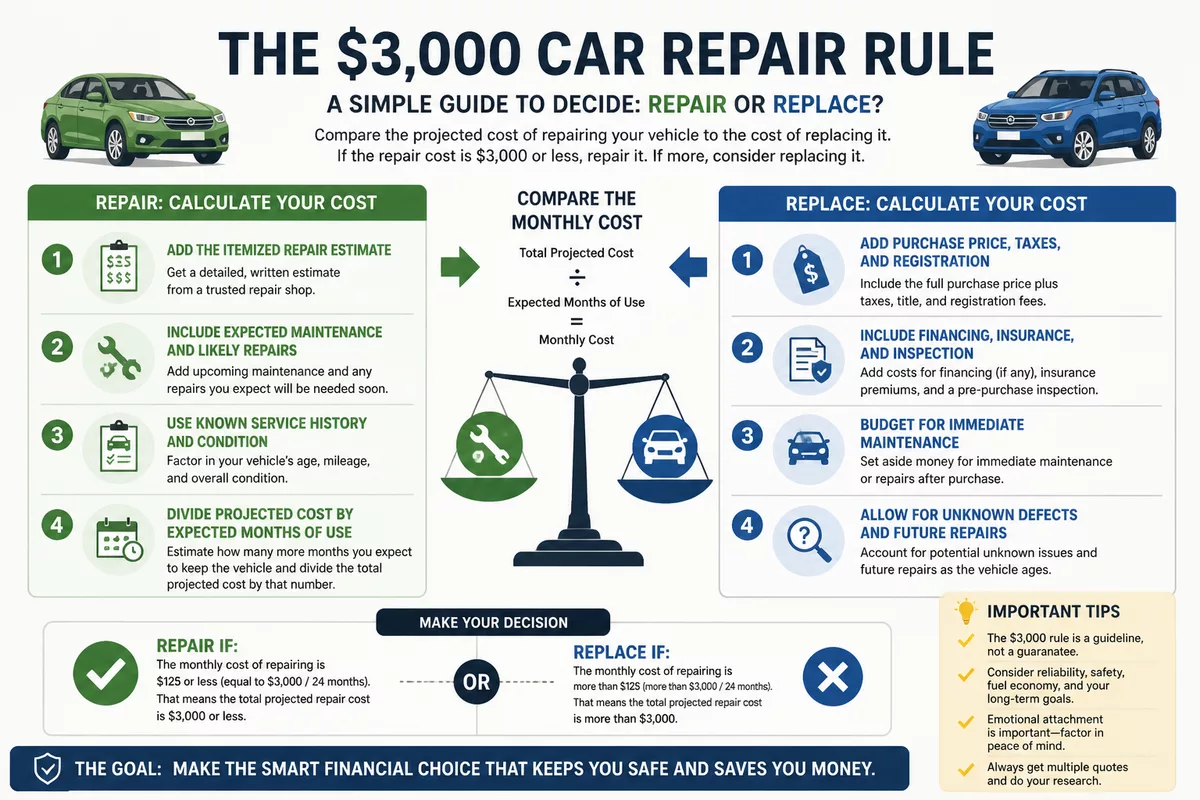
Compare realistic twelve-month and monthly ownership costs rather than comparing a $3,000 repair with a replacement vehicle’s sticker price. Add the current repair, expected maintenance, likely repairs, insurance, registration, financing, inspection, and uncertainty for both options.
The most useful comparison is not “repair bill versus car value.” It is “cost of dependable transportation over the period I expect to keep driving this vehicle.” Use more than one valuation source, and do not assume that a newer vehicle is automatically cheaper, safer, or more reliable.
| Step | Keep the vehicle | Replace the vehicle |
|---|---|---|
| 1. Establish the immediate cost | Use the complete written repair estimate | Use the negotiated purchase price plus acquisition charges |
| 2. Add near-term costs | Include maintenance and known upcoming repairs | Include inspection, tires, brakes, fluids, or other immediate service |
| 3. Add ownership costs | Include insurance, registration, fuel, and repair reserves | Include payment, interest, insurance, registration, and fuel |
| 4. Assess uncertainty | Use the vehicle’s service and breakdown history | Use an independent inspection and vehicle-history records |
How to Calculate the Cost of Keeping the Vehicle
Start with the immediate repair estimate, then add expected maintenance and likely near-term repairs. Divide the projected total by the number of months you realistically expect to keep driving the vehicle.
For an illustrative calculation, a $3,000 repair plus $1,200 of documented maintenance and likely service over twelve months produces a projected vehicle-related cost of $4,200, or $350 per month before fuel, insurance, and registration. The figures are hypothetical and should be replaced with your own written estimates.
How to Calculate the Real Cost of Replacing It
Calculate the replacement option using the purchase price, taxes, registration, financing, insurance, inspection, and immediate maintenance. Allow for the possibility that a replacement vehicle will need repairs even if it appears newer or has fewer miles.
Compare the replacement’s monthly payment and ownership costs with the repaired vehicle’s projected monthly cost. A replacement may still be appropriate when it materially improves safety, reliability, or transportation capacity, but the improvement should be weighed against the financial pressure it creates.
How Do Repair Shops and Parts Choices Affect the Estimate?
Independent repair shops and dealerships may produce different estimates because labor rates, diagnostic procedures, facility equipment, warranty terms, and parts choices differ. No universal percentage can reliably describe the difference for every vehicle or region.
Request equivalent estimates and ask whether original-equipment, reputable aftermarket, or remanufactured parts are suitable for the specific repair. A lower quote is not genuinely lower if it omits diagnosis, fluids, taxes, programming, required calibration, labor, or warranty coverage.
Before contacting a repair provider, a free car advice overview can help you identify which questions to ask and where extra charges may appear. Treat general guidance as preparation, not as a substitute for a vehicle-specific inspection.
When Does a $3,000 Repair Usually Make Sense—and When Does It Not?
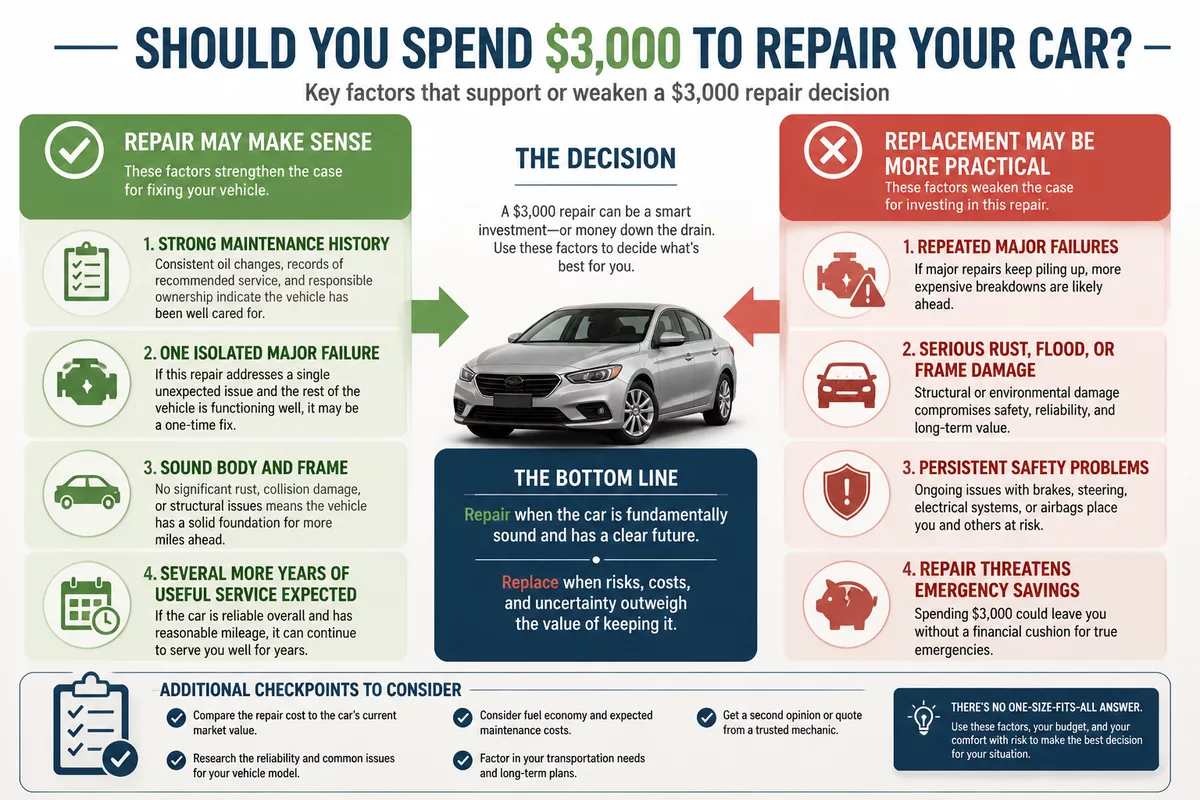
A $3,000 repair is more defensible when the vehicle is safe, structurally sound, well maintained, and affected by an isolated failure. Replacement becomes more attractive when major failures recur, structural damage exists, reliability is unpredictable, or the repair would consume money needed for essential expenses.
The decision should focus on expected future ownership cost and dependable service rather than resale value alone. A vehicle can have little resale value but still provide affordable transportation after a well-defined repair.
Signs That Fixing the Vehicle May Be the Better Choice
- The vehicle has a strong maintenance history and a generally reliable record.
- The estimate concerns one substantial repair rather than a sequence of unrelated major failures.
- The body and frame are sound, with no serious rust, flood damage, or unresolved safety defect.
- The repair is covered partly or fully by a valid warranty or service contract.
- The vehicle is paid off and replacement financing would create significant monthly pressure.
- The repair offers a reasonable expectation of continued safe service for several years.
Signs That Replacing the Vehicle May Be More Practical
- Repeated engine, transmission, electrical, or cooling failures have occurred recently.
- Serious rust, frame damage, flood damage, or persistent safety problems affect the vehicle.
- The $3,000 repair is only one part of a larger list of urgent or overdue work.
- The vehicle no longer meets essential transportation needs.
- Approving the repair would eliminate an emergency fund or create unaffordable debt.
What Do Three Real-World $3,000 Car Repair Scenarios Look Like?
The same repair amount can produce different answers because vehicle history, condition, safety, and replacement alternatives change the calculation. The following examples use illustrative numbers to show the method, not universal repair prices or current market averages.
A Well-Maintained Older Vehicle With One Major Failure
Assume a paid-off older sedan has complete service records, no serious rust, and one isolated repair estimated at $3,000. If the owner expects $1,200 of additional maintenance during the next twelve months, the illustrative keeping cost is $4,200 before insurance, fuel, and registration.
Repairing may be financially sensible if a dependable replacement would require a down payment, financing, acquisition costs, and immediate maintenance above that amount. A professional inspection should still confirm that the repair addresses the actual failure and that no major system is approaching failure.
A Vehicle With Repeated Major Failures
Assume a vehicle has already required major engine, electrical, and cooling-system work, followed by a new $3,000 estimate. The latest bill should be evaluated alongside the cumulative repair history and the condition of other systems.
Replacement may be more practical when the next repair is unlikely to restore predictable transportation. The decision should not be based on the money already spent, because past costs cannot be recovered; it should be based on the future cost and reliability the next decision is likely to provide.
A Safety-Critical Repair on a Low-Value Car
Assume an older vehicle with low resale value needs work involving brakes, tires, steering, or suspension. The low market value does not make the vehicle safe to drive, and safety-critical work should not be postponed solely to avoid spending money on an old car.
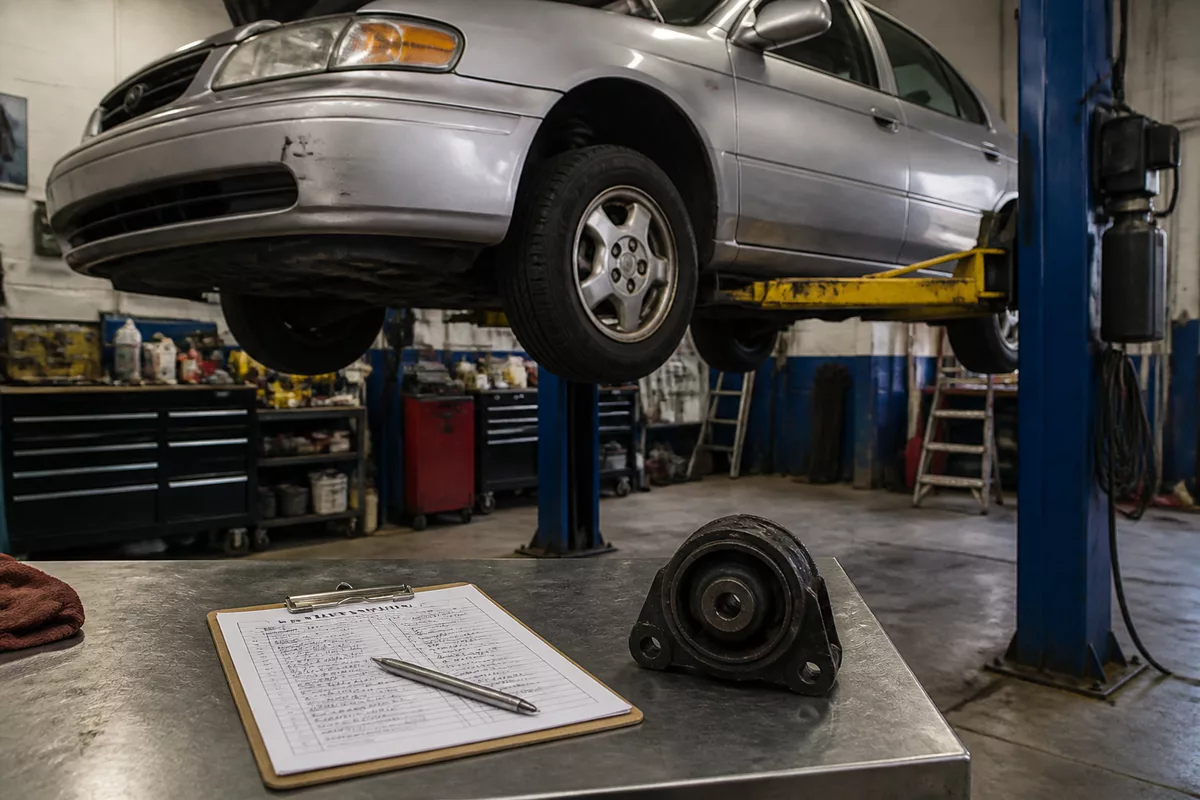
If the vehicle is structurally compromised or cannot be made safe at a reasonable cost, compare immediate safe replacement options. A qualified repair professional can explain whether the problem is isolated, repairable, and safe to address.
How Can You Make a Repair-or-Replace Decision? Follow These Steps
A practical repair-or-replace process turns the 3,000 car repair rule into a documented comparison. Complete the steps in order, keep the estimates and records, and avoid authorizing unrelated work before the urgent problem is understood.
- Confirm the diagnosis. Ask which component failed, what evidence supports the diagnosis, and whether the vehicle is safe to drive.
- Obtain a complete written estimate. Check labor, parts, diagnosis, fluids, taxes, programming, warranty terms, and possible additional findings.
- Separate urgent work from optional work. Identify safety-critical repairs, preventive maintenance, and convenience items separately.
- Get a qualified second opinion. Use an independent inspection for major, expensive, or unclear repairs, while comparing equivalent work.
- Review the vehicle’s history. Check mileage, maintenance records, recent repairs, rust, accident history, recalls, and known upcoming service.
- Calculate twelve-month costs. Add the repair, maintenance, likely repairs, insurance, registration, and other ownership expenses.
- Calculate replacement costs. Include purchase, taxes, registration, financing, insurance, inspection, immediate maintenance, and possible defects.
- Protect emergency savings. Do not create unaffordable financial pressure or postpone necessary safety work.
- Choose based on dependable transportation. Repair when the cost buys safe, reliable use; replace when future ownership is unlikely to be predictable or affordable.
How Can You Reduce the Cost of a Major Repair?
Compare an itemized estimate from a qualified independent shop with a dealership estimate when both are appropriate for the vehicle and repair. Ask each facility to identify labor hours, diagnostic charges, parts quality, taxes, warranty coverage, and conditions that could change the final bill.
A lower estimate may not provide equal value if it uses unsuitable parts or excludes required calibration. A higher estimate may include manufacturer-specific equipment or a longer warranty. Compare the work line by line rather than choosing by headline price.
For broader preparation, reading car advice reviews critically can help you distinguish recurring service concerns from isolated complaints. Reviews do not verify a diagnosis, so repair decisions still require vehicle-specific evidence.
Common Mistakes to Avoid
- Using trade-in value as the replacement budget: a trade-in figure does not include taxes, financing, inspection, insurance, or immediate maintenance.
- Approving a vague estimate: an unexplained total makes it difficult to compare shops or challenge omitted charges.
- Ignoring cumulative repair history: several major failures may indicate an unfavorable reliability pattern even when the latest repair is reasonable by itself.
- Delaying safety work because of resale value: brakes, tires, steering, and suspension require a safety-focused decision.
- Assuming newer means cheaper: a newer replacement can still bring financing costs, depreciation, insurance changes, and unknown defects.
Final Decision Test
Repair the vehicle when the estimate buys continued safe and dependable transportation at a favorable ownership cost. Replace the vehicle when repeated failures, structural problems, unresolved safety issues, or projected costs make dependable ownership unlikely.
The $3,000 figure is the start of the analysis, not the conclusion. The strongest decision combines a verified diagnosis, a realistic twelve-month budget, vehicle condition, warranty information, and the true cost of a dependable replacement.
Key Takeaways
- 🔧 The 3,000 car repair rule is a review point, not an automatic replacement threshold.
- 💵 Compare total ownership costs, not the repair bill with trade-in value alone.
- 🧾 Request a written diagnosis, itemized estimate, warranty review, and qualified second opinion.
- 🛡️ Treat brakes, tires, steering, suspension, and structural defects as safety priorities.
- 🚗 Repair when the vehicle offers dependable future use; replace when repeated failures make ownership unpredictable.
Frequently Asked Questions
Is a $3,000 car repair worth it?
A $3,000 repair may be worth approving when the vehicle is safe, well maintained, structurally sound, and affected by an isolated failure. Compare the repair with twelve-month ownership costs and the full cost of obtaining dependable replacement transportation.
Should I repair a car that is worth less than the repair?
Vehicle value alone should not decide the issue. A car can be worth less than its repair and still cost less to keep than buying, financing, insuring, and maintaining another dependable vehicle.
At what point should I stop fixing my car?
Consider stopping when major failures recur, structural or flood damage exists, safety problems remain unresolved, or projected costs threaten essential savings. The relevant question is whether the next repair is likely to provide safe and predictable transportation.
Is it better to repair a car or finance another used car?
Repairing may cost less when the current vehicle is paid off and its history is known. Financing another used car may make more sense when repeated failures or structural problems make the current vehicle unreliable, but include interest, insurance, taxes, registration, inspection, and immediate maintenance.
Should I get a second opinion on a $3,000 car repair?
A second opinion is sensible for a major, expensive, or uncertain diagnosis, especially when the repair involves the engine, transmission, electrical system, or safety components. Ask the second facility to provide its own findings and an itemized estimate rather than simply commenting on the first shop’s total.