30-60-90 Car Maintenance: What to Check at Each Mileage Milestone
30-60-90 Car Maintenance: What to Check at Each Mileage Milestone
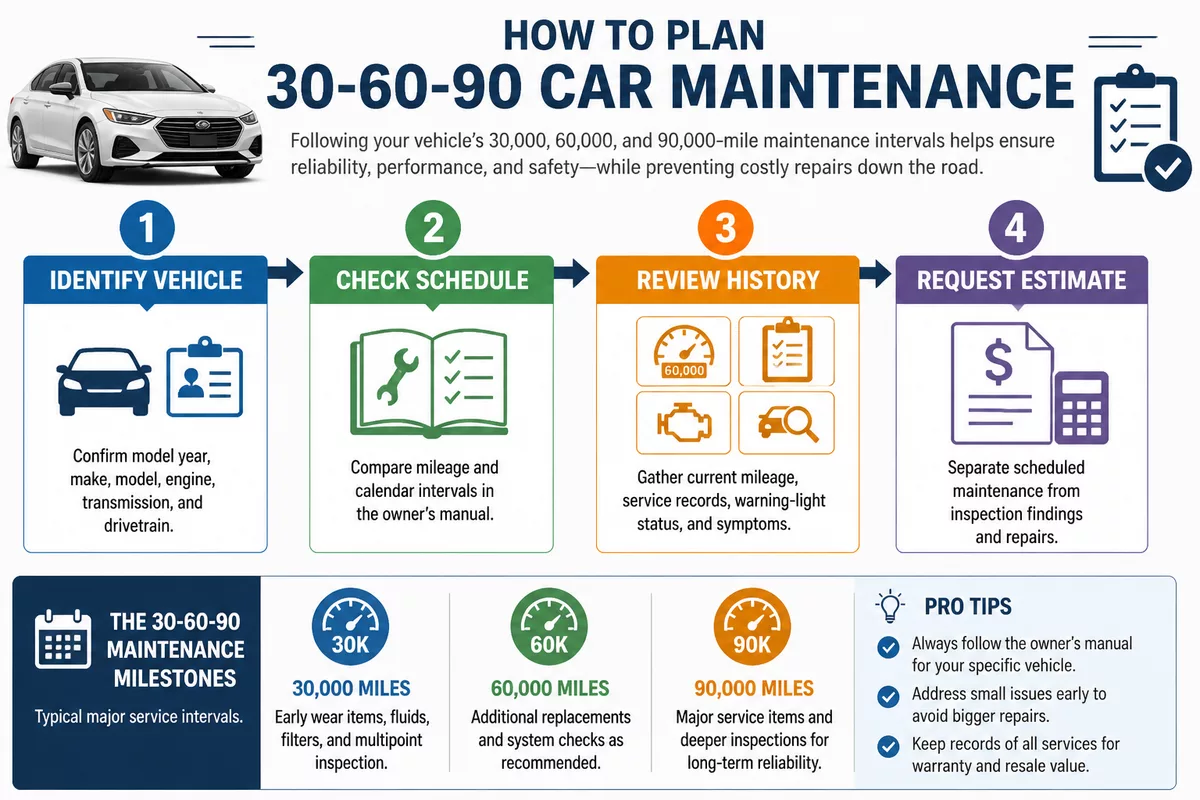
The 30-60-90 car maintenance rule is a general planning framework: 30,000 miles usually covers foundational inspections and filters, 60,000 miles often adds deeper fluid, brake, ignition, and transmission checks, and 90,000 miles commonly involves major-component inspections or replacements. The exact work depends on the manufacturer’s schedule, driving conditions, vehicle age, and engine design.
This guide explains what each mileage checkpoint may include, which services require confirmation in the owner’s manual, and when a mechanic should inspect the vehicle. Use the checklist to organize preventive care, not to approve automatic flushes, replacements, or repairs that your vehicle does not require.
Quick Summary
- 🛠️ 30,000 miles is generally a broad inspection point for filters, fluids, brakes, tires, belts, hoses, and battery condition.
- 🔧 60,000 miles may bring scheduled spark plugs, transmission service, coolant, differential-fluid, or timing-belt work, depending on the vehicle.
- 🚗 90,000 miles requires a complete review of the manufacturer’s schedule rather than a universal “major service” package.
- ⚠️ Warning lights, overheating, brake problems, steering faults, and fluid leaks should be addressed before any mileage milestone.
What the 30-60-90 Car Maintenance Rule Means
The 30-60-90 car maintenance rule is a mileage-based planning framework that groups preventive checks around 30,000, 60,000, and 90,000 miles. The milestones help vehicle owners review recurring maintenance, identify wear before it becomes a breakdown, and plan service expenses. They are not universal factory service packages.
Preventive car maintenance combines routine inspections with services that the manufacturer schedules for a specific vehicle. Oil changes, tire-pressure checks, brake inspections, and warning-light checks may occur well before or between the three milestones. Calendar intervals also matter because brake fluid, coolant, tires, rubber components, batteries, and wiper blades can age even when a car is driven infrequently.
The 30-60-90 rule is a planning aid, not a substitute for the vehicle-specific maintenance schedule.
The owner’s manual and the manufacturer’s maintenance schedule control the exact services due for your car. Recalls, safety inspections, warning lights, diagnosed faults, and visible damage should never be postponed simply because the odometer has not reached 30,000, 60,000, or 90,000 miles.
Why the Schedule Varies by Vehicle
A car maintenance schedule is a vehicle-specific service plan that reflects the design and operating requirements of a particular vehicle. The schedule can change according to model year, make, model, engine, transmission, drivetrain, hybrid system, climate, and vehicle age.
Some vehicles use a maintenance minder or electronic service indicator instead of fixed mileage packages. A generic vehicle maintenance checklist should therefore identify items to verify, rather than automatically authorize every fluid flush, filter replacement, or belt change.
- Check the model year, engine, transmission, and drivetrain before using a mileage checklist.
- Confirm both mileage and calendar intervals in the owner’s manual.
- Separate factory-scheduled work from repairs discovered during an inspection.
Before Using a 30-60-90 Maintenance Checklist
Before booking a 30,000-, 60,000-, or 90,000-mile service, locate the exact maintenance schedule for the vehicle’s year, make, model, engine, and drivetrain. The correct schedule may be available in the owner’s manual, the manufacturer’s service portal, or an authorized dealer’s documentation.
Review the mileage interval and the calendar interval together. When the manufacturer specifies both, follow whichever comes first, and check whether the vehicle has been used under severe-service conditions. Warranty documents, recall records, technical service information, and open service campaigns can also change what should be inspected or repaired.
What Counts as Severe Driving?
Severe driving describes operating conditions that can place greater demand on fluids, brakes, tires, cooling systems, suspension components, and drivetrains. Manufacturer schedules may define severe service differently, so use the wording in the vehicle’s manual rather than relying on a generic label.
- Frequent short trips that do not allow the engine to reach normal operating temperature.
- Stop-and-go traffic, prolonged idling, or repeated low-speed driving.
- Towing, carrying heavy loads, or driving on dusty, unpaved, or muddy roads.
- Regular operation in extreme heat, extreme cold, or mountainous terrain.
Low mileage does not eliminate calendar-based service. A rarely driven vehicle can still need checks for fluid aging, tire age, battery condition, hoses, seals, wipers, and rubber components.
What to Check at 30,000 Miles
A 30,000-mile service is usually a thorough inspection point rather than an automatic replacement package. The technician should confirm the oil and oil-filter interval, inspect major safety systems, and compare the vehicle’s current condition with the manufacturer’s schedule.
Routine checks at this milestone commonly include oil, filters, fluids, brakes, tires, lighting, battery connections, belts, hoses, wipers, and the spare tire. Replacement decisions still depend on the owner’s manual, the condition of each component, and any evidence of a fault.
Fluids, Filters, and Scheduled Service
Engine oil and the oil filter should be changed according to the specified interval and oil grade. The engine air filter and cabin air filter may be due for replacement, but some schedules use condition, time, or a different mileage interval.
Transmission fluid, coolant, brake fluid, power-steering fluid where applicable, and washer fluid should be checked according to the vehicle’s requirements. Transmission-fluid service, coolant replacement, spark-plug replacement, and brake-fluid changes vary significantly between models.
A mileage milestone can justify an inspection without proving that every fluid or filter needs replacement.
Be cautious when a service package includes preventive flushes, additives, or parts that are not listed in the manufacturer’s schedule. Approve those operations only when the owner’s manual, vehicle condition, or documented diagnosis supports them.
Safety and Wear Inspection
Brake inspection should cover pad and rotor condition, calipers, brake lines, parking-brake operation, and signs of fluid leakage. Tire inspection should include pressure, tread depth, uneven wear, tire age, visible damage, and rotation requirements.
Brake, steering, suspension, and electrical faults can require specialist tools or measurements. A professional inspection is appropriate when the vehicle pulls, vibrates, clunks, wanders, develops uneven tire wear, or shows a warning light.
What to Check at 60,000 Miles
The 60,000-mile milestone is a point to review major scheduled services and inspect systems that may show accumulated wear. Spark plugs, transmission fluid or filters, coolant, fuel filters, and differential fluid may be due, but only the manufacturer’s schedule can confirm the requirement.
The 60,000-mile maintenance review should also cover the suspension, steering, wheel bearings, exhaust, underbody, driveshafts, constant-velocity boots, and four-wheel-drive components where fitted. Battery condition and charging performance deserve attention if the vehicle has starting problems or electrical symptoms.
Timing Belts and Other Mileage-Sensitive Parts
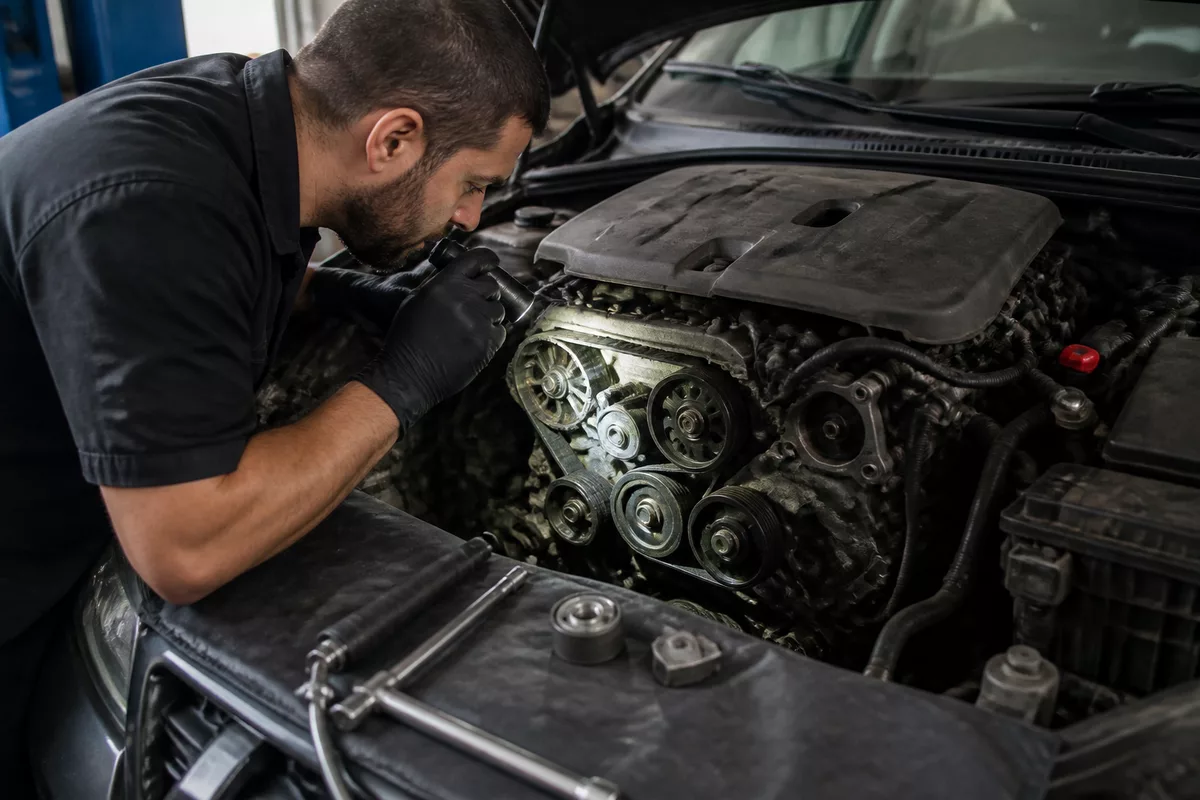
A timing belt synchronizes internal engine components, while an accessory or serpentine belt drives external accessories such as the alternator or air-conditioning compressor. A timing chain is a different design, and its service requirements are not interchangeable with a timing-belt interval.
Never assume that every vehicle needs a timing-belt replacement at 60,000 or 90,000 miles. Check the exact timing-belt replacement interval for the engine, because missing a prescribed interval can cause severe engine damage on some designs.
Ask for a written estimate that separates scheduled maintenance from repairs found during inspection. The estimate should identify the part, the reason for replacement, the evidence supporting the recommendation, and whether the work is urgent.
Chassis, Steering, and Suspension Checks
Inspection should look for leaks, looseness, cracked bushings, worn ball joints, damaged boots, poor damping, corrosion, and alignment-related tire wear. Steering or suspension problems can affect vehicle control and should not be treated as routine cosmetic defects.
A professional evaluation is recommended when the vehicle pulls, vibrates, clunks, wanders, or develops uneven tire wear. Brake, steering, suspension, and drivetrain repairs involve safety-critical components and may require lifting equipment or specialized measurements.
What to Check at 90,000 Miles
A 90,000-mile service can be more involved because several manufacturer-scheduled items may coincide, but there is no universal 90,000-mile package. Review the complete maintenance schedule and separate required maintenance from condition-based repairs.
Possible review items include timing belts, accessory belts, coolant, transmission or differential fluid, spark plugs, fuel filters, brakes, tires, suspension, steering, axles, exhaust, underbody corrosion, electrical components, climate controls, lights, and rubber parts. The actual list depends on the vehicle.
Planning for Higher-Mileage Ownership
Vehicle age, service history, driving conditions, expected future ownership, and previous repairs matter alongside mileage. A car with complete records may need a targeted service, while a used vehicle with missing records may need a documented baseline inspection.
Request a written inspection report and prioritize work in this order: immediate safety risks, manufacturer-required maintenance, repairs that could cause mechanical damage, reliability concerns, and convenience items. A forward-looking plan for the next 10,000 to 20,000 miles can be more useful than treating 90,000 miles as an endpoint.
For owners comparing advice from different service providers, a guide to free car advice options can help clarify what an initial consultation includes and which costs may appear later.
30-60-90 Maintenance Checklist at a Glance
The table below is a planning aid. “Typical check” means the item may be inspected at that milestone, while “possible scheduled service” means the owner’s manual must confirm whether replacement or adjustment is due.
| Mileage | Typical checks | Possible scheduled service | Confirmation required |
|---|---|---|---|
| 30,000 miles | Oil, filters, fluids, brakes, tires, lights, battery, belts, hoses, wipers | Air filters, cabin filter, tire rotation, selected fluid service | Oil grade, filter interval, brake-fluid and coolant timing |
| 60,000 miles | Major fluid review, brake system, suspension, steering, wheel bearings, exhaust, underbody | Spark plugs, transmission service, coolant, fuel filter, differential fluid, timing-belt work | Engine design, drivetrain, severe-service schedule, timing-belt interval |
| 90,000 miles | Complete scheduled-service review, leaks, performance, brakes, tires, suspension, electrical systems | Belts, plugs, fluids, filters, timing-belt work, corrosion-related repairs | Full manufacturer schedule, vehicle age, history, inspection findings |
How to Read the Checklist
Oil, tire, brake, and warning-light checks may recur before any 30-60-90 milestone. A vehicle used for short trips, towing, heavy loads, dusty roads, or severe temperatures may need earlier attention.
An inspection finding is not automatically a confirmed repair recommendation. Ask what was measured or observed, whether the item is unsafe, and whether the manufacturer requires the proposed service.
Maintenance Needs That Do Not Follow Mileage Alone
Time-based maintenance matters when a vehicle is driven infrequently. Brake fluid, coolant, tires, wiper blades, belts, hoses, batteries, and seals can deteriorate because of age, moisture, heat cycles, or storage conditions.
Use the calendar interval and the odometer together whenever the manufacturer provides both. The maintenance schedule should also account for climate, storage, driving pattern, and severe-service conditions.
Warning Signs That Should Not Wait
Brake noise, a soft brake pedal, fluid leaks, overheating, steering problems, unusual vibration, severe pulling, starting difficulties, and dashboard warning lights require prompt attention. A vehicle should be stopped and professionally assessed when continued driving could create a safety risk or cause further damage.
- Stop driving if overheating continues or the temperature warning appears.
- Arrange immediate inspection for a soft brake pedal, major fluid leak, or steering fault.
- Do not use a mileage checklist to diagnose an active warning light.
- Record the symptom, warning message, date, and mileage before contacting a repair facility.
When to Use a Professional Mechanic
Professional service is recommended for brake, suspension, steering, timing-belt, transmission, electrical, cooling-system, and warning-light diagnosis. These systems can require specialist tools, controlled testing, lifting equipment, or manufacturer-specific procedures.
Owners can often handle record keeping, visual checks, tire-pressure checks, and manual verification, but safety-critical repairs should be assessed by a qualified technician. Ask what was inspected, what evidence supports the recommendation, and which items are urgent.
How Much Does 30-60-90 Maintenance Cost?
There is no reliable universal price for 30-60-90 maintenance because cost depends on the vehicle, location, labor rate, parts, drivetrain, required fluids, and inspection findings. A scheduled service can be relatively limited, while a milestone that includes several manufacturer-required operations may cost more.
Separate routine maintenance from repairs discovered during the inspection before approving a quote. Compare the estimate with the manufacturer’s schedule, and question flushes, additives, or package services marketed as standard when the manual does not list them.
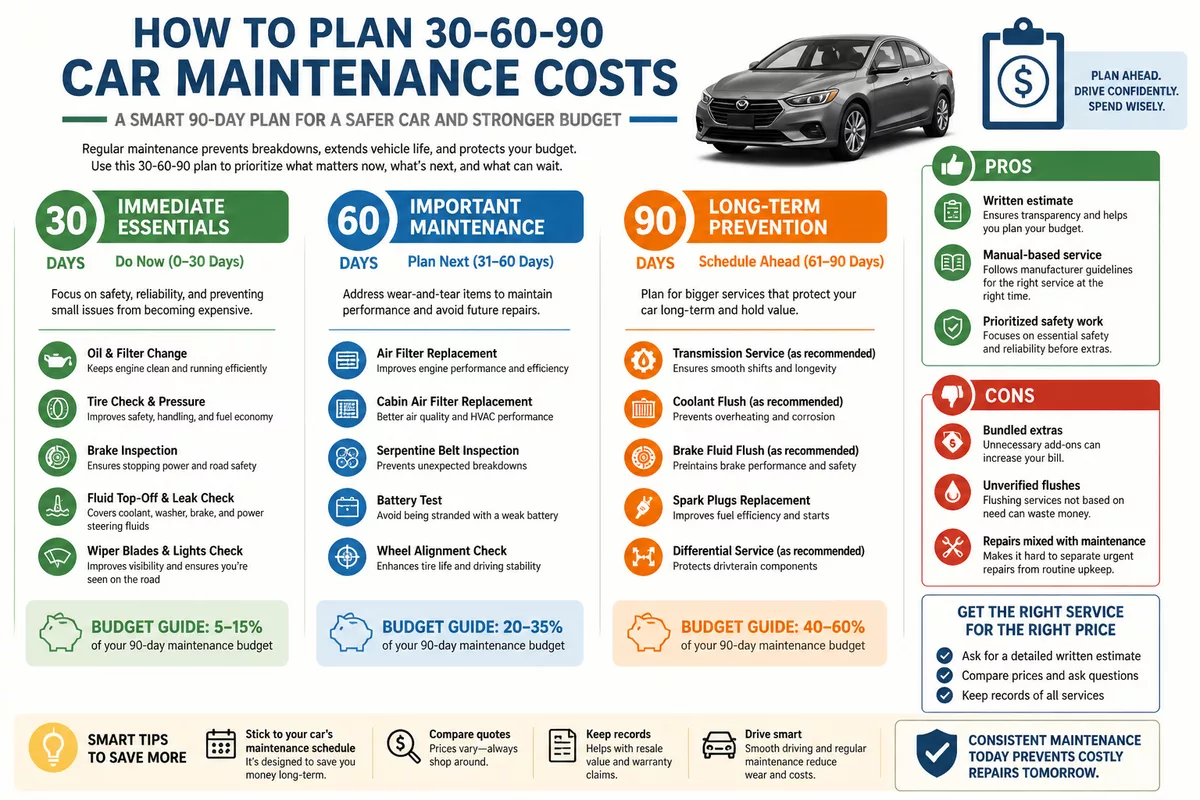
For an explicitly hypothetical example, a quote could list a $120 inspection, $90 in scheduled filters, and $450 for a manufacturer-required belt service, producing a $660 subtotal before taxes or additional repairs. The example is not a market average; actual pricing must be confirmed locally for the specific vehicle.
Prioritize work according to safety risk, risk of mechanical damage, manufacturer requirements, reliability, and convenience. A service provider should explain the reason for each line item instead of presenting every possible operation as mandatory.
How to Keep Reliable Maintenance Records
Record the date, mileage, service performed, parts or fluids used, and next due interval. Keep receipts, inspection reports, warranty documents, and recall records together so the next technician can distinguish completed work from unknown history.
- Use a digital reminder or maintenance calendar for recurring intervals.
- Note recurring symptoms, warning messages, and unusual noises.
- Save the vehicle identification number with service documents.
- Treat missing records as a reason for a baseline inspection, not proof that every major service is overdue.
A maintenance app can help organize reminders and records, but the vehicle’s owner’s manual remains the controlling source. Owners considering digital tools can review how a car advice app is set up before relying on it for reminders.
Key Points
- ✅ Use 30,000, 60,000, and 90,000 miles as planning checkpoints, not automatic service packages.
- 📘 Verify every operation in the owner’s manual for the exact year, engine, transmission, and drivetrain.
- 🔍 Separate inspections, scheduled replacements, and repairs discovered during service.
- 🛑 Address warning lights, brake faults, overheating, leaks, and steering problems before the next mileage milestone.
- 🧾 Keep written records and request itemized estimates for future maintenance planning.
The 30-60-90 car maintenance rule can organize preventive care, but the manufacturer’s schedule and current safety condition should determine what happens next.
Frequently Asked Questions
Is the 30-60-90 rule the same for every car?
No. The 30-60-90 rule is a general planning framework, while the exact schedule varies by vehicle, engine, drivetrain, age, and driving conditions. The owner’s manual takes priority over a generic mileage checklist.
What is usually needed at 30,000 miles?
A 30,000-mile service often includes a broader inspection of oil, filters, fluids, brakes, tires, belts, hoses, battery condition, lights, and wipers. Replacement decisions depend on the manufacturer’s schedule and the condition of each item.
What is commonly replaced at 60,000 miles?
Spark plugs, fluids, filters, differential fluid, or a timing belt may be due at 60,000 miles on some vehicles. The manufacturer’s schedule must confirm each interval because not every car uses the same components or timing.
Is 90,000-mile service expensive?
It can cost more when several scheduled items coincide, but the final amount depends on the vehicle, location, labor, parts, and inspection findings. Ask for an itemized estimate that separates scheduled maintenance from unrelated repairs.
Should maintenance be based on mileage or time?
Use both mileage and calendar intervals when the manufacturer provides both. Follow whichever interval comes first, and remember that tires, fluids, batteries, rubber parts, and wipers can age even when the vehicle is driven very little.
What should I do if my used car has no service history?
Arrange a baseline professional inspection and verify recalls using the vehicle identification number through the National Highway Traffic Safety Administration’s recall search. Review fluids, brakes, tires, safety systems, and manufacturer requirements before creating a documented maintenance plan.