What Is the 27.40 Dollar Rule? How This Small Daily Habit Can Support Saving
What Is the 27.40 Dollar Rule? How This Small Daily Habit Can Support Saving
The 27.40 dollar rule means setting aside $27.40 each day. Over 365 days, the calculation produces $10,001 before interest, taxes, fees, or withdrawals, making the method a simple framework for pursuing an approximately $10,000 annual savings goal.
The figure is a planning device, not an official financial rule or guaranteed path to wealth. This guide explains the arithmetic, shows equivalent weekly and monthly transfers, and helps you decide whether the target fits your income, essential costs, debt payments, and existing savings priorities.
Quick Summary
💵 Save $27.40 per day for 365 days and the principal contribution equals $10,001.
📅 The same target can be organized as $191.80 per week, $383.60 every two weeks, or an average of about $833.42 per month.
🧾 The amount is only appropriate if it remains affordable after rent, food, utilities, insurance, required debt payments, and irregular expenses.
🔎 A smaller, sustainable transfer is preferable to an ambitious target that causes overdrafts or missed bills.
The 27.40 Dollar Rule Explained
The 27.40 dollar rule is a personal budgeting method that suggests transferring $27.40 into savings each day. The amount is designed to turn a large annual target into a repeatable action rather than leaving the goal as a distant $10,000 figure.
The 27.40 dollar rule is a planning framework, not an official regulation, guaranteed investment strategy, or promise of wealth.
The method concerns saving $27.40, not earning $27.40. A person could earn more or less than that amount and still use the framework if the transfer fits the available cash flow. The daily figure also does not account for interest, taxes, account fees, inflation, or withdrawals.
What the rule is designed to achieve
The rule is designed to support a consistent savings habit and provide a clear path toward a $10,001 contribution target over one 365-day period. The fixed amount acts as a planning tool, so it should be adjusted when income, bills, debt, or household responsibilities change.
- Create a visible and repeatable savings habit.
- Break an annual goal into a smaller daily action.
- Measure deposited money separately from interest or investment growth.
- Adapt the target instead of treating the daily amount as universal.
Readers starting from zero may find it useful to review broader personal finance basics before committing to a fixed transfer.
Why $27.40 a Day Equals About $10,001 a Year
The central calculation is straightforward: $27.40 multiplied by 365 days equals $10,001. The result represents principal contributions only, assuming one transfer occurs on every day of a 365-day year and no money is removed.
| Schedule | Calculation | Target amount | Important note |
|---|---|---|---|
| Daily | $27.40 × 1 | $27.40 | Direct version of the rule |
| Weekly | $27.40 × 7 | $191.80 | Seven daily contributions |
| Every two weeks | $27.40 × 14 | $383.60 | Useful for biweekly pay cycles |
| Average month | $10,001 ÷ 12 | About $833.42 | Average, not the exact amount for every calendar month |
| 365-day year | $27.40 × 365 | $10,001 | Before interest, fees, taxes, or withdrawals |
The weekly figure of $191.80 and the biweekly figure of $383.60 are exact results of multiplying the daily amount. The monthly figure is an average because calendar months contain different numbers of days, while the annual result assumes 365 daily deposits.
Rounding a transfer to a convenient payday amount can make automation easier, but the final yearly total may differ slightly from $10,001.
Daily, weekly, biweekly, and monthly equivalents
A daily transfer is not required if the banking setup makes it inconvenient or costly. A weekly, biweekly, or monthly transfer can represent the same annual objective when the amount and timing are calculated carefully.
- Seven-day contribution: $191.80.
- Four-week approximation: $766.40, although four-week periods do not cover every calendar month evenly.
- Biweekly contribution: $383.60.
- Average monthly contribution: about $833.42.
Someone paid monthly could schedule an average transfer of about $833.42 after receiving income, but the exact timing should reflect rent, utilities, debt payments, and other bills. A person paid every two weeks could use $383.60 as the mathematical equivalent, provided the transfer does not leave too little cash before the next paycheck.
How Much Could You Save Over Time?
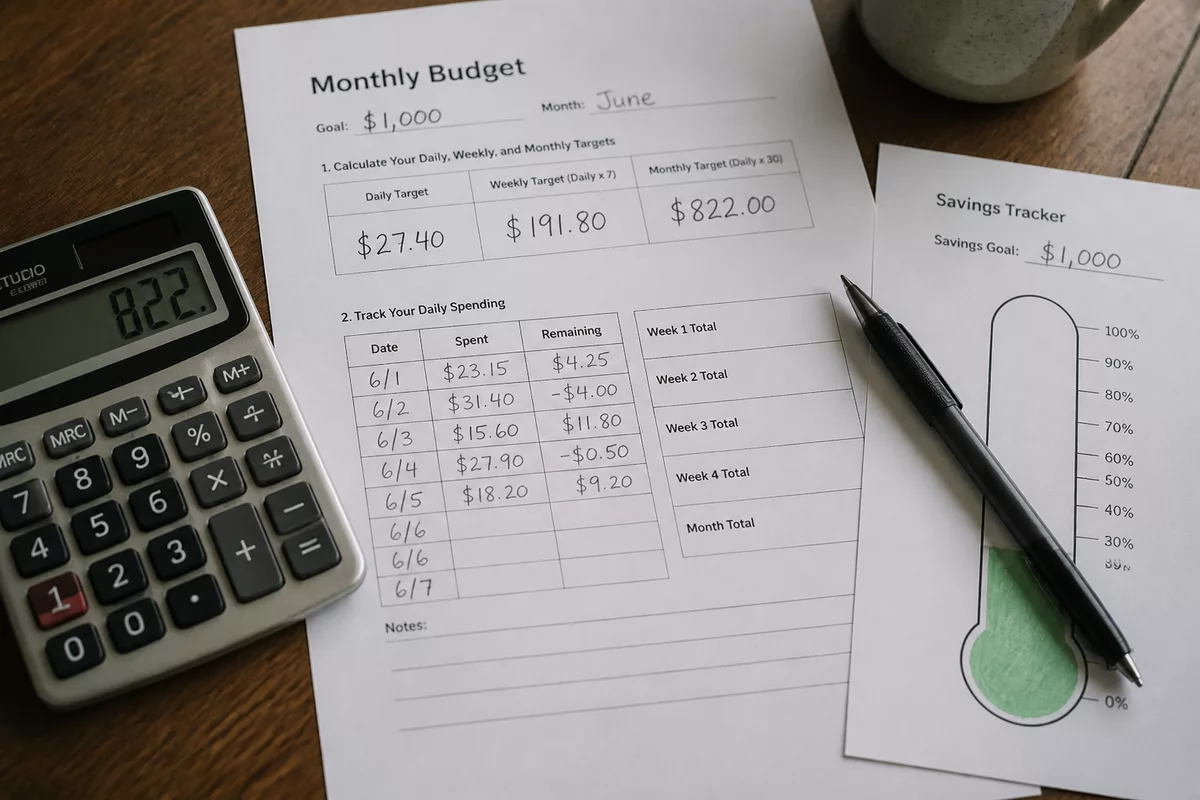
With a constant $27.40 contribution, the principal reaches $191.80 after one week, about $833.42 after an average month, approximately $5,000.50 after 182.5 days, and $10,001 after 365 days. These milestones use contribution arithmetic rather than a forecast of investment performance.
One week, one month, six months, and one year
The six-month estimate uses 182.5 days, which is half of a 365-day year. Actual deposits may vary if you use monthly transfers, skip contributions, round amounts, or begin partway through a calendar period.
| Milestone | Principal calculation | Approximate balance | Assumption |
|---|---|---|---|
| One week | $27.40 × 7 | $191.80 | Seven daily deposits |
| Average month | $10,001 ÷ 12 | $833.42 | Annual target divided across 12 months |
| Six months | $27.40 × 182.5 | $5,000.50 | Half-year estimate using 182.5 days |
| One year | $27.40 × 365 | $10,001 | 365 daily deposits with no withdrawals |
Why interest is not guaranteed
Money held in a savings account may earn interest, but rates can change and account terms can impose conditions or fees. Investment returns are uncertain and involve the possibility of losing part or all of the invested capital.
Fees and taxes can reduce the amount that remains available, while inflation can reduce the future purchasing power of the balance. The Consumer Financial Protection Bureau and the Federal Deposit Insurance Corporation provide general consumer information about deposits, account terms, and financial risks; current conditions should be checked with the relevant institution or official source.
How to Fit the 27.40 Dollar Rule Into Your Budget
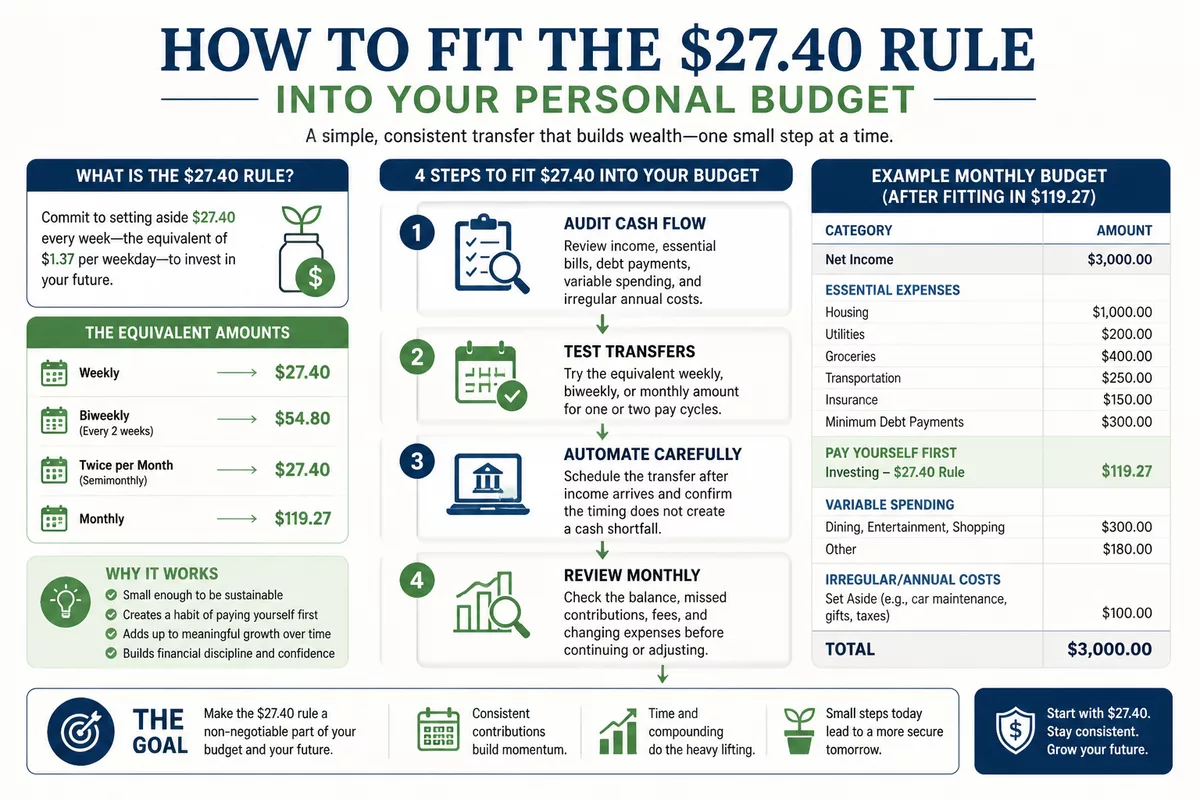
Before automating $27.40 per day, compare the target with take-home income, essential bills, variable spending, irregular costs, required debt payments, and existing savings commitments. A transfer is affordable only when the remaining balance can cover normal obligations and a reasonable cash buffer.
Check affordability before automating
A useful budget review includes a typical month and expenses that appear less often, such as insurance premiums, school costs, vehicle repairs, annual subscriptions, or seasonal bills. Reviewing only the most recent pay cycle can make a transfer look affordable when a larger scheduled payment is approaching.
- List reliable take-home income for the period being reviewed.
- Subtract rent or mortgage, food, utilities, insurance, transportation, and required debt payments.
- Account for irregular expenses by estimating their yearly total and dividing it across the relevant months.
- Set aside a cash buffer before choosing the savings transfer.
- Test the target for one or two pay cycles and inspect the account balance.
- Automate only after the transfer date matches actual cash flow.
A lower amount that can continue for several months is more useful than a higher amount that causes missed payments. The first few transfers should be treated as a test of the budget, not as proof that the plan will work under every future circumstance.
Choose a transfer schedule that matches your income
Daily transfers may be practical when they are free and easy to monitor, but many people can simplify the same goal with a periodic transfer. A separate, clearly labeled savings account can also reduce the chance of spending money intended for a specific goal.
- Use daily transfers only when the bank supports them without problematic fees or timing issues.
- Use $191.80 weekly when weekly budgeting is easier to manage.
- Use $383.60 every two weeks when income follows a biweekly payroll schedule.
- Use an average of about $833.42 per month when monthly income and bills are predictable.
Readers looking for practical ways to reduce spending without extreme cutbacks can also review these budgeting ideas for young professionals.
Track progress without treating the habit as all-or-nothing
A banking app, spreadsheet, calendar, or savings tracker can show how much has actually been deposited. Record missed days and later catch-up contributions separately so the balance remains transparent.
Monthly reviews are more informative than judging the plan by a single missed transfer. The review should ask whether the amount remains affordable, whether fees appeared, and whether a new obligation requires an adjustment.
What to Do If You Cannot Save $27.40 a Day
Not everyone can safely save $27.40 per day. Income, rent, food costs, dependents, debt, insurance, irregular bills, and existing financial commitments determine whether the target is realistic, so the method should be reduced or postponed rather than funded by missed essentials.
Start with a smaller fixed amount
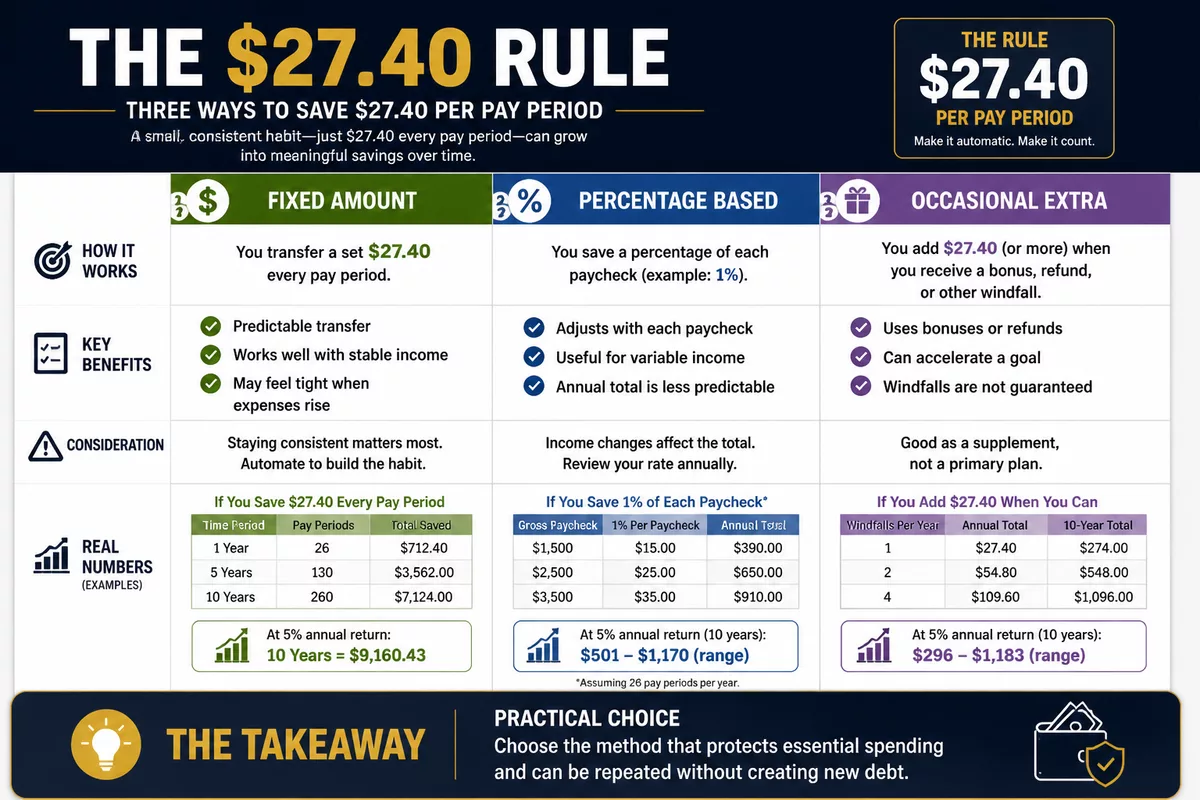
A smaller daily, weekly, or monthly transfer can preserve the habit while protecting essential spending. For example, a person who can consistently set aside $10 per day would contribute $3,650 over 365 days before interest, fees, taxes, or withdrawals; that is a different goal, but the calculation is clear and repeatable.
Increasing the amount after several sustainable months may be more realistic than starting at $27.40 and repeatedly reversing transfers. The target can be reviewed after a pay increase, a paid-off obligation, or a lasting reduction in expenses.
Use a percentage of each paycheck
Percentage-based saving changes with income, which can make it more flexible for people whose pay varies. Fixed-dollar saving offers a more predictable annual target when income and expenses are stable, but it requires the same amount even during a weaker pay period.
Neither method is automatically better. A fixed amount supports a defined goal such as $10,001 in 365 days, while a percentage may reduce pressure when hours, commissions, or freelance revenue fluctuate.
Add occasional contributions
A bonus, tax refund, gift, or other windfall may support the goal when directing part of it does not create a later cash shortage. Uncertain income should not be counted as guaranteed savings capacity.
Reviewing one optional recurring expense may also free money for the plan, but essential food, housing, insurance, utilities, and required debt payments should not be sacrificed to preserve a savings challenge.
Should You Save $27.40 a Day or Pay Off Debt First?
Required debt payments should remain current regardless of the savings strategy. For additional money, high-interest debt creates a known borrowing cost, while the return from a savings account or investment is not necessarily equal, fixed, or guaranteed.
The decision also depends on emergency cash. Directing every available dollar to debt can leave a person exposed to an unexpected repair or bill, potentially forcing new borrowing. A modest accessible cash buffer may therefore matter even while debt reduction remains a priority.
Questions to weigh before choosing
- What interest rate and fees apply to the debt?
- Are all minimum payments current?
- How much accessible emergency cash is available?
- Would an unexpected expense require new borrowing?
- Can the savings be accessed without costly penalties or restrictions?
- Is the savings objective an emergency fund, a planned purchase, or a longer-term goal?
Debt consolidation does not automatically lower total costs or monthly payments; the result depends on the new rate, fees, term, and repayment behavior. A qualified financial professional can help assess a personal situation, while official consumer-finance sources can explain general account and borrowing terms.
Common Mistakes When Using the 27.40 Dollar Rule
The most common problem is treating a simple calculation as a universal prescription. The rule becomes less useful when the target causes overdrafts, missed bills, new borrowing, or the cancellation of necessary insurance or debt payments.
- Calling it an official rule: it is a budgeting framework, not a government regulation.
- Ignoring irregular costs: annual bills and seasonal expenses can make a monthly budget look stronger than it is.
- Automating without checking timing: a transfer before rent or a debt payment can create an avoidable cash shortfall.
- Counting interest as guaranteed: rates can change, and investments involve risk and possible loss of capital.
- Treating one missed day as failure: the relevant measure is affordable progress over time, not a perfect streak.
A safer measure of success is whether the plan remains affordable, transparent, and repeatable as financial circumstances change.
A safer way to judge success
Review the amount deposited, the number of reversals, the effect on bill payments, and the size of the remaining cash buffer. A plan that needs frequent withdrawals is signaling that the target is too high or the timing is poorly matched to income.
Use the 27.40 dollar rule as a flexible framework. The annual target can be changed, the transfer can be scheduled weekly or monthly, and the method can be paused when essential obligations require attention.
Key Points
- 💵 $27.40 deposited daily for 365 days equals $10,001 before interest, fees, taxes, or withdrawals.
- 📆 Weekly, biweekly, and monthly transfers can represent the same goal when calculated and timed carefully.
- 🧾 Essential bills, required debt payments, irregular expenses, and a cash buffer come before an ambitious savings target.
- 🔁 A smaller sustainable amount is a valid alternative when $27.40 per day is not affordable.
- ⚠️ Savings rates can change, and investments involve risk, so growth should never be treated as guaranteed.
Frequently Asked Questions About the 27.40 Dollar Rule
How much is $27.40 a day in one year?
$27.40 multiplied by 365 days equals $10,001. The amount is the contribution total before interest, account fees, taxes, inflation, or withdrawals.
Can I follow the 27.40 dollar rule if I am paid monthly?
Yes, a monthly schedule can use an average transfer of about $833.42. The transfer should be placed after income arrives and adjusted around rent, bills, debt payments, and other cash-flow needs.
Is saving $27.40 a day realistic for everyone?
No. Affordability depends on income, essential expenses, debt, dependents, irregular costs, and existing obligations. A lower amount is more appropriate when the full target would cause missed bills, overdrafts, or new borrowing.
Is saving a fixed amount better than saving a percentage of income?
A fixed amount provides a predictable target and may work well with stable income. A percentage adjusts when pay changes, which can offer more flexibility but makes the final annual total less predictable.
Where should I keep money saved with the 27.40 dollar rule?
The appropriate location depends on the goal, access needs, fees, account protections, withdrawal conditions, and the potential for interest to change. General information from the FDIC, the Consumer Financial Protection Bureau, or the relevant financial institution can help you verify account terms before making a decision.
The 27.40 dollar rule is most useful as a flexible savings framework: choose an amount your budget can support, automate it carefully, and review the plan whenever your financial reality changes. This article provides general education rather than personalized financial advice; consult a qualified professional or an official consumer-finance source for an individual decision.